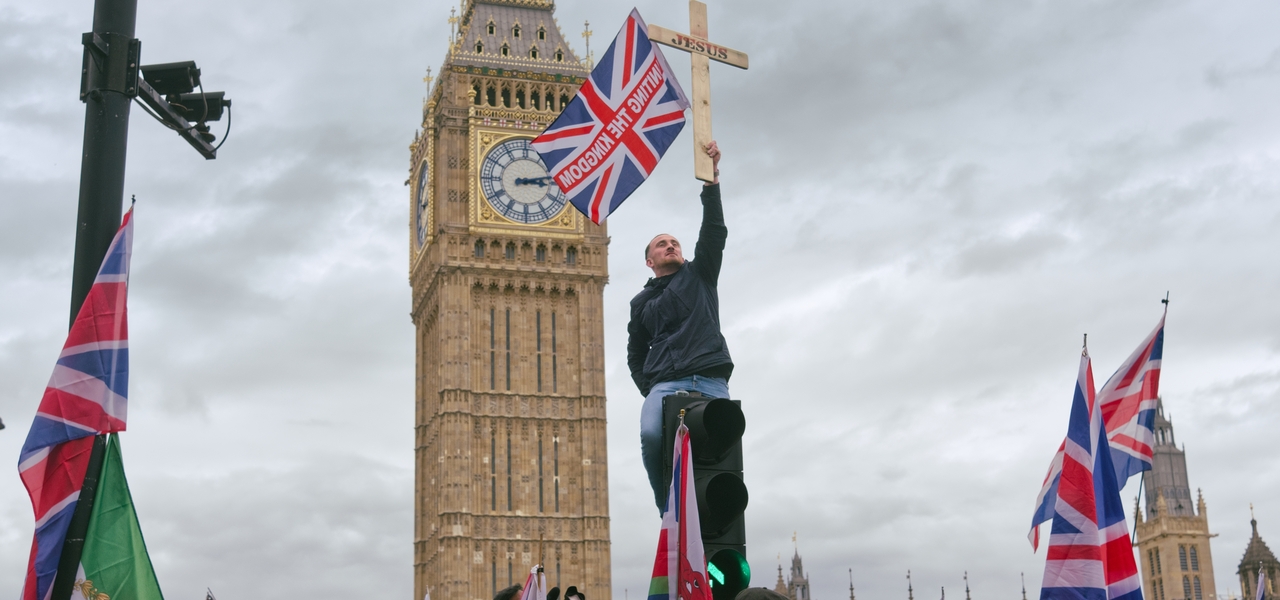

At the ‘Unite the Kingdom’ march in September 2025, a wide group of people mingled together in Central London. Some were there for a political rally, others came as groups from churches. Some waved flags, while others carried large wooden crosses. Different political views mixed with different theological perspectives. Some who gathered openly expressed far-right and anti-Islamic views, but there were also Christians present who would not have associated themselves with extremist organisations. The Lord’s Prayer was led from the platform, and on the stage flew the flag of St. George alongside a flag declaring ‘Christ is King’.
Those two flags, of country and of Christ, represent the dilemma of Christian Nationalism. How do we relate to our nation and to our faith as followers of Jesus? Can we separate the two, and should we try?
Defining Christian nationalism
There are several different ways of viewing the relationship between Christ and country, which makes defining Christian Nationalism a tricky task. Christian Nationalism is such a slippery term that Oxford academic Luke Bretherton, in a briefing to Church of England bishops, has argued that the expression is counterproductive for Christians and should not be used.
Nevertheless, Christian Nationalism is a term that is increasingly used in political discussion today, and so it is important that we engage with it. However, another reason for the difficulty in definition is that it is more frequently used about people than by them. I am more likely to label someone else as a ‘Christian Nationalist’ than I am to encounter (in the UK at least) someone who calls themselves by that title.
Nationalism itself is a little easier to pin down, even though it comes with a range of different expressions. Some view nationalism as nothing more than love for one’s country, while for others it denotes a desire for national independence. But nationalism differs from something like patriotism by promoting loyalty to the nation above all other interests. It claims not just that nations are good, but that a person’s allegiance belongs first and foremost to their nation. How this develops depends a great deal on what you define as a ‘nation’. Along with geographical or ethnic boundaries, national identity can be defined around shared cultural ideas, such as faith, history, or heritage.
Nationalism appeals to those who feel disenfranchised from politics and government. Many of those attending the ‘Unite the Kingdom’ rally expressed frustration with ‘the establishment’ and said that they weren’t listened to by the government or represented by the media. An increasing distrust of institutions, and pessimism about the state of the nation, drives people to want to hold on to a sense of identity and belonging. Nationalism gives that to people.
For some, nationalism can also provide someone to blame for their personal and political ills. Nationalism often promotes a certain type of ‘Englishness’ or ‘Britishness’ which results in antagonism toward those who are different, usually immigrants and those of other faiths. This has been evident in anti-immigration protests that have sprung up across the UK over recent years.
Christian Nationalism brings together the nation and the Christian faith and tries to conflate them into one identity. Christ and country become the same. The claim is that the UK is a ‘Christian nation’ not only because of Christianity’s historical legacy, but in the nation’s very identity. To be British means to be Christian and, by implication, to have a different faith is un-British.
In their influential book ‘Taking America Back for God: Christian Nationalism in the United States’, Andrew Whitehead and Samuel Perry define the idea of Christian Nationalism in the US context as a “cultural framework that blurs distinctions between Christian identity and American identity, viewing the two as closely related and seeking to enhance and preserve their union.”
This idea of Christian Nationalism gets more complex in the UK because there are various groups who might carry different understandings of Christianity.
Three types of Christian
First, there are cultural Christians who might also be nationalists.
These are people who have a nationalist political agenda and use elements of Christianity as a way of communicating and ‘packaging’ their ideas. There might not be genuine faith behind their adoption of Christian themes and symbols, but there is a genuine affection for the cultural trappings of the Christian faith: Christmas carols in the parish church, visits to cathedrals and abbeys, a desire for Christian ‘values’ in politics and education.
Cultural Christians would probably tick ‘Christian’ on a census form but wouldn’t necessarily attend church other than high days and holidays. There is a strong sense of nostalgia for a past where people were ‘more Christian’ even if that idea is difficult to pin down. Their politics is driven by a desire to return to this imagined past and to uphold Christian morality, even if they don’t themselves believe in Christian doctrine. Those with a traditional view of issues like gender and sexuality may react to a perceived ‘wokeness’ in society by embracing a nationalist agenda.
Nigel Farage, the leader of Reform UK, would fit into this category. He used to attend church and was baptised and confirmed in the Anglican church. But he no longer goes to church, saying “I used to believe in it. I used to attend”. However, he has said that he believes that the UK is “fundamentally a Christian nation” and that Christianity “should be recognised by Government at all levels.”
Next, there are committed Christians who want the UK to reflect Christian values.
This group are followers of Jesus who may not hold to an extreme right-wing nationalist agenda. They do, however, believe in the truth of the Christian faith and that Christianity should have a voice in politics and public policy.
Many Christians would fall into this category, believing that faith and morality matter in the public square and that the basis for these are found in Scripture. They love the country where God has placed them, and believe the best way to love this nation is to shape its laws and government on God’s ideals. They affirm both faith and nation, and perhaps fear that Christianity’s representation in our country’s direction has been eroded over recent years.
Quite a number of people at the ‘Unite the Kingdom’ rally would be part of this group. They are unashamedly positive about their faith and about their country. Their views are probably best expressed by Danny Kruger, who defected from the Conservatives to Reform, and who said in a speech in Parliament:
We are a Christian country, or we were, and we need to recover the sense that our values are not arbitrary but are grounded in the eternal truths of the Christian faith. Danny Kruger
Kruger’s words show not just a nostalgic idea of ‘Christian values’ which shape our country, but the truth of Christian faith as the bedrock of public policy.
Finally, there are convinced Christian nationalists.
This group are not only convinced of their Christian faith, but also theologically convinced of the bringing together of Christ and nation. Of all the groups they are the ones most likely to claim the title of ‘Christian Nationalist’ for themselves.
There are not many people writing or arguing for a robust theological defence of Christian Nationalism in the UK today. Much of the substance of this position comes from the United States. Stephen Wolfe’s book ‘The Case for Christian Nationalism’ is probably the best known articulation of this idea. Wolfe writes:
Christian nationalism is a totality of national action, consisting of civil laws and social customs, conducted by a Christian nation as a Christian nation, in order to procure for itself both earthly and heavenly good in Christ. Stephen Wolfe
This is the position closest to Whitehead and Perry’s definition of Christian Nationalism where church and nation become one and the same.
Christian nationalism today
Two hundred years or so ago, Alexis de Tocqueville wrote that an “abstract word is like a box with a false bottom: you put into it the ideas you want and take them out again unobserved.” In many ways Christian Nationalism is an abstract term into which people can put whatever ideas they want. It is possible to end up talking at cross purposes with people who have very different views of what Christian Nationalism actually is.
Some might be labelled Christian nationalists, but want little more than their faith to be represented in politics. Others may pursue a nationalist agenda and put on a Christian veneer to make it seem acceptable. As Christians we need to be “as shrewd as snakes and as innocent as doves” (Matthew 10:16), discerning truth from error, good from evil, and positive influence from negative attacks. The label ‘Christian Nationalist’ matters less than whether we are loving God, and loving our neighbour, in a way that glorifies Jesus Christ rather than any one nation.