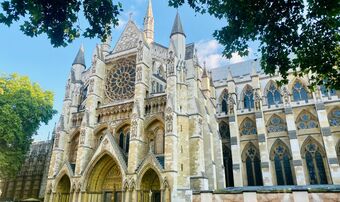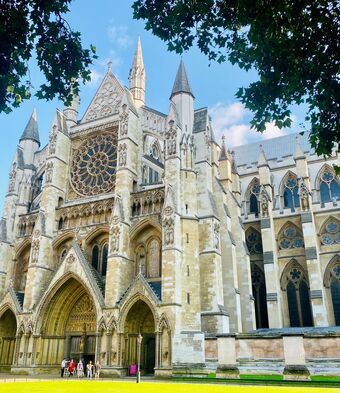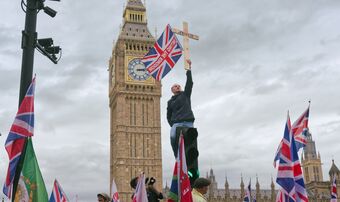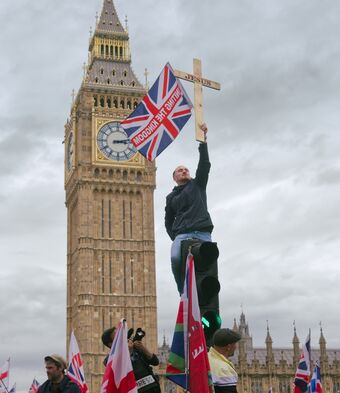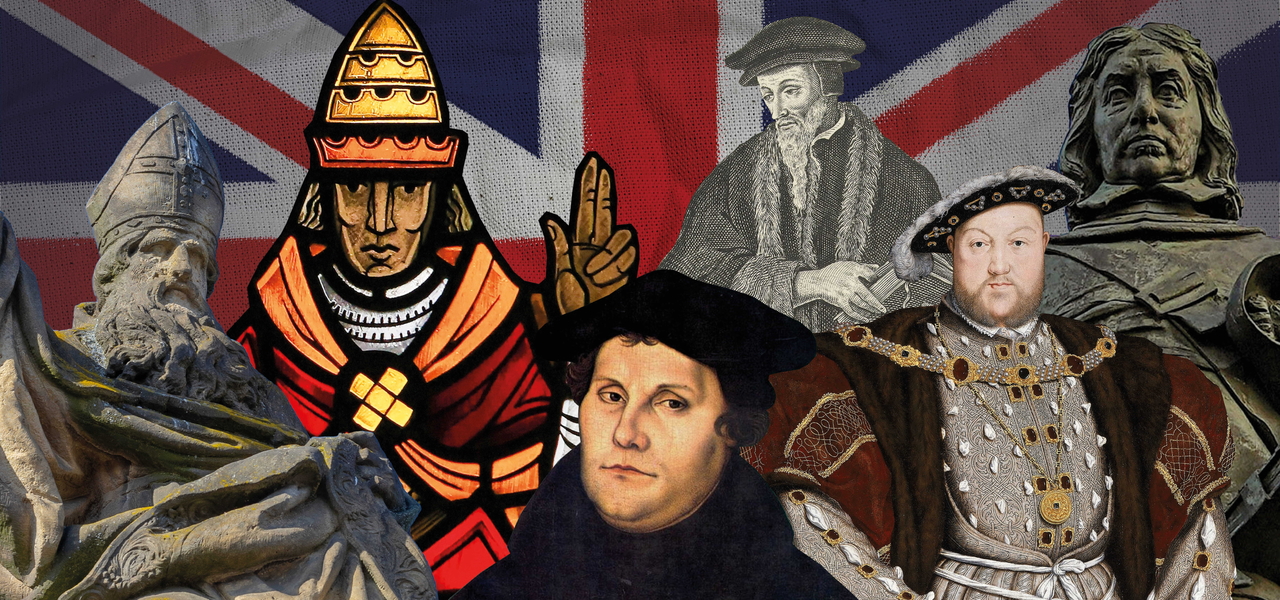

Although the term ‘Christian nationalism’ has only gained widespread acceptance in recent years, the questions the movement poses have been around for centuries. Do we want the government to promote Christianity? Should the Church exercise political power? Should church and state be kept entirely separate?
Ecclesiastes 1:9 reminds us ‘There is nothing new under the sun”. Across two millennia of theology, Christians have taken a range of positions. Interested in how it played out in practice? Here’s a quick survey…
Early Church Fathers — From persecution to imperial influence
The earliest Christians lived under the often-hostile rule of Rome, but affirmed the goodness of human authority and that rulers (even their persecutors) were ordained by God. Christians took seriously the commands to live as good citizens, to pay taxes, and to pray for the emperor. Tertullian even wrote that the Emperor “is more ours than yours [the pagans], for our God has appointed him.” However, they refused to participate in emperor-worship, obeying God over man when the two came into conflict.
Things began to change under Constantine I, who favoured Christianity; although the extent of his conversion is debated, he involved himself in church affairs, calling the Council of Nicaea in AD 325 to resolve the Arian controversy (around the full divinity of the Son). Christianity was proclaimed the empire’s official religion by Theodosius I in AD 380, and emperors continued to call synods to resolve theological disputes. After the empire split in two, Eastern Roman Emperors began to heavily influence the selection of Popes, particularly from Justinian onwards.
Christians now had new realities to think through. Augustine wrote the ‘City of God’ in the early 5th century, and proposed there are two cities: the city of God (those who love God above all) and the Earthly City (those who love themselves above all). He rejected identifying any state, or even the visible Church, as the City of God, recognising the reality of sin, which affects every human institution. Instead, he distinguished between the responsibilities of political authorities (maintaining order and justice), and spiritual authorities (proclaiming the gospel and guiding people towards salvation), although he did believe in co-operation between the two, and suggested the state could support true religion.
Medieval Thinkers — The rise of Papal authority
As the Catholic Church became more established, questions about the relationship between church and state became more prominent: some argued that the Church should have authority, as caring for eternal souls was more important. However, by this time, the Church’s authority had become centred around the Papacy, and excommunication was sometimes used as a political weapon. Pope Gregory VII argued in the 11th Century that only the Church had the right to appoint bishops, and even suggested that Popes could depose Emperors. 200 years later, Pope Boniface VIII went even further: “It is absolutely necessary for salvation that every human creature be subject to the Roman Pontiff.”
Others were more nervous: William of Ockham argued that secular rulers had legitimate authority independent from the Pope, and that Papal authority had its limits. These debates were still relevant in the build-up to the Reformation.
The Reformers — ‘Two kingdoms’ and the question of state power
The Reformers agreed that Popes should not hold authority over kings, but what this looked like in practice varied.
Martin Luther, expanding on Augustine’s teaching, developed the ‘two kingdoms doctrine’, which divides God’s rule into a spiritual kingdom (through the gospel, the Spirit and the Church) and an earthly kingdom (through civil authorities). Popes, bishops and priests should not be concerned with political power; and the state could not compel genuine faith, although in practice, Luther ended up relying on German princes to oversee church reform.
John Calvin’s approach in Geneva was different; while believing that church and state had different roles, he believed the state should promote good, and that involved promoting true Christianity. Church and state co-operated closely, and magistrates not only defended the Church from threats, but punished blasphemy, including, in the case of Michael Servetus, up to execution. In Zurich, Huldrych Zwingli relied even more heavily on the city council to promote the Reformation.
The Anabaptists took an alternate approach, and enforced the separation between church and state more severely. Many rejected the possibility of Christians serving as magistrates or soldiers, and they rejected state-churches.
The Anglicans — A monarch’s duty to preserve true religion
The Church of England began through similar questions around church and state, after Henry VIII’s failure to convince the Pope to dissolve his marriage. Key Anglican figures, like Thomas Cranmer and Richard Hooker, tried to balance two positions: the positive influence of the Church upon society, and the duty of the monarch to promote true religion. Church and state were different, but linked.
Given its roots, it was natural for Anglicanism to take a strong stance against Papal authority, and the King is still its Supreme Governor today; in practice, this evolved over time, and the monarch’s influence diminished during the 17th century. The King’s role is now primarily ceremonial. Many evangelical Anglicans today take a pragmatic approach, recognising the advantages of a state church (such as in marriages or funerals), while not being wedded to its established function.
The Westminster Confession — Defining the limits of the state
The Westminster Confession was written during the English Civil War, when the English Parliament summoned an Assembly, consisting largely of Puritans, to reform the doctrine and government of the Church of England.
Chapter 23 explicitly said that civil magistrates may not assume preaching the Word or administer the sacraments, and that they do not have “the power of the keys of the kingdom of heaven”. However, it also said that they had a duty to preserve peace and unity in the church, to safeguard truth, to suppress heresy and blasphemy, and had the power to call synods. Its understanding is not dissimilar to Anglicanism, despite proposing different systems of church government.
The Confession lost official status in England after the Restoration of the monarchy, but was widely adopted by Presbyterian churches and is still heavily influential today, although the American Presbyterian Church revised Chapter 23 in 1789, to remove the civil magistrate’s role in religious matters.
The Free Church — Freedom of conscience and protection from state corruption
Some English Protestants opposed having a state church from early on; figures like Thomas Helwys, who died in prison, argued that the monarch had no authority over people’s consciences. Similarly, John Bunyan was imprisoned for preaching without a state licence, arguing the state could not compel him not to preach. Such figures emphasised the importance of personal conversion, and said the state could not enforce true worship.
Others, such as Roger Williams in America, argued that state-involvement would corrupt the Church, and there should be a “hedge or wall of separation between the garden of the church and the wilderness of the world.” The Baptist preacher Charles Spurgeon later took a similar position, opposing government support for churches, because he believed state churches tended to result in nominal Christianity.
The Neo-Calvinists — ‘Sphere sovereignty’ and the Lordship of Christ
Neo-Calvinism originated in the Netherlands in the late 19th century, with key thinkers like Herman Bavinck and the Dutch Prime Minister Abraham Kuyper, who developed the idea of ‘sphere sovereignty’: this splits society into different spheres, all accountable to God, and not just limited to church and state, but includes, the family, schools, or hospitals. It is not the duty of the state (or the church) to control any of these spheres, which are accountable initially to God. For instance, the state should not control family life (although it could step in in extreme circumstances). Kuyper was particularly in favour of faith schools, where parents could establish schools rooted in their own convictions.
The neo-Calvinists opposed the idea of a state church. But they believed government was accountable to God too, and that Christians should be involved in public life. Kuyper famously said: “There is not a square inch in the whole domain of our human existence over which Christ, who is Sovereign over all, does not cry: 'Mine!’”
The American Right — An opportunity for Christian values?
In recent years, some in America have argued that Christians should seek political power again, and enforce Christian values for the benefit of the nation. This can be particularly seen in the alliance between some evangelicals and Donald Trump; while some have supported him due to his stances on transgender rights and abortion, he has drawn criticism from other Christians for his personal conduct, his muscular approach, and a perceived arrogance or narcissism.
America has a heritage of religious freedom, rooted in the First Amendment, and has traditionally separated church and state. Those advocating for forms of Christian nationalism have different reasons; some such as Stephen Wolfe, attempt to root their approach in the Reformers and suggest the state should promote Christianity. Others, like Doug Wilson, are more shaped by postmillennial interpretations of the end-times, believing Jesus will only return after a unique period of Christian influence and flourishing on earth.
‘Christian nationalism’ is simply the latest development in a discussion that has lasted for hundreds of years. But as we learn from the debates of the past, we want to engage with the questions of today. What does Christianity nationalism mean for us in 21st-century Britain?