
Mariam
If Christian nationalism meant Christians lovingly shaping society, strengthening our laws and institutions for human flourishing and religious freedom, count me in. If it meant loving Jesus, loving our country, being salt and light, and living boldly for Christ wherever He places us, who could object?
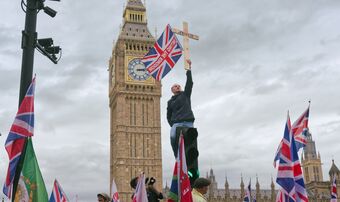
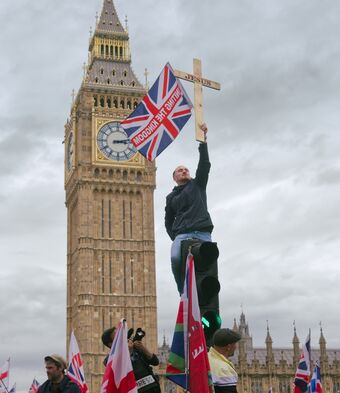
But in practice, it seems to me that Christian nationalism is driven by a nostalgic longing for cultural dominance and political power for a particular expression of Christianity. It rarely reflects the Christianity of turning the other cheek, giving the shirt off your back or carrying the cross. Too often, its political allies are those pursuing a culturally, racially, or ethnically homogeneous nation.
Regardless of birthplace, ethnicity, or passport, our first allegiance is to Christ and His global Church, not to a flag, a nation, or an ethnic identity. Because of this, when I think of Christian Nationalism, I think of a movement that claims Christ’s name whilst being fundamentally not of Him.
Ayomi
When I think of Christian Nationalism, I think of a Christianity which has become problematically associated with national identity. It understands Christianity primarily as an important ideology to the nation, rather than on its own terms.
I think that the term ‘Christianism’ is similar and useful to explain the concept: it is “not a substantive Christianity… It’s a secularized Christianity as culture … It’s a matter of belonging rather than believing” (Rogers Brubaker). In practice, this looks like invocations to Christian values, without much reckoning with what those values actually are. For example, Pete Hegseth’s (U.S. Secretary of Defence) frequently misuses scripture to suggest God’s blessing on U.S. military operations. He often does not engage with the correct context, or the many examples in the Bible where Christians are called to peace.
Christian Nationalism is a reactionary movement which reaches for Christian history as something to use to define its nation, ignoring parts of the Bible that don’t serve its agenda.
Patrick
I speak as someone brought up in the Church of England, and I know how easily faith, identity and nationhood can become tangled. I feel this most when watching football. Before England played Mexico, I jokingly sent a message to our church staff asking them to pray for “God to ignore any Mexican prayers for victory whilst, of course, comforting them afterwards in their loss”. Although flippant, it exposed something real. We all have loyalties. I am English, and I am a child of God.
That is why Christian nationalism concerns me. Flags can be positive symbols of identity, belonging and a shared history. But when St George's flags appear at night, put up by masked people, they can send a different message: “If you are not like us, you are not welcome.” Symbols that should unite can become boundary markers, feeding suspicion and fear. ‘Christian’ can become little more than an empty label masking fear, superiority or exclusion.
Lachlan
When I think of Christian nationalism, I just think of a Christian nation. By that, I mean a nation which honours God in the way it carries out the things which make nations nations, namely law-making, protection of its people, diplomatic relations with other nations, and promoting civil order.
Romans 13:4 tells us that ‘the one in authority is God’s servant for our good’. The state, according to Paul, is part of God’s created order. God has given us authorities, including national governments, for our good. Governing authorities then ought to govern with respect to their own subordination to God’s rule.
Jesus commanded His apostles to ‘make disciples of all nations, teaching them to
obey everything I have commanded you’. Jesus’ command is for nations to be reached with the gospel. And so I think a healthy and sincere form of Christian nationalism would come about if the population of a nation repented and put their trust in Jesus. That would be genuine Christian nationalism, the sort of thing that happened in Nineveh, or in ninth century England under Alfred the Great, namely, national repentance. We should pray it happens here once again
Brenda
I never think of ‘Christian Nationalism’, as the words do not belong together in my mind. The political climate in the USA reveals a growing mindset that I thought was a thing of the past – in America but also in South Africa where I grew up. Apartheid was an expression of a deeply held belief that white people were God’s people and therefore had superiority and authority over all other races. The result was the oppression, marginalisation and great suffering of the ‘non-white’ people of South Africa despite them being the vast majority.
Recent abuses of power by those in Christian leadership only serve to reinforce that our problem is the human heart, not the position of authority. There is a place for Christians to influence politics and laws and leaders, but we have not been called to make a Christian nation. Christians are called to show the love of Christ, whatever our tribe or ancestry or passport we hold.
The diversity of these responses shows some of the difficulties with defining the term Christian nationalism: it means different things to different people, and is associated with a range of views on country, government, and identity.
Christians themselves have a range of opinions on the subject, with some in favour and others are strongly opposed. Some recognise the potential for good within a form of Christian nationalism, but are sufficiently concerned about the bad that they have distanced themselves from the label altogether. Even some who are more positive about Christian nationalism will still be nervous about negative outworkings of it.
As brothers and sisters in Christ’s family, we need to be able to think differently, and debate issues while still recognising our greater allegiance and the bonds of love which unite us. Since God has brought us together as one people in Christ, we must avoid making politics the dividing line between Christians and churches.