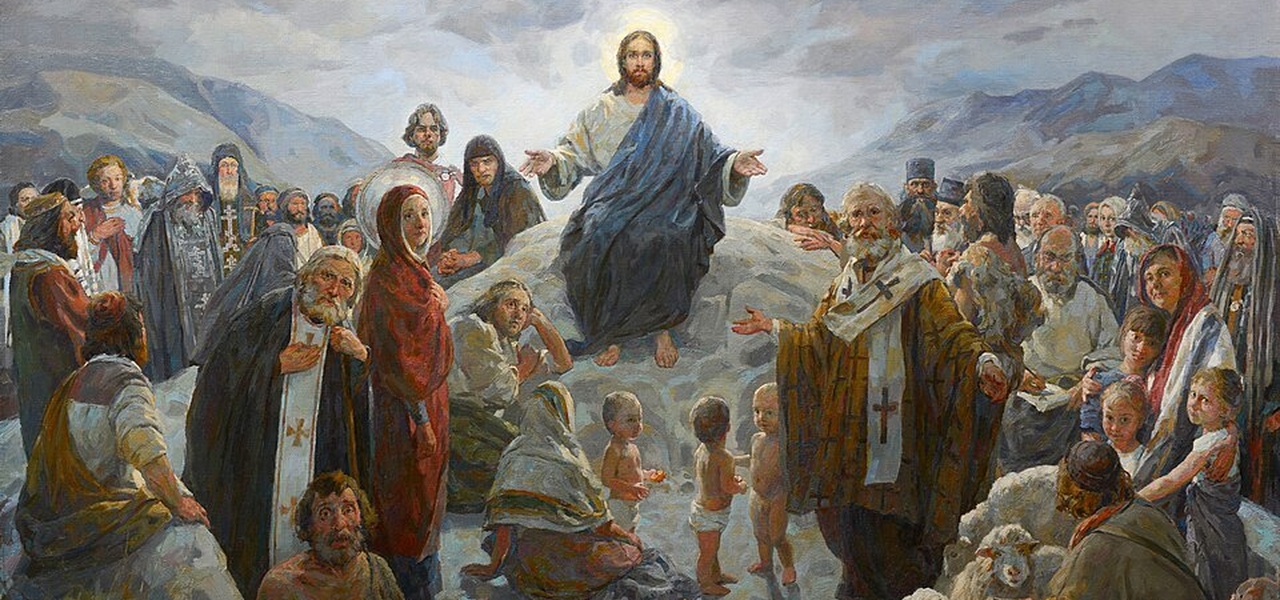

Arguably the most famous passage of Jesus’ teaching comes in Matthew 5-7, in what we know today as the Sermon on the Mount. In it, Jesus takes the assumptions which his audience hold - both from the Old Testament and from everyday life - and turns them on their head. ‘You have heard it said…but I say to you’, he says, calling his disciples to a higher standard.
As disciples today, we need to be open to having our assumptions reshaped too, sometimes in challenging (or even disturbing) ways. This goes for our questions around politics and the pursuit of power, just like it does in every other area of life.
It almost feels logical that if you want to shape the world for good, you need power to do it. For how else can you exercise the influence you want?
The Bible has an ambiguous relationship with power. It does not tell Christians not to pursue it; but it doesn’t suggest they should either! Some leaders exercise power well (Moses), some abuse it (Ahab) and others are corrupted (David).
These questions take on a new dimension in the context of the debates around Christian nationalism today. Many people lament the increasing marginalisation of Christianity in the UK. But some suggest Christians should fight back, framing things as a battle, even if it means aligning ourselves with genuinely far-right characters.
So how can we let Jesus reshape our assumptions too? Here are three things to remember…
1. Remember to be more like Jesus
By 30 AD, Judaea had been under Roman occupation for decades. Messianic pretenders had arisen, and been swiftly cut down. Surely, one day, God would send his true leader to defeat Israel’s enemies, to unleash his revenge upon evildoers and establish God’s new age?
This was the landscape in which Jesus walked. It is why his ministry felt so confusing: when Peter said, “Lord, this will never happen to you” (Matthew 16:22), he could not conceive of a suffering Messiah. Jesus was supposed to be the one to defeat the Romans, not to be killed by them. In John’s gospel, we read that after the crowd witnessed the feeding of the 5000, recognising that Jesus had power, they “intended to come and make him king by force” (John 6:15).
God’s primary concern is to make us more like Jesus. Yes, Christian influence may be a good thing, but how we get there matters: for Christians, ends do not justify means. God is less interested in our success, and more invested in who we are becoming: “he predestined [us] to be conformed to the image of his Son” (Romans 8:29).
In the last couple of years, far-right voices have encouraged Christians to fight for their culture. Elon Musk told the ‘Unite the Kingdom’ in 2025 rally: “you either fight back, or you die”. Others have encouraged rioting and violence.
While we want to see more Christians in public life, any attempt to take power by force is utterly out of step with Jesus.
Jesus came from the Father full of “grace and truth” (John 1:14). He warned that “those who live by the sword, die by the sword” (Matthew 26:52). If we want to be more like him, we will resist the urge to demonise those who disagree with us. We will respond with love, even when we are met with hostility. And “if it is possible, as far as it depends on you, [we will] live at peace with everyone” (Romans 12:18). Christians are to be people everyone speaks well of and whose light shines before others as a witness.
2. Remember where power really comes from
It is natural to think that we need Christians to be in power for God to be at work; how else is God going to build his Kingdom? We can so easily convince ourselves that our plans are actually His plans, that our chosen politicians are His chosen politicians.
God is sovereign over all things, including elections and politicians. No leader - even the very worst - is in office without his say-so. Pilate asked Jesus: “Don’t you realize I have power either to free you or to crucify you?”. Jesus flips Pilate’s assumptions on their head: “You would have no power over me if it were not given to you from above” (John 19:10-11). We see in the Old Testament how God uses the great empires - Assyria, Babylon or Persia - to accomplish his plans and purposes, like putty in his hands.
But those plans and purposes are often a mystery to us. We assume it is God’s plan to raise up Christian leaders in the UK and establish a revival here, but it doesn’t always work like that. We recognise in the Psalms the confusion which we so often feel ourselves: “How long, Lord, will the wicked, how long will the wicked be jubilant?” (Psalm 94:3). Sometimes, God’s plans seem to work against His own people, such as when Jerusalem is sacked and the Temple destroyed. We wonder what He can be doing.
But we know those purposes do exist, even if for now, we “see through a glass darkly” (1 Corinthians 13:12). His political leaders might not be the ones we would choose, and His purposes might not even be the ones we want, but He is still working. We don’t need to try and make God’s plans for him; if he wants Christians to be in power, then they will be. If He calls us into politics, we obey. But if not, He will still be at work.
The irony is that Christians have far more power already than many of us realise. God has given us His Holy Spirit: “that power is the same as the mighty strength he exerted when he raised Christ from the dead” (Ephesians 1:19-20). An ordinary Christian has supernatural power inside them. But it’s a power expressed not by getting our own way, but by God having his way in us, transforming us into the people we are meant to be.
3. Remember how the victory was won
Two thousand years ago, the greatest victory in the history of the world was won. It was the hour “when darkness reigned” (Luke 22:53) and the powers of hell did their worst. The mighty enemies of sin, death and evil, which had ruled over humanity almost from the very beginning, were cast down and trampled.
But it wasn’t won by the swing of a sword. Jesus could have called upon legions of angels, yet He did not even open his mouth. He was a Suffering Servant, obedient, even to death, and death on a cross.
Christianity has undoubtedly lost much of its influence in recent decades. Laws have been liberalised; culture has changed; the Church is perceived as irrelevant at best. Whether through mass migration or culture wars, the UK of today is very different to what it was fifty years ago. In response, we might think that the only way back is to flex our muscles and to fight back.
But the Church has not always been very good at being in power, for we are susceptible to corruption and hypocrisy too. We see in history how Christians can be seduced by power, or how the persecuted can become the persecutors.
Chris Wright comments, “It seemed natural, perhaps even providential, that the power of the state should promote and protect the interests of Christianity, while it might be hoped that Christianity would sanctify the workings of the state. Unfortunately, the price Christianity paid for its protection was its own corruption and complicity in the greed, ambition, immorality, endless conflicts, and endemic violence of all-too-fallen and sinful human power structures, and those who used them for their own enrichment. In gaining the world (or at least a continent), we lost our own soul.”
Jesus shows us the pattern and the path to glory: “Now if we are children, then we are heirs… if indeed we share in his sufferings in order that we may also share in his glory" (Romans 8:17). His death and resurrection prove that humility is not weakness, and that the power of evil can be broken by the power of sacrifice. He reshapes what we think of as reality and shows us another, better way to live.
We worship a God whose power “is made perfect in weakness” (2 Corinthians 12:9): perhaps the most powerful thing we can do, when Christian influence is diminished, is to love our enemies, and surrender ourselves to our God. For when we put our trust in Him, rather than ourselves, we can say as Paul did, “when I am weak, then I am strong” (2 Corinthians 12:10).
“You have heard that it was said, 'Love your neighbor and hate your enemy” (Matthew 5:43). You might even have heard it said that Christians should fight back and scrap for every inch of territory.
“But I say unto you”...