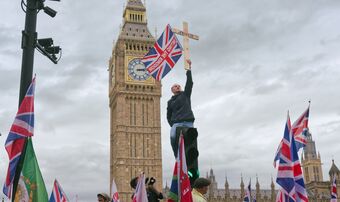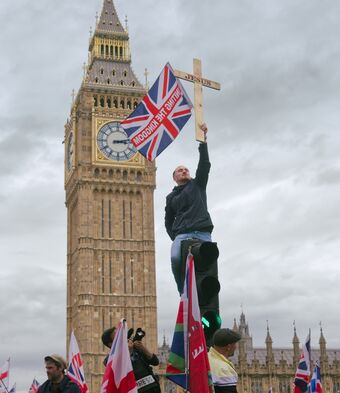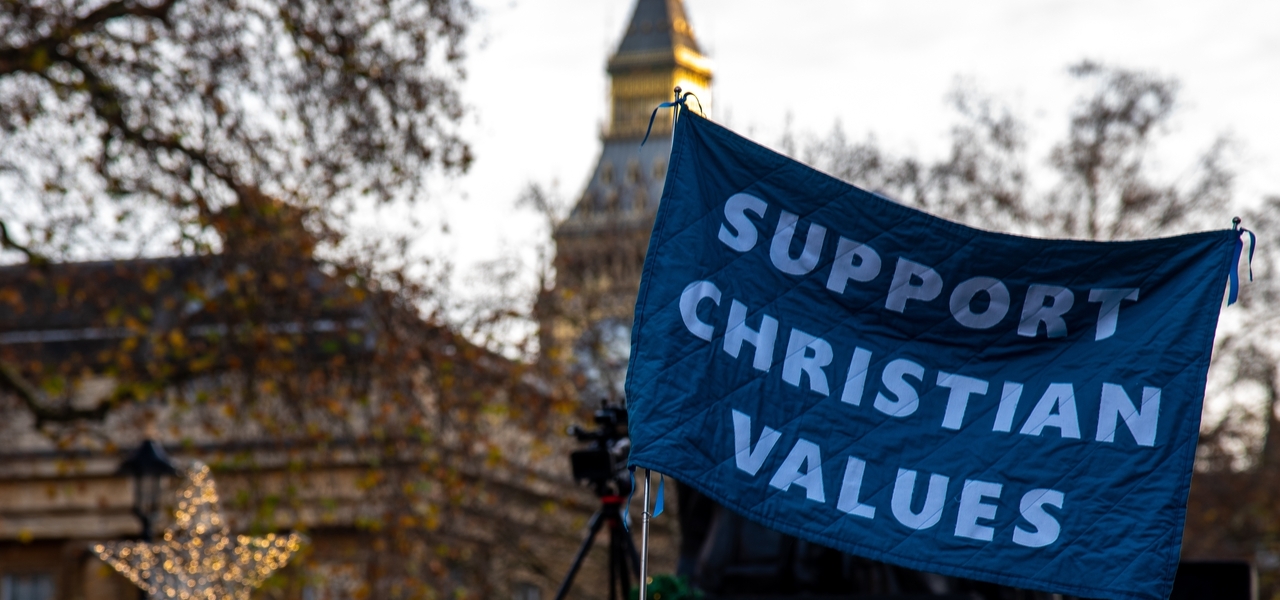

If you feel conflicted about how Christianity is being invoked in the public square, you’re not alone. Many of us will hear talk about Christian values, or Jesus being honoured, and think, ‘Surely that is a good thing?’, even if we are uncertain about the people saying it.
Many of the aims being discussed are good in and of themselves. As Christians, we care about human flourishing. Jesus said to his disciples, “You are the salt of the earth…You are the light of the world.” As salt we are to preserve what is good, and as light, we bring the truth and the hope of the gospel to a world in darkness. We do not believe that faith is simply a private matter, or something to be hidden away.
The term ‘Christian nationalism’ has been defined in various ways, and is sometimes used carelessly to invalidate Christians taking faith into the public square. Some beliefs are characterised as Christian nationalism when they are simply standard Christian doctrine.
So here are three areas where every Christian ought to be able to agree…and no, they don’t make you a Christian nationalist in and of themselves!
We want people to become Christians
Some people are increasingly concerned about there being fewer Christians in the UK today. In its simplest form, this is something which we should all care about; all people have sinned, and are in need of God’s mercy, which we can have access to by the cross of Christ. Without personal trust in Jesus, our friends, family or neighbours will perish in their sins.
Jesus commissioned his disciples in Matthew 28: “Therefore, go and make disciples of all nations, baptising them in the name of the Father, the Son and the Holy Spirit”. We long to see more people come to faith in Jesus, for “there is no other name on heaven or earth by which we can be saved”.
But it’s important to define ‘being a Christian’. 46% of people in the UK said they were Christians in the most recent census, but in reality, only 5% of UK adults attend church on a weekly basis, suggesting that many view it primarily as a cultural marker.
And although Christian practice has been in decline for decades among white Brits, the cries about Britain losing its Christian heritage have arisen more in response to mass migration and Islam than they did in response to the rise of atheism and secularism.
The gospel offer of salvation is extended to all, irrespective of race or nationality. Every Christian will long to see people (whoever they are) turning to Christ; but to the real Christ, not simply to a cultural identity marker.
We want Christians to be in politics
In the Bible, we read many stories about faithful believers in politics, and can see the positive difference they make, even in a foreign land.
Joseph serves as a quasi-Prime Minister in Egypt, organising the collection of food to see the country through a seven-year famine; Esther speaks for the Jewish people and prevents a genocide; Nehemiah organises rebuilding the city walls of Jerusalem; in the New Testament, we read about Erastus, the “director of public works” in Corinth.
Perhaps most prominent is Daniel (and his friends) in Babylon: he serves for close to seventy years, and after Babylon is taken by the Persians, he is appointed as one of Darius’ three chief administrators, overseeing 120 satraps. We read, “Daniel so distinguished himself among the administrators and the satraps by his exceptional qualities that the king planned to set him over the whole kingdom.”
This does not mean that the only politicians we want are Christians; God can use anyone to achieve his purposes (and Christians do not always do a good job!). But just as “they could find no corruption in Daniel, because he was trustworthy and neither corrupt nor negligent”, Christians should strive for the highest standards of integrity and ability and serve those around them.
We want Christianity to influence culture
Although people need to trust in Jesus to be saved, that does not mean there is no benefit if British culture and laws are influenced by Christianity.
People sometimes suggest that our country should be secular, as the only neutral option. But secularism is no more neutral than any other worldview.
Cultural vacuums never remain empty: in the UK’s case, we have idolised individualism since the 1960s and the Sexual Revolution. And because culture lies upstream of law, since then, we have passed the most liberal laws in Europe on abortion, almost introduced assisted suicide, and witnessed the decline of the traditional family unit and trialled drugs like puberty blockers on children questioning their gender.
God commissioned mankind to “fill and subdue the earth”. As humans made in God’s image, we are to reflect Him to the world around us. We believe we can find God’s desires for human flourishing in the Bible, and that God’s law “is perfect, refreshing the soul”, even if we need to think through how to apply it to our own context today. And we know that God cares about injustice, and is on the side of the vulnerable and the downtrodden.
This is the reason why organisations like CARE exist: we want a society, and laws, that reflect God’s heart, where justice is promoted, the powerful are challenged, and the vulnerable are protected. That might look like speaking on behalf of women trapped in the sex industry, or championing freedom of speech, or challenging companies who put profit before people.
God “makes the sun shine on the righteous and the unrighteous” (Matthew 5:45). By common grace, His pattern for human flourishing - summed up, above all, in love of God and love of neighbour - will benefit everyone who follows it, regardless of whether they know the King or not, for it is the best way to live.
Believing none of these three things automatically makes you a Christian nationalist (although Christian nationalists may believe them).
Rather, they make you an everyday Christian. If the term Christian nationalist is to mean anything at all, it has to mean more than this…