
In the last few years, Christian language and symbolism have been far more visible in our public spaces and political discourse than they have for some time. Is this something we should welcome? Or might this present a cause for concern?
There is much that we can welcome here. When Alistair Campbell said ‘We don’t do God’ (2003) his words were symptomatic of the aggressive secularisation of public discourse which had been developing for some time in this country, and which regarded the views of anyone with a faith commitment as automatically under suspicion. And while these strands are still visible (see the National Secular Society and Humanists UK’s comments on faith leaders who spoke into the recent assisted suicide bill), there is also evidence for a turning tide which is making the public sphere a place where voices of faith are welcome once more.
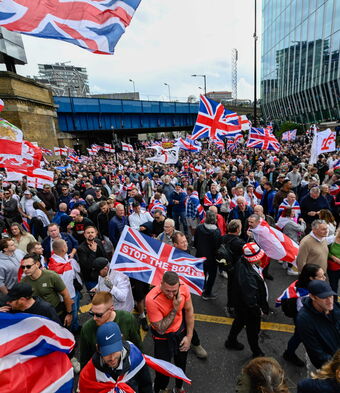
But there may also be elements that should concern us. At times Christian language and symbols are being used to lend impetus to a political purpose, in ways which I would consider bear little connection to their true spiritual significance. We are in a highly charged and deeply polarised society right now, and the use of Christian-sounding language is sometimes exacerbating the divisions rather than promoting love of neighbour in healing and reconciliation.
I’m here referring to the use of such language by ‘far right’ groups – some embedded within our political institutions and some beyond them. Please note: my use of the term ‘far right’ is not as a pejorative slur, but in a clearly defined way. I use it to refer to politically right-leaning groups whose ideology would undermine elements of liberal democracy, such as the protection of minorities, freedom of speech and the independence of the press and judiciary.
Now, it is important to note that there are some very sincere Christians within some of these movements, both at leadership level and among their grassroots followers. Some of the thought-leaders have offered careful theological arguments for the stances that they take. These arguments deserve respectful and careful engagement, which is a task that I am actively engaged in. They are not the subject of the rest of this piece.
But it cannot have escaped our notice that Christian-sounding language and symbols are also being used by some people who do not evidence any genuine Christian faith. And this presents a danger. Because when political actors offer slogans and soundbites that we instinctively agree with – that sound like things we might say in church, perhaps – we are more likely to listen receptively to their broader message. In this way, Christians can sometimes be ‘played’ by those whose intentions, and perhaps actions, bear no resemblance to the message or person of Jesus Christ. Bluntly, there is the danger that we become unwittingly coopted to movements that are dangerous and divisive. Allow me to name five themes, images and tropes being used at present, and offer some questions for us to consider when we see them at work in political spaces.
First, when we sing of the kingship of Christ in church (and in our personal devotions) we are probably leaning upon a rich matrix of biblical ideas. We might be recalling the servant king who rode into Jerusalem on a donkey and washed his disciples’ feet. We may be thinking of the promised king who sits on David’s throne and will enact God’s perfect judgment. And we may have in mind the Lamb at the centre of the throne, before whom all nations will bow. So when we see and hear ‘Christ is king’ being used in political ways, we should consider whether these themes are likewise being invoked. Or is the phrase being used as a slogan, to promote a particular political cause, or in order to make a grab for power? Perhaps the best question is: to what end is this declaration being made?
Second, the language of ‘restoring our Judaeo-Christian heritage’ is a popular trope at present. Again, this may be appealing to many who lament the loss of certain Christian moral standards from society. But what is actually being proposed when such an appeal is made? Is it operating with a rich and nuanced view of the complexities of our Christian heritage? We might well remember and celebrate the activism of the Clapham sect or the prophetic leadership of Archbishop William Temple (for example). But is there simultaneously a convenient amnesia about the Christian rationales provided for colonialism or slavery? Is nostalgia for the 1950s glossing over the structural inequalities of the day, such as those evidenced by the common sign in boarding houses ‘No Irish, No Blacks, No Dogs’? Indeed, we might ask: who would belong in such a restored Judaeo-Christian nation? And who would be excluded? And by what means?
Next, two additional theological ideas that are at work in some of these movements, often less through slogans than in embedded thought-patterns and consistent messaging, are that Christians should have ‘dominion’ in society, and that God is ‘on our side’ – by which, I think, is meant he’s in our pocket. Again, we should consider such claims carefully. Jesus’ instructions that we should be salt and light in our culture, and his command to make disciples, absolutely preclude quietism – we should be bold and willing to speak and live out our faith in winsome, transformative ways (see 1 Peter 3:15). But should Christians expect to rule in some way? To exercise control over those of no faith, or to suppress other faiths? There are some who would make such claims, and we should be aware that these ideas are in the mix. We might want to consider whether we agree with them, in case we inadvertently find ourselves caught up in political movements whose ideological foundations are more autocratic than we originally realised. And Scripture teaches us that God is in no-one’s pocket.
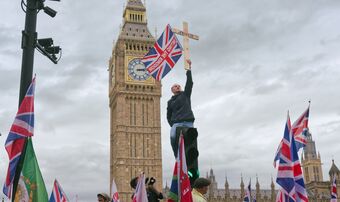
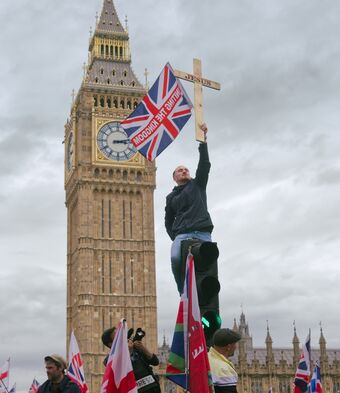
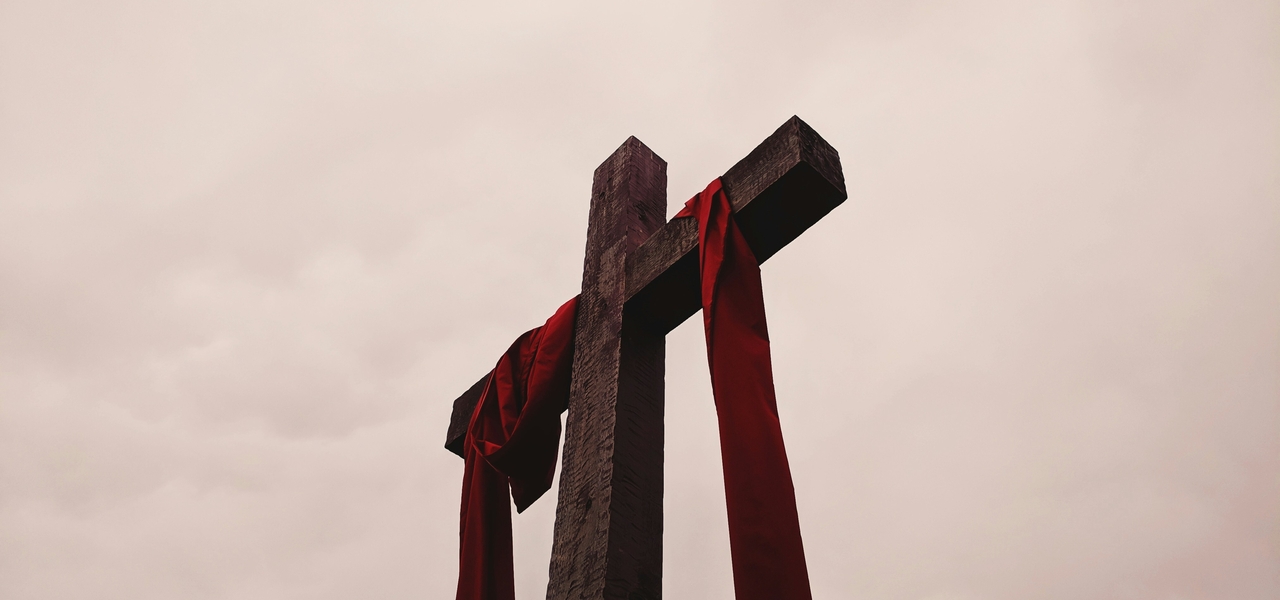
Fifth, we should notice where the cross is being employed as a visual symbol in political spaces. When we see it being displayed we might ask: what is it saying in this space? Is it being used as a mascot, a rallying point? If so, do we consider that an appropriate use? Is it being used to assert dominance, to intimidate people of other faiths? It might be a helpful exercise to jot down what we believe the cross symbolises, and then use this framework to evaluate what is going on, when we see it being used on our streets.
The apostle John urges us to ‘test the spirits’ (1 John 4:1), and Jesus tells us to be as wise as serpents while remaining as innocent as doves (Matthew 10:16). These calls upon the Christian are important in every age, but never more so than in our day when there are some cynical political actors who would use our own faith-language as a Trojan horse; who – to put it bluntly – would seek to play us for fools. As the old hymn goes, ‘Grant us wisdom, grant us courage, for the facing of this hour’.