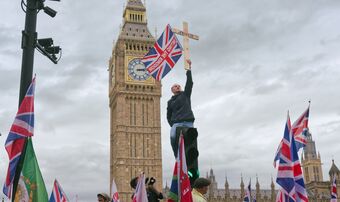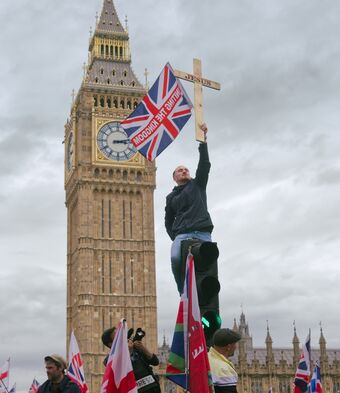

When Donald Trump supporters protested the election results at the United States Capitol building on January 6th, 2021 and riots broke out, there was a surprising amount of religious – even Christian – fervour present. Protestors planted wooden crosses on the Capitol grounds, and rioters held up signs saying ‘Jesus saves’. One person brought a placard depicting Jesus wearing a ‘Make America Great Again’ hat. When they broke through onto the Senate floor, one rioter led a prayer, saying: “Thank you for filling this chamber with patriots that love you, and that love Christ”.
The January 6th riot is just one example of the differences between Christian nationalism in the US to that in the UK. To the outside observer, there is a lot of overt religious sentiment in the United States. Americans say the pledge of allegiance containing the line “one nation under God”, and money is printed with the motto “In God we trust”. At the same time, most people outside of the US are aware of the historical separation of church and state in the country, with public prayer in schools and religious displays in government buildings being points of contention.
In some ways, Christian nationalism seems very different in the US to the UK. At the same time, there are also many similarities: a fusion of church and nation, a desire for God’s law to shape the country’s legislation, and a nostalgia for a ‘Christian past’ that by and large did not really exist. So what does Christian nationalism look like in the United States, and how is it different to debates on this side of the Atlantic?
What does it look like?
A 2024 survey found that 10% of Americans are committed Christian nationalists, while a further 20% are sympathetic to the ideas of the movement. Yet Christian nationalism in America suffers from the same problem it does in the UK: Different people mean different things by it.
In 2020, sociologists Samuel Perry and Andrew Whitehead wrote the book ‘Taking America Back for God: Christian Nationalism in the United States’, based on research they had conducted into the subject. They identified six key statements that Christian nationalists might believe in (or in the case of the third one, oppose):
- The federal government should declare the United States a Christian nation.
- The federal government should advocate Christian values.
- The federal government should enforce strict separation of church and state.
- The federal government should allow the display of religious symbols in public spaces.
- The success of the United States is part of God's plan.
- The federal government should allow prayer in public schools.
The more of these statements a person might agree with (or disagree for the third) the more likely they are to be a Christian nationalist. However, even these six propositions are rather broad. What does it mean to ‘advocate Christian values’, for example?
Perry and Whitehead summarise their ideas in the book with the following definition: “Simply put, Christian nationalism is a cultural framework—a collection of myths, traditions, symbols, narratives, and value systems—that idealizes and advocates a fusion of Christianity with American civic life.”
This idea of the fusion of Christianity with civic life is a common denominator to Christian nationalism in both the UK and the US. The way this appears will differ due to the history and culture of the two nations.
Journalist Ross Douthat wrote in the New York Times in 2024 about four possible definitions of Christian nationalism. They were:
- The belief that America should unite religion and politics in the same manner as the tribes of Israel in Leviticus and Deuteronomy or Puritan New England with religious law enforced by the government, and non-Christian religions disfavoured.
- The belief that America is a chosen nation commissioned by God to bring about some form of radical transformation in the world — the spread of liberty, the triumph of democracy — and that both domestic and foreign policy should be shaped by this kind of providential aim.
- The belief that American ideals make the most sense in the light of Christianity, that Christians should desire America to be more Christian rather than less and that American laws and policies should be informed by Christian principles.
- Any kind of Christian politics that liberals find disagreeable or distasteful.
He says, “If I were referring to Christian nationalism, I would intend either the first or second definition… But this isn’t how the term ‘Christian nationalism’ is typically deployed these days. In my experience, the most common usage is by liberals who really intend Definition Four — they’re mostly looking for a way to critique religious conservatives, a label to slap on their ideological enemies.”
Putting Douthat’s definitions along with Perry and Whitehead’s, we begin to see how Christian nationalism in the US has formed around an American exceptionalism – that God has chosen the USA as a special nation for his purposes – and that America succeeds when its laws and policies are explicitly Christian in nature.
This concept of God using the United States as a chosen nation through which God will achieve his purposes ties in with a theological position known as ‘postmillenialism’. This is the idea that the ‘thousand years’ in Revelation 20 refers to a literal thousand year reign of triumph for the Church before Jesus returns. Christian nationalists with a postmillenial viewpoint see the pursuit of a Christian nation as part of ushering in this thousand year reign.
What are the arguments?
Many American Christians would see Christian nationalism as part of the founding of the United States. As Ross Douthat writes: “Understanding this kind of Christian nationalism is essential to understanding American history — especially our moments of destructive hubris”. From the Pilgrim Fathers escaping religious persecution in the 17th century, to the rights given by a Creator in the Declaration of Independence, through to the ‘moral majority’ of the 1980s, Christian political influence has always run through the history of the United States.
Today there are a few different strands of Christian nationalism:
One strand is Calvinistic nationalism. This has a Reformed theological flavour and draws on the political organisation of Calvin’s Geneva in the 16th century as a model. Key proponents of this approach would include Stephen Wolfe, who wrote ‘The case for Christian nationalism’ and Douglas Wilson, pastor of Christ Church in Moscow, Idaho.
Calvinistic nationalism sees the church and state as partners, rather than separate. It is founded on the idea of ‘theocracy’ where God is the ultimate ruler, and religious authorities rule in his stead. It often manifests in ‘theonomy’ which is an attempt to apply Old Testament law to contemporary society. Douglas Wilson is a proponent of this view, arguing for homosexuality to be made illegal and for women’s rights to vote to be replaced by a ‘household vote’.
Stephen Wolfe’s book asserts that the nation needs to be led by a ‘Christian prince’ who is essentially a benign religious dictator. He says that ethnicities should not mix, heretics should be killed, and that violent revolution to bring in this approach is justified. He argues that non-Christians do not have equality with Christians in a Christian society.
Another strand of Christian nationalism in the US is Charismatic dominionism, which has been popularised in the ‘Seven mountains mandate’. This idea originated from Loren Cunningham, founder of Youth With A Mission, and Bill Bright, founder of Campus Crusade for Christ. It claims that God has given seven ‘mountains’ – or key areas of public life – where Christians are commanded to lead: the government, the church, education, family, news media, entertainment/culture, and business. A poll in 2024 found that 41% of the American public believe in the Seven Mountains Mandate.
Charismatic dominionism is supported by churches of the New Apostolic Reformation (NAR), which includes in its leadership Paula White-Cain, Senior Advisor to the White House Faith Office and spiritual advisor to President Trump. Among its supporters are former National Security Advisor General Michael Flynn, Congresswoman Marjorie Taylor-Greene, and Speaker of the House of Representatives Mike Johnson. On his ReAwaken America Tour, Flynn said, “If we are going to have one nation under God, which we must, we have to have one religion. One nation under God and one religion under God, right? All of us, working together”.
C Peter Wagner, who is often thought of as the founder of the New Apostolic Reformation, has said:
Our theological bedrock is what has been known as Dominion Theology. This means that our divine mandate is to do whatever is necessary, by the power of the Holy Spirit, to retake the dominion of God's creation which Adam forfeited to Satan in the Garden of Eden. It is nothing less than seeing God's kingdom coming and His will being done here on earth as it is in heaven.
A third strand of note is Catholic integralism. This concept imagines a political approach where secular authorities recognise and respect the final authority of the Church in all matters, including society and politics. According to one definition, it Is a way of thinking that, “rejecting the liberal separation of politics from concern with the end of human life, holds that political rule must order man to his final goal.” It envisions a situation where only baptised members of the Catholic Church would be allowed the full benefits of citizenship.
Vice-President J D Vance is notable for converting to Catholicism later in life, and in his book ‘Communion: Finding my way back to faith’ he touches on matters that connect with integralism. He has not used that label publicly, however.
What are the differences?
One of the most notable characteristics of American Christian nationalism is the idea of the USA as God’s chosen nation through which he will bring about a millennial Christian reign. Churches in the UK have tended to reject this interpretation of Revelation, while its acceptance in many US churches has driven an adoption of Christian nationalist ideas.
This idea of American Christian exceptionalism can be traced back to the puritan settlers in the seventeenth century. In 1630, John Winthrop, who would later become governor of the Massachusetts Bay colony and founder of the city of Boston, preached a sermon entitled “A model of Christian charity”. He laid out a vision of the New World as a place where “the Lord will be our God, and delight to dwell among us, as his own people, and will command a blessing upon us in all our ways. So that we shall see much more of his wisdom, power, goodness and truth, than formerly we have been acquainted with.” He concludes that “we must consider that we shall be as a city upon a hill. The eyes of all people are upon us.”
This idea of the USA as a ‘city upon a hill’ has impressed itself on America’s national identity. In the nineteenth century, it expressed itself through the idea of ‘manifest destiny’ which claimed that expanding America’s territory was a God-ordained imperative. While this exceptionalism has been more or less prominent over the years, it is a driving force behind a lot of Christian nationalist thinking.
Former Anglican bishop Graham Tomlin notes that during the seventeenth century some people spoke about England in similar terms. Some scholars also argue that during the Anglo-Saxon period, the English thought of themselves as a ‘chosen people’. The British Empire certainly thought of itself as superior as it pursued colonisation, but that kind of British exceptionalism was not driven by Christian beliefs. The United Kingdom, perhaps because of its complex and stormy history with church, Parliament and monarchy, has never had a lasting conviction of itself as God’s chosen nation.
Perhaps one of the biggest differences with Christian nationalism in the US compared to the UK is how accepted it is. Mainstream politicians and political parties wear their faith on their sleeves much more than in Britain. Alistair Campbell’s quip “We don’t do God” would not get much traction in the States, either at the time or today. Unlike in the UK, an increasing number of Christians, and politicians, are willing to wear the label ‘Christian nationalist’ with pride.
Many Americans, perhaps most, would see faith of some kind as integral to their nation’s identity. G K Chesterton noted in 1922 that America is “a nation with the soul of a church”. Many Americans would also subscribe to some sort of American nationalism as well. As John D Wilsey notes:
All Americans are nationalists, of some sort. As long as we abide by the laws, acknowledge the supremacy of the Constitution, enjoy the blessings that America gives, appeal to American ideals, and contend for justice in the name of the United States both domestically and internationally, we subscribe to American nationalism. To do away with religion or nationalism is to do away with America.
Whether the same could be said about the UK is a matter of debate. But for many Americans, ‘Christian’ and ‘nationalism’ are part of what it means to be American. Putting the two together into Christian nationalism is therefore much easier and more natural on the other side of the Atlantic than it is over here.