From Prince to Prisoner

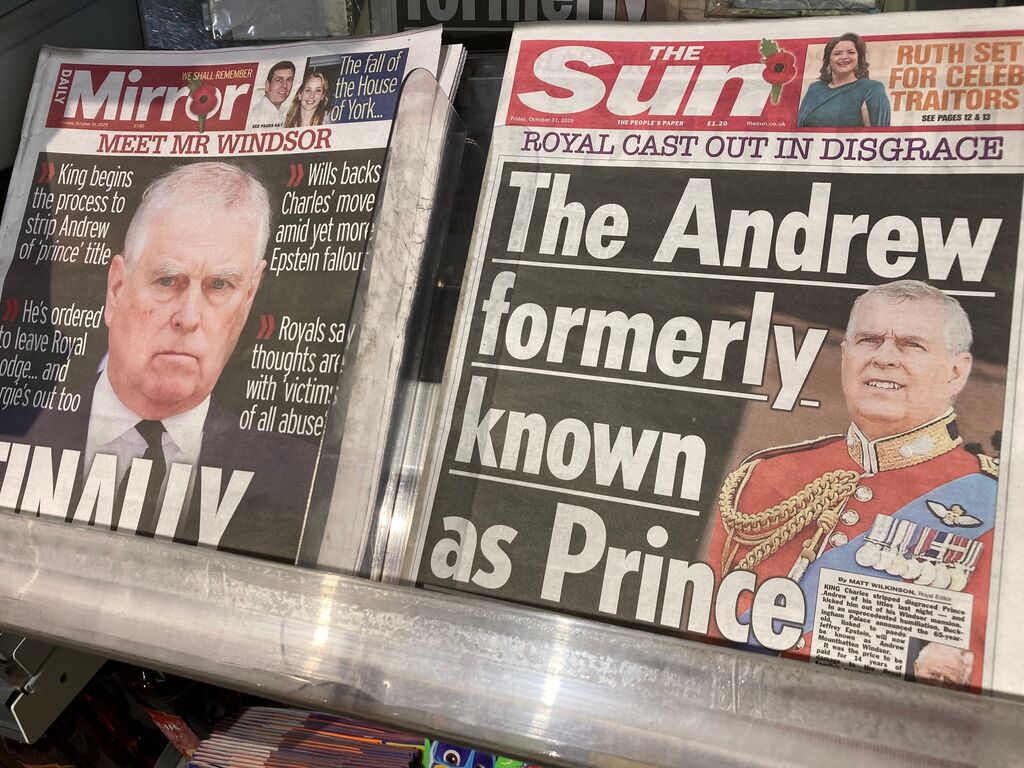
Since Charles I, no British royal has ever been arrested. Until 08:00 hours yesterday morning. Andrew Mountbatten-Windsor, formerly Prince Andrew, spent his 66th birthday in police custody under suspicion for misconduct in public office. He was released late last night, but the investigation is ongoing.
It is but the latest shockwave that has burst out after the Department of Justice in America released a whole tranche of the Jeffrey Epstein files. So far, an Ambassador has been sacked and disgraced, the Prime Minister has lost his chief of staff and his Head of Communications. Oh, and the chief civil servant in the country also stood down (albeit less directly connected to Epstein).
And now, the scandal has reached directly into the Royal Family. Yes, Andrew might not be a prince any longer. But he is still eighth in line to the throne. I’m not sure it is possible to calculate the damage this will do to ‘The Firm’. Andrew’s actions tar his family by association and I worry that no amount of remedial action by the King can fully sever that link.
For His Majesty, this will be acutely embarrassing. For the Prime Minister, perhaps it will be a welcome distraction from his own troubles. For the victims, a suggestion that maybe some sort of justice is coming. For the UK as a whole, a sign that even a prince is not above the law.
But what about the church? What can we learn from this?
What is misconduct in public office?
We need to understand a bit more about what he’s been charged with. In technical terms, he’s under investigation for misconduct in public office. This refers to “serious wilful abuse or neglect” of powers relating to the role in public office. There must be a direct link between the misconduct and the abuse of those powers or responsibilities.
Legal expert Joshua Rozenberg told Sky News that it is an ‘unusual’ offence “because it’s one created by judges, laid down by the courts over many years. For this reason, there isn’t actually a maximum penalty at all. It’s life imprisonment because parliament has never actually set a maximum.”
Proving the charge and the offence itself might be complex. But what is clear is this is very, very serious. You might be a republican or a monarchist. But if you are a follower of Jesus, how should we respond to this tragic and sorry saga?
Beware gossip
This may seem an unusual place to start. But the Bible is very clear that we must be very careful how we speak and part of this is being careful not to gossip. Just consider the following verses:
Ephesians 4:29: “Do not let any unwholesome talk come out of your mouths, but only what is helpful for building others up.”
Exodus 23:1: “Do not spread false reports. Do not help a guilty person by being a malicious witness.”
In fact, gossiping is specifically cited as an example of what unbelievers are like: “They are full of envy, murder, strife, deceit and malice. They are gossips.” (Romans 1:29).
When a major scandal breaks, the temptation to gossip and speculate is high. So we must be on our guard. What does this mean practically?
I am certainly not saying it is wrong to discuss the case. But we should aim to be clear about what is fact and what is as yet unproven. We can also speculate to a degree about what we think is going on. But ask yourself: what is your goal? Are you doing so because you love the drama of it all? Or is your goal to learn lessons that will help us become more Christlike?
The Apostle Paul says this in Philippians 4:8: “ Finally, brothers and sisters, whatever is true, whatever is noble, whatever is right, whatever is pure, whatever is lovely, whatever is admirable—if anything is excellent or praiseworthy—think about such things.”
In this context, thinking about justice being done, wrongdoing exposed, some relief for the victims is all right, noble and good. Enjoying the downfall of a man, however obnoxious he may or may not be, does not.
Beware the love of money
As for Andrew himself, I believe it is possible and not at all judgemental to say there have been very concerning patterns of behaviour evidenced for decades. In particular, his life is a warning about the danger of greed and the love of money. In my opinion, he was a man obsessed with money. And as the Bible says, all sorts of evil resulted.
There have long been questions and concerns raised about where his income comes from. For example, it is a matter of public record that he spent £7 million on renovations for his former home in Windsor.
Even today, the Telegraph’s headline was: “Epstein plotted £1m deal for Andrew.”
In 1 Timothy 6, Paul has this to say about money: “For the love of money is a root of all kinds of evil. Some people, eager for money, have wandered from the faith and pierced themselves with many griefs.”
Notice that it is the love of money that is the root of all kinds of evil. Surely Andrew Mountbatten-Windsor is as clear a warning to us all as there could be. It is very easy to love money and to love what money can get us. But Christians must resist this and steward all our gifts for the good of our families, the church and the Kingdom of God, recognising that our money is from God and for the purpose of blessing others.
We should desire justice
The rich and powerful often act as if the law does not apply to them. And all too often they seem to get away with it. But in Christian thinking, there should be no such inconsistency. All of us are equal before the law of the land. All of us should face the same justice for committing crimes. The Prime Minister said this in an interview with the BBC. The King has said the same. And this principle, which is at the heart of our justice system flows directly from the impact and influence of Christianity in our nation.
In the Bible, we find warnings that systems and institutions can be stacked against the poor and needy. In Ecclesiastes 5:8 we read this: “If you see the poor oppressed in a district, and justice and rights denied, do not be surprised at such things; for one official is eyed by a higher one, and over them both are others higher still.”
In James 5:1-6 we have a stern rebuke of the rich who think they are safe and can get away with exploiting others: “You have lived on earth in luxury and self-indulgence. You have fattened yourselves in the day of slaughter” (James 5:5).
Psalm 10 also shows us the rich and wicked thinking that God does not see what they do: “His ways are always prosperous; your laws are rejected by him; he sneers at all his enemies. He says to himself, “Nothing will ever shake me.” He swears, “No one will ever do me harm.”
But the rich and the wicked have this in common: they forget that God sees all. He is the God of justice and righteousness who will put all things right one day. Even if the wicked escape temporal justice, they will not escape God forever.
And we rejoice, too, that our God has a particular care and heart for the most vulnerable. He detests dishonest scales and wants justice to flow down like a river (Amos 5:24).
Grieve over the disregard for women
There is another factor we cannot and should not ignore. Andrew is currently being investigated for the specific charge of misconduct in public office. But this is just one part of a wider and broader story.
I am sure we’ve all been horrified by the Epstein saga and especially what it has revealed about attitudes towards women and girls. As my colleague Peter and I discussed on our recent engage podcast, this is the real scandal beyond the scandal.
At CARE, we’ve long campaigned against sexual exploitation of women through our work around prostitution and human trafficking. It is a brutal and tragic reality of life that around the world, hundreds of thousands of women and girls are trafficked for the purpose of sexual exploitation.
In Andrew’s case, I just do not think you can divorce what happened yesterday from the very serious questions raised by the claims Virginia Giuffre made. She died alleging that she had been trafficked and exploited by the convicted paedophile Jeffrey Epstein and this included having sex with Andrew, something he has denied. Her case was settled by Andrew outside of court for a reported £12 million. I don’t think it is gossiping to suggest this surely implies some sort of guilt?
More recently, the Epstein files revealed a picture of Andrew leering over a young woman. We also know Andrew received massages which Epstein paid for. And he visited Epstein on his private Island where we also know girls were trafficked for the purpose of sexual exploitation. Where once people laughed at the nickname ‘Randy Andy’, now I hope that those who winked at this, or turned the other way, are ashamed of themselves.
The Bible is clear that all people are made in God’s image (Genesis 1:26-27). Men and women are deserving of equal respect and dignity. Women are never to be treated as mere objects for the sexual gratification of men. For too long, much of Andrew’s known and reported behaviour towards women and girls has gone unchallenged.
We can pray
In light of this, it is right to respond with prayer as well. And I think that starts with praying for the victims of Epstein, Maxwell and everyone connected with this sordid, horrendous story. We can pray that justice is delivered and that this will bring relief for those damaged, hurt and abused. This is the very opposite of God’s better story for humanity. We were made to live free from exploitation and abuse.
I think we can and should also pray for Andrew. We should ask ourselves, what is his greatest need? How could he ever experience some kind of restoration? It is only through the gospel of God’s grace in Christ. Only the Prince of Peace can save him.
But God can use this to save him. He too is still an image-bearer of God. Therefore, in Christian teaching, it is right that he faces punishment if he is found guilty. It is also right that he is treated respectfully and with the appropriate degree of dignity. And if he is found to be innocent, he should be treated as such.
What we can pray for is that he genuinely repents. And what would this look like? It must include godly sorrow and grief over sin (2 Corinthians 7:15). It involves turning from sin and towards God (Psalm 51). There must be confession of wrongdoing (Psalm 32:1-4). And it includes a move towards the victims to say sorry and try and make some amends (Luke 19:8).
To conclude…
What happens now is up to the police, the Crown Prosecution Service and, if it goes to court, to the jury that will preside. It is also in God’s hands. It is right, I think, to feel a degree of sympathy for a man who has fallen so spectacularly. But perhaps alongside the possible victims, I feel most sorry for his daughters. What must they think? How will they process and react to this?
There is no doubt that there is a lot more to come out. Ultimately, we want the hidden things of darkness to be brought into the open. So, with humility, we should brace ourselves for more to come. And pray that justice is done and all who are truly guilty face the consequences for their actions.