Belfast's burning: a Christian response to the riots in Northern Ireland

I’ve never actually witnessed violence taking place. Having grown up in leafy suburban London and having subsequently lived in very safe neighborhoods as well, my experience of the UK has been one of peace and security. Yes, threats have existed (and in the political world as much as anywhere), but in all honesty, I’ve rarely felt anxious or threatened personally.
Not everyone’s experience is like that.
My wife grew up in County Armagh in Northern Ireland towards the end of the Troubles. While she was still a toddler, my father-in-law had to throw himself to the ground when he was randomly caught in a cross-fire on their road. The BBC showed pictures of their house on the news that night, her cuddly toy sitting in the window.
We tend to visit Northern Ireland to see friends around once a year or so. As a Londoner, it can feel like visiting a parallel world. If you’re young, you might assume the Troubles ended in 1998 with the Good Friday Agreement; I certainly didn’t have any more than a passing knowledge of them as I grew up, and it’s rare that news from Northern Ireland dominates the UK-headlines.
And of course, the landscape is vastly different to how it was from the 1960s through to the 1990s, during which around 4,000 people were killed, and 50,000 injured.
But you can’t sweep a generation of violence under the carpet as if it never happened. Today, the Peace Walls in Belfast, Londonderry and Portadown, dividing Protestants and Catholics, still stand at the request of those living there. Last year we were visiting in the run-up to the 12th July, on which Protestants celebrate the victory of William of Orange over the Catholic king James II. Banners hung up in the towns put the cross next to a skull and crossbones and a coffin.
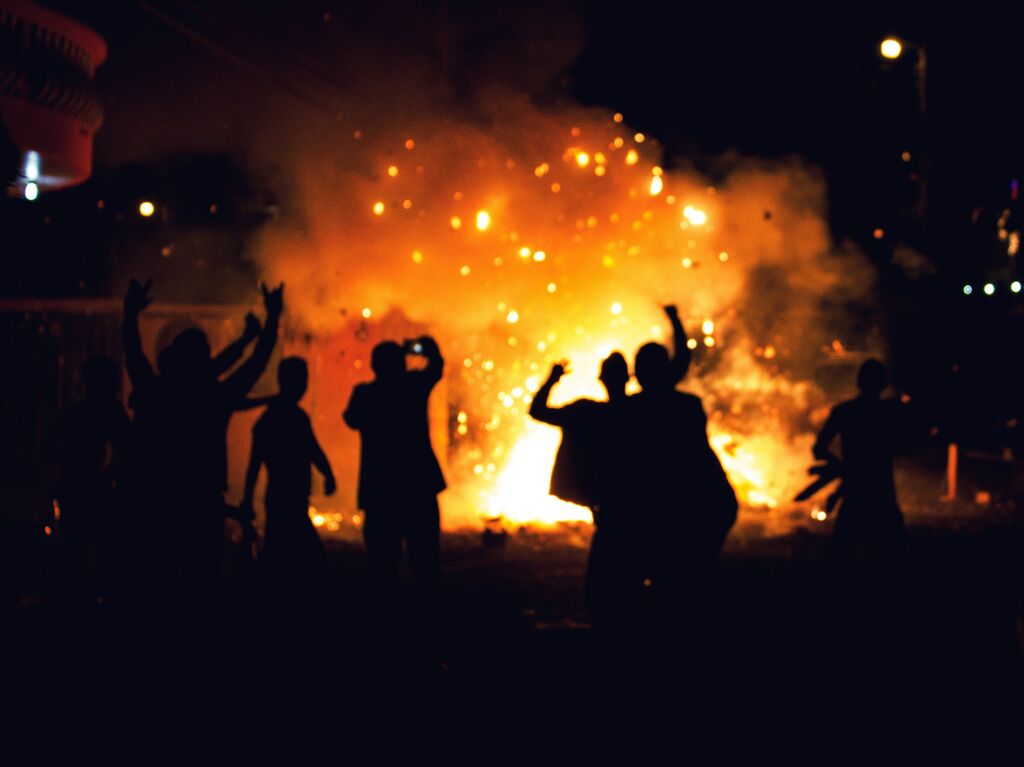
Civil unrest is not uncommon at this time of year, whether it is bricks through windows, cars set on fire or clashes with the police. If, as a society, you’re more accustomed to riots, it’s less of a surprise when it happens again.
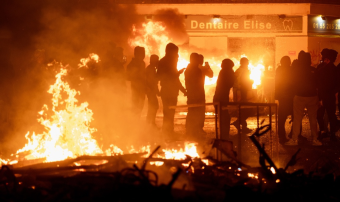
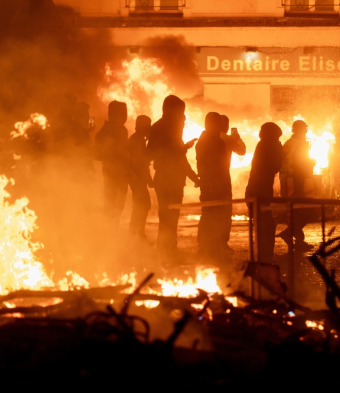
But what was uncommon this week was the target. ‘The Times’ headline read: ‘Belfast riots: mobs burn immigrant homes in modern-day pogrom’.
It’s the second week in a row where we’ve having to write about a criminal attack and subsequent rioting, coming shortly after details were released about the awful murder of Henry Nowak. Much of what Ross wrote then is still helpful, I think.
This time, the perpetrator was an asylum seeker from Sudan, Hadi Alodid, with an address in Duncairn Avenue in north Belfast. The crime was exceptionally violent and extremely disturbing: stories suggested an attempted beheading, and the victim, Stephen Ogilvie, is believed to be in a serious condition, having lost one eye, suffered damage to the other, and with slash-wound injuries on his back and face. Alodid faced the courts on Wednesday, and should swiftly be brought to justice.
But of course, this crime comes with a context. According to Ipsos’ survey in May, immigration is seen as the number one issue of concern for UK voters (41%), above the economy. Nigel Farage’s Reform Party continues to maintain a consistent lead in the polls. And more light is being shone, more consistently, upon the bad behaviour of some who have migrated to the UK: the Southport murders, the Rochdale grooming gangs, the murder of Rhiannon Whyte.
It was interesting to read the words of Jonathan Hall, the independent reviewer of terror legislation, this week: “If [people from] certain countries are more likely either to commit very serious offences or particular offences, or to get involved with state threat activity, do we need to start thinking about migration now, not simply in terms of the economy and housing, but also in terms of national security?”
There absolutely are legitimate questions around Britain’s immigration policy (and indeed, how it integrates those who have moved here), and I don’t think it’s been helpful for some of those in Government in recent years to pretend that there is ‘nothing to see here’ or to hush behaviour up to try and avoid rising community tension.
Not all cultures are the same, and it’s not racist to say that, it’s just common sense. Charts from the Centre for Migration Control show that 15.4% of convictions for sexual assault go to foreign nationals (despite foreign nationals making up only 11% of the population). That figure grew by 62% between 2021 and 2024 (a much faster rate than for the UK-based population). In the same time period, convictions for criminal damage and arson grew by 105% among foreign nationals (and just by 19% for Brits).
There are also genuine practical questions: how do you avoid people travelling from Ireland to Northern Ireland when everyone is agreed that we don’t want a hard border?
And as Christians, we know well that the question of immigration is not a simple one. We know that God is building a church composed of people from every tribe and tongue (and that absolutely governs how we should treat immigrants within our churches!), but church and state are not the same. The Bible does not mandate a particular immigration policy, and we are left weighing up competing principles: how do we balance the love of neighbour (which transcends ethnic and religious lines, as we see in the story of the Good Samaritan), with a government’s duty to protect the welfare of its own citizens?
These are legitimate questions. And the Government can’t keep avoiding them forever, or they will be booted out at the ballot-box by an electorate who will say it’s not listening.
At CARE, we do believe in the right of Christians to question the government, and sometimes that might even look like peaceful protest, as we’ve written about here.
But what we’ve witnessed in some parts of Northern Ireland this week has been quite different. Protest can never look like this…
Christians do not destroy
‘The Times’ told the story of Sumayah Nakazibwe and Stella Ariokot, carers from Uganda, who sat trapped in their homes as smoke from the fires began to seep in. Petrol bombs had been thrown at their neighbour’s home. Stones were being thrown at their window. Emergency services told them over the phone that it was too dangerous to evacuate them. One of them fainted through fear.
They only escaped after a local pastor pleaded with a group of 20 masked men with bricks in their hands, imploring them to give him ten minutes to get the women to safety. They are now homeless.
Baroness Anderson, the Parliamentary Secretary for the Cabinet Office, said that 27 people are now homeless “because people went door to door to try and target foreign nationals”. Elsewhere in the city, there were reports of non-white healthcare workers being chased by masked men, and others being questioned on their nationality. Indeed, it wasn’t even just ethnic minorities at risk: there were other stories about Ukrainian refugees being targeted.
Perhaps most concerning of all was the story of lists of homes to be targeted being circulated on social media, based around where foreign nationals were believed to be living.
Hadi Alodid’s crime was deplorable. But Sumayah Nakazibwe and Stella Ariokot had nothing to do with it. Their ‘crime’ was nothing more than being immigrants.
And they are created in the ‘image of God’, and their lives are worth just as much as Stephen Ogilvie’s is. If you want to take issue with immigration policy, take it up with the Government.
The likes of Tommy Robinson, who at times speak with quasi-Christian language, have called for the actions in Northern Ireland to be replicated elsewhere in the UK. At times, they speak of the UK as if it were a warzone, and we’re in a battle for Britain’s soul.
They are utterly wrong, not only about the diagnosis, but about the remedy.
We read in Proverbs 6: "There are six things the Lord hates, seven that are detestable to him: haughty eyes, a lying tongue, hands that shed innocent blood, a heart that devises wicked schemes, feet that are quick to rush into evil, a false witness who pours out lies and a person who stirs up conflict in the community."
How many of those have we seen this week?
Of course, violence like we have seen undermines any legitimate concerns that protestors want to raise. Far more attention has been given to the riots than to immigration, not because it is a distraction, but because the riots themselves have been unacceptable. As is so often the case with riots, you wonder whether all of those participating really understood what they were supposed to be making a fuss about, rather than just wanting to get involved in violence. Matt McKiernan, who bravely disrupted the original attack on Stephen Ogilvie, said on ‘Good Morning Britain’: “Everyone is entitled to their right of opinion and their right to protest. When it turns violent, then you lose sight of the protest and what it stands for.”
Many other religions - both ancient and modern - have believed in gods of violence and destruction. The Ancient Greeks told stories of divine brutality and cosmic conflict; Egyptian mythology ends with the world being dissolved back into chaos. Hindus continue to believe in Shiva, the Destroyer of Worlds.
The God of the Bible is a God who brings order out of chaos, and who heals what has gone wrong. When Jesus greeted his disciples, his regular greeting was ‘Peace be with you’. The Hebrew word he would have used was ‘shalom’, a word encapsulating peace in its deepest sense, not just a lack of conflict, but wholeness. The story of the Bible ends with God putting all things right again, the time of complete ‘shalom’.
Following the way of the King does not mean bringing division and destruction: it involves the very opposite.
Christians are witnesses
One of the foundational texts for Christians in understanding their relationship to the Government is Romans 13: it talks about how the “authorities that exist have been established by God”, and how “it is necessary to submit to the authorities”. This all appears within the context of ‘whole-life worship’, which Paul sets up in Romans 12:1-2, and is a general principle for Christians.
That does not mean there are no circumstances in which Christians can disobey the government (as we see in Acts 4, where Peter and John refuse to stop preaching in the name of Jesus when they are hauled in front of the Sanhedrin), but the bar is a high one: we are not to disobey our government just because we do not like them, or just because they are promoting policies which we disagree with.
But it’s interesting to look in Romans 12 to some of Paul’s practical guidance for living as a Christian in a world where things do go wrong. He is at pains to show that Christians should not take the law into their own hands: instead “If it is possible, as far as it depends on you, live at peace with everyone.” This is not because evil does not exist; but Christians should “not repay anyone evil for evil. Be careful to do what is right in the eyes of everyone.”
When there is evil, it is for God to avenge, and for human authorities to punish, as is happening with Hadi Alodid at the moment: that is the role which God himself has given them: “They are God’s servants, agents of wrath to bring punishment on the wrongdoer”. Christians are not to pursue some form of vigilante justice.
Instead, Christians are to be beyond reproach, and our behaviour is a witness to the world around us.
I watched an interesting clip with Ian Paisley Jr a couple of days ago; the line which stuck with me was one where he said, “We’re strangers in our own country”. Notwithstanding whether that is right or not (there was a helpful article in ‘The Telegraph’ this week which explained why immigration could disrupt social harmony in Northern Ireland more than in other communities), it struck me that that has so often been the experience of God’s people.
But then the question is: how are Christians to behave?
In his first letter, Peter writes to “exiles scattered throughout the provinces of Pontus, Galatia, Cappadocia, Asia and Bithynia”. In Chapter 2, he writes about what it means to be a citizen of God’s kingdom in a foreign land: “Dear friends, I urge you, as foreigners and exiles, to abstain from sinful desires, which wage war against your soul. Live such good lives among the pagans that, though they accuse you of doing wrong, they may see your good deeds and glorify God on the day he visits us.”
People sometimes say ‘You may be the only Bible your friends may ever read’. Christians are not supposed to behave like the rest of the world; but the rest of the world is watching, for good or ill.
It is a sad state of affairs when Northern Ireland, which in theory has a higher percentage of people claiming to follow Jesus than any other region of the UK, hits the headlines for violence, rather than for its ‘good deeds’.
Christians follow the way of the Cross
When you read a story about a brutal attack on a British citizen by an asylum-seeker, you might feel anger at a life ruined. You might feel fear: how many other people like this have come into our country? You might feel frustration at how our government seems incapable of getting a grip on the problem of mass migration (although it is worth saying that it has been falling in the last couple of years, largely as a result of policies introduced by the previous government).
As Christians, we are limited in what we can change. We can vote at the ballot-box, but we might not get the government we want (and even if we do, how often do we then feel let down by them). We can write to politicians, but we cannot necessarily change their minds.
But there is one thing which we are in control of: our own hearts.
We believe that God is at work in us to make us more like Jesus. This is the destiny of every Christian: “those God foreknew he also predestined to be conformed to the image of his Son, that he might be the firstborn among many brothers and sisters” (Romans 8:29).
There has been much talk in the last couple of years about how Britain is a ‘Christian country’, and is built upon Judaeo-Christian principles. Such questions have always been more acute in Northern Ireland, where for some, religious and cultural identity have almost merged into one.
But God does not just care about the Christian label; he cares about the heart. Do our thoughts reflect God’s thoughts? Do our actions reflect the way Jesus would act? Are we prioritising the weightier matters of the law, like justice and mercy? For if not, He will have no pleasure in our performative prayers and sacrifices.
(And yes, there is such a thing as righteous anger, but even when Jesus was angry, it was in a targeted way; we read in Mark 11 that Jesus “went into the temple courts” and “looked around at everything” the day before he overturned the tables.)
If we allow Jesus to be our model in how we respond, we will discover some disturbing things. We are not just to love our own (for even sinners do that), but to love our enemies. We are to pray for those who persecute us. We are not to fight evil with evil - which brings us down to the same level - but with good.
Last night, providentially, I was reading Luke 6 in my Bible reading, where Jesus speaks words which are well-known, but hard to live out: “If someone slaps you on one cheek, turn to them the other also. If someone takes your coat, do not withhold your shirt from them. Give to everyone who asks you, and if anyone takes what belongs to you, do not demand it back.”
Riots and violence exist in the world where might is right. Jesus shows us that sacrifice, service and suffering are not weakness. In fact, this is the way of the Cross, and the route to glory; Paul writes in Romans 8, “Now if we are children, then we are heirs—heirs of God and co-heirs with Christ, if indeed we share in his sufferings in order that we may also share in his glory.”
That is not to say that all this is how the UK should run an immigration policy! But better to be an exile in a foreign land who behaves like Jesus, than a ‘Christian’ whose actions reveal we never knew him at all.
You are probably not called to resolve the UK’s problems with immigration (unless you’re a politician reading this!).
You are called to become more like Jesus.