The Odyssey and a world longing for home

“Sing to me of the man, Muse, the man of twists and turns … driven time and again off course, once he had plundered the hallowed heights of Troy. Many cities of men he saw and learned their minds, many pains he suffered, heartsick on the open sea, fighting to save his life and bring his comrades home.”
Those words were first sung around 2,700 years ago. In 2018, when BBC Culture asked literary experts for the most enduring narrative in the history of the world, ‘The Odyssey’ topped the list. It is a tale of gods and monsters, of justice and revenge, and one man’s quest to return home, only to find that his home is not the same as he remembered.
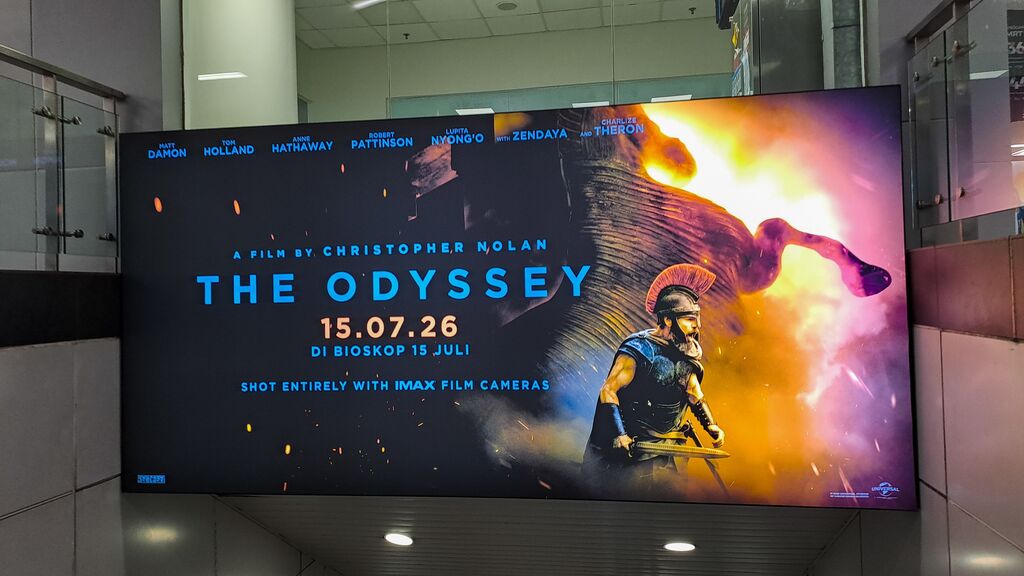
Last Friday, Christopher Nolan’s adaptation of ‘The Odyssey’ was released in theatres across the UK and America. One of the few directors in the world today with genuine star-power - and a devoted fanbase - his stock has arguably never been higher, given the success of his most recent film, ‘Oppenheimer’ in 2023, for which he won both Best Picture and Best Director.
Well-known for his tricks with time (Memento, Dunkirk, Tenet) and his retellings of journeys home to family (Inception, Interstellar), the project was swiftly labelled as the culmination of Nolan’s career. Armed with a £250 million budget, and a star-studded cast (Matt Damon, Anne Hathaway, Robert Pattinson and Tom Holland), the film was shot on-location across six different countries in just 91 days.
The result is a quite extraordinary piece of film-making (regardless of what you make of it as an adaptation of Homer). The Times called it ‘A masterpiece in every way’; The Telegraph, described it as ‘the film of the year’; The Standard, ‘A colossal piece of cinema’. My wife and I saw it on Monday. As she said, ‘I feel like I’ve been trying to get home for twenty years!’
The run-up to the film’s release had been slightly disrupted by an online anti-woke campaign, conducted with quasi-religious zeal and spearheaded by Elon Musk himself, decrying the use of a black actress to play Helen of Troy (who was in the film for 3 minutes) and the mere presence of a transgender actor. The claim was that using such actors made the film ‘not historically accurate’.
The irony is, that in some ways, the film is not historically accurate, but in ways which reshape its meaning far more than the colour of an actor’s skin. The historian (not the actor) Tom Holland perhaps summarised the film’s achievement best: “It honours Homer while simultaneously making something new of him.”
As a former Classicist, I was on the look-out for the iconic episodes from the poem and they are (almost) all there: the Cyclops, Circe, the Sirens and the suitors. The emotional high-points are retained (Eurycleia and in particular, Argus…if you know, you know).
But Nolan - like any director - is shaped by the air he breathes, to borrow Glen Scrivener’s phrase. As various reviewers have pointed out, although this is a film ostensibly set in the Bronze Age, some of its values have been transported into a Christian (or post-Christian) age, not because Nolan himself is a Christian (he isn’t), but because he himself lives in a world which has been so shaped by the gospel, whether consciously or not.
This is of course, the way art has often worked: we read stories through the lens of our own time. Just look at the paintings of some of the great Renaissance painters, many of whom transported Biblical scenes into their own medieval settings. The idea of a genuinely historically-accurate version of Homer is, pardon the pun, a complete Trojan horse: when a studio gives £250 million to produce a film made entirely in Ancient Greek, let me know!
At CARE, our primary calling is to work within the world of politics: our vision is to see Politics Renewed, and Lives Transformed. But we know that the worlds of politics and culture are intimately connected; the values our society holds dear are the same values which come to shape our laws later down the line. In order to work effectively within our world, we first need to understand the world we inhabit (and in this case, how that world affects our perceptions of an ancient world too).
The importance of moral law
Within the first few minutes of Christopher Nolan’s adaptation of the Odyssey, the audience is introduced to the concept of ‘Zeus’ law’, a moral concept which binds all characters, regardless of their social status. This is explained in terms similar to the ‘Golden Rule’, a ‘treat others as you wish you be treated’ code.
To Christian audiences, this might feel like an anachronism, where Nolan has transposed Jesus’ teaching about loving your neighbour as yourself onto a context a millennium earlier. In reality, it’s slightly more complicated: what Nolan has called Zeus’ law is a stand-in for the Ancient Greek concept of ‘xenia’, which is one of the most important themes of the poem.
‘Xenia’ or ‘hospitality to the stranger’, dictated that it was a moral obligation to welcome the stranger at your door into your home. It was particularly associated with Zeus (hence calling it ‘Zeus’ law’ here). Hosts were expected to provide guests with food and drink, shelter, gifts and safe passage to wherever they were going. Guests were not to be a burden (or a threat) to their hosts, and would be expected to return the favour if they were ever a host.
It is a concept rooted in reciprocity: you welcome a stranger, because you do not know whether one day you might be a stranger yourself. And it is also rooted in the divine: who knows who the stranger may be? Could it be a god in disguise?
This concept pervades both the poem and the film of the Odyssey. The whole Trojan war is rooted in an abuse of ‘xenia’, when the Spartan queen Helen runs away from her husband with the Trojan prince Paris, who was being entertained. Odysseus encounters threats from his hosts (the Cyclops, Circe) or is not able to leave them (the Lotus-eaters, Calypso). And all the while, his home is being abused by the Suitors, who have been welcomed as guests, but attempt to steal his wife Penelope and murder his son Telemachus.
We often speak of the ancient world as a brutal place; and it was. But even within pagan environments - by God’s common grace - we can find the concept of a binding moral law, even if Nolan has Christianised it for our modern ears. C.S. Lewis writes in ‘Mere Christianity’ about the innate sense within each of us, as humans created in God’s image, about what is right and wrong: we feel we ‘ought’ to do something, and that obligation is rooted in something beyond this physical, material world.
In some ways, our godless society is just as aware of right and wrong and duties as ever; we see it in the moral outrage that pervades our politics. Topics like climate change or immigration are seen as ‘moral’ issues, with a right and a wrong answer (which vary, depending on your perspective!). Or take war in the Middle East: whichever side people take, they see it as their moral duty to support them.
Our world believes in binding moral laws just as much as it ever did. Our cultural values may not be identical across 3,000 years, but that sense of ‘ought’ is just as powerful as ever.
The effects of sin
If there is a moral law, then there is moral transgression. If humans ‘ought’ to behave in certain ways, then failing to live up to our duties is - to use a Biblical term - the way of ‘sin’.
This is where Homer and Christopher Nolan diverge more sharply: although Homer certainly had a concept of divine transgression (in Book 1 line 8, in the initial prologue, he explains the sin which led to Odysseus’ companions not being able to return home), Nolan’s adaptation reshapes Odysseus’ crowning achievement (the Trojan Horse and the sack of Troy) and turns it into his greatest regret.
This exposes the fault-lines between the ancient and modern worlds. The world of Homer - in the Odyssey, but perhaps even more so in the Iliad - is a brutal, blood-filled world, where heroes vaunt over their fallen enemies and threaten to throw their corpses to the dogs. It is a world where violence and martial conquest, and its human cost, is the route to glory and song.
Homer’s Odysseus is a man who boasts of his achievements to Cyclops after defeating him (leading to the Cyclops calling down Poseidon’s wrath, which shapes much of his later wanderings). When he is welcomed by the Phaeacians (an episode not in the film), he asks the bard Demodocus to sing of the fall of Troy, in which he himself is the central character.
Nolan’s Odysseus comes to recognise the cost of what he has done in the trick of the Trojan Horse (and in this retelling, breaking Zeus’ law), as he sees the flames raging and people dying, particularly symbolised in one female figure. But perhaps more interestingly, in Nolan’s version, we see the ever-widening impact of one man’s sin. Its consequences do not end at Troy. Odysseus’ transgression of the moral law gives licence for others to do the same. He has sown the seeds of his own destruction.
Nolan’s adaptation has particular relevance to our own time, where people seek to jettison what has made the modern West and in particular, the Judaeo-Christian consensus which has governed our world for the last thousand years. Turn your back on the divine law, and watch as the world does the same…
Sin has consequences, not just for ourselves, but for those around us. There is a ripple effect, whether it is on spouses, children, parents or friends. We see this in the story of David and Bathsheba; David’s sin has consequences not just for himself, but for Bathsheba’s husband Uriah, and then for Bathsheba’s unborn child. The effects continue into the next generation, with the conflict between Amnon and Absalom, and by extension, for the people of Israel.
The longing for home
Perhaps the abiding reason why ‘The Odyssey’ has endured for almost three thousand years is the universal longing for home. For Odysseus, the road is long, and fraught with danger and death, trying unsuccessfully to save his companions. Ten years of fighting are followed by ten years of voyaging. And even when he does return to his beloved Ithaca, he is not welcomed back with open arms, returning in disguise to a palace overrun with suitors drinking his wine and vying for the attentions of his wife.
Home is the place of security and safety, and above all, the place of rest, where we can lay our cares down and be at peace. But in Nolan’s retelling, Odysseus cannot simply rest, haunted by the visions of what he unleashed at Troy and the failure to save his men. For rest is not simply physical; it is mental, emotional and spiritual as well. Nolan’s Odysseus is a man looking for an absolution in a world without a Saviour.
And in doing so, Nolan grasps at something truer than perhaps he knows. For as much as we long for our stories that we read or watch to have that ending of perfect resolution, when the tensions in the chords are all resolved and all is well, we know that that is not real life. Our world longs for a happy ending, and yet all the while, it chokes under the curse of the Fall. Things go wrong, because this world is not as it is supposed to be. Jobs don’t work out. Our health fails us. Our relationships break down. And every human story ends the same way, the way of Genesis 5, ‘and then he died’.
C.S. Lewis once put it like this: “If I find in myself a desire which no experience in this world can satisfy, the most probable explanation is that I was made for another world.”
As Christians, we know that this world is not our home (or at least, not this world as it is now). Peter describes us as ‘foreigners and exiles’. Paul speaks of how our ‘citizenship is in heaven’. In Hebrews 4, we read of the coming ‘Sabbath-rest’ for the people of God, when our mortal journeys are done and we leave this weary road behind and enter God’s presence.
We long for the day when we make it home. Except, in one of the great twists and turns, it’s not really us reaching home after all. It is home coming to us, as heaven comes down to earth: “I saw the Holy City, the new Jerusalem, coming down out of heaven from God, prepared as a bride beautifully dressed for her husband” (Revelation 21:2).
Whereas Odysseus strains every sinew to get home, and battles monsters and the wrath of gods to see Ithaca again, our journey is quite different: the work is already accomplished, and all we need do is turn around and see the Father come running. Nolan’s Odysseus cannot escape the weight of his guilt and shame, but our sins are already paid.
This is the day when tears are genuinely wiped away and the world is put right, not in revenge under a hailstorm of arrows, but by the blood of the Lamb.
This is the true homecoming; when the Lord welcomes us to a world of shalom, deep peace, where everything is as it should be, not because of our efforts, but because of His.