France Burns, Nihilism Reigns

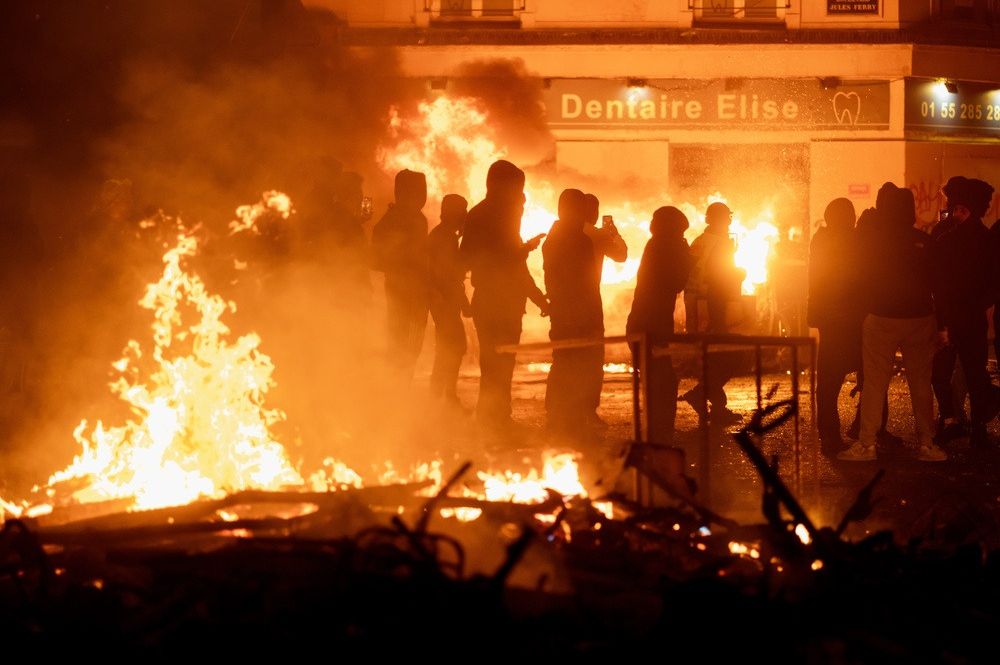
What began a month ago as protests about the conditions of French schools erupted last weekend into some of the worst unrest in France since 1968.
On 17 October, as teachers, parents, and pupils gathered to march in Paris calling for better funding for schools and public services, others prepared to unleash anarchy on French streets.
Hours later more than 3,000 shops and businesses had been looted and over 1,000 police and gendarmes were injured. Public buildings were smouldering ruins, graffiti littered the walls, and electric bikes had been set on fire and manipulated into barricades.
By Sunday the Interior Ministry was reporting over 2,400 had been arrested and more than 900 were being prosecuted. Then this week President Macron banned ‘illegitimate’ protests amid the threat of further disorder this weekend with some cities adopting partial curfews and bans on public gatherings.
Whilst the union-related protests exhibited a peaceful and legitimate airing of grievances regarding the state of public finances and support amid high costs of living, Macron condemned “factitious groups from the ultra-left, joined by numerous delinquents” for the slide into disordered violence.
In the chaos, those with ill intent thrived. As France burned, bands of looters roamed the streets, desecrating businesses and shops in pursuit of a quick buck and the wanton thrill of destruction.
Despite the mass arrests, the police have faced criticism from some quarters for being heavy-handed, and from others for being ill-prepared and outmanoeuvred by cynical and calculated actors, intent on undermining the state. As such, Interior Minister Laurent Nuñez attempted to resign on Monday, only for President Macron to refuse to accept his resignation.
With only six months to go until the next Presidential election, and Macron hamstrung by a divided Parliament and the typical ‘lame-duck’ era of this stage of a presidency, there is much talk about the political implications of the burgeoning disorder for France, and perhaps Europe more generally.
Internally, Macron is viewed as finished. There is no natural successor to Macron’s legacy able to galvanise sufficient public support. Lying in the wings and vying to replace him are Marine Le Pen of the far-right, or at least hard-right, populist party National Rally, and the hard-left political leader Jean-Luc Mélenchon who took part in Saturday’s protests and heads up La France Insoumise (LFI).
In the immediate aftermath Le Pen criticised Mélenchon for being associated with hard-left elements that “look to throw the country into chaos". Meanwhile, Mélenchon has gone as far as to suggest that the governing parties may have allowed the disorder to happen in order to then position themselves as the voice of law and order, distracting the public from their failures in office in the process. Le Pen appears to be the immediate beneficiary of all this chaos given her standing as an anti-establishment figure willing to take a hard line against those responsible for the weekend’s anarchy. Indeed, polling suggests her popularity has increased since the rioting began.
Of course, political posturing in the wake of major public crises (as well as many minor spats) is nothing new. It is the nature of the beast that all public developments are an opportunity for shoring up one’s political credibility.
Yet the battles on French streets last week have gone beyond the usual political spin and feature as the new ground zero in the ongoing existential debate about the future of democracy, the West, and civilisation.
For liberal centrists, events in France pose searching questions over the health of European democracy in its liberal form. With centrism embattled across Europe, voters are looking towards the ‘extremes’ for change. In France Le Pen and Mélenchon embody such polarisation with the disorder on the streets a foretaste of what is to come unless centrism sorts its act out.
For the right, the disorder across France is evidence of the sickness of Europe and the imminent fall of Western civilisation. The fruit of the twin wrongs of mass immigration and radical leftism are there for all to see in the rioting of recent weeks. For those on the right, Marine Le Pen’s strong leadership and willingness to confront an entrenched leftist agenda, mass immigration and Islamism represent the solution.
For the left, the protests are a valuable contribution in the struggle against neoliberalism. Rioting is the righteous response of the disenfranchised and downtrodden who act in defiance of the injustice and hardships systematically imposed on them by a fundamentally unjust society. Ardent resistance against a corrupt state and the potential for a ‘fascist’ Le Pen presidency is essential.
And what makes the burning of France particularly incendiary is that many other European nations face similar underlying conditions. An unwieldy and unsustainable welfare system which resists any meaningful reform. A narrowing tax base paying ever higher rates for a growing cohort of dependents. A fracturing social fabric, undermined by a naïve multiculturalism and a liberalism bereft of a governing moral order.
Indeed, Belgium has been experiencing its own protests and closer to home in Britain we have our own memories of the disorder of 2011 or, even more recently, the summer of 2024 to keep us awake at night. Of course, what makes the debate so interesting is that element of fear that underpins the question ‘could it happen here?’
In this sense, the lazy trope that this is just France being France is an ill-suited comfort blanket for a world experiencing profound unease as its governing shibboleths collapse under the weight of internal contradictions and the old familiar constraints of hard-nosed economic and geo-political realities.
Yet accepting that it could indeed happen poses the more difficult question ‘what is to be done?’
Those using an economic or material lens would be right to point to some of the underlying economic conditions causing frustration in France and elsewhere. Those more interested in questions of culture or identity are not wrong either to highlight how matters of meaning and belonging have become muddled and confused.
However, there is a danger with these things that in our natural bid to side with our political inclinations we look to rationalise events before us and seek justification or meaning where there is none. As Madeline Grant said on Quite Right this week, sometimes it all just boils down to the fact some people “see an opportunity and they’d like to have some new trainers”.
Far from a riot of the righteous, as Louise Perry writes, this was a riot of resentment driven by “inchoate emotions like resentment, envy, rivalry, bitterness and contempt.” Rioters were not searching for bread like the sans culottes of revolutionary France, they were raiding designer stores and destroying a France which they despise.
As Macron said, “Watching these images, we have all asked ourselves how could French people do this to France?”
As much as the hard-left may wish to paint such acts as part of a noble crusade, as Luke Bretherton points out using the words of Markus, “Being imperfectly just is not the same thing as being unjust."
This was no act of love for a nation erring from the straight and narrow (no matter how flawed or misaligned the priorities of French government may be). This was anarchy rooted in the carefree abandonment that comes from a deep-seated belief that others will pick up the pieces. This was a horrific mix of the cruelty that comes from those who believe anything, and anyone, is worth sacrificing on the altar of their utopianism, combined with the destructive disorder that flows from despair and disenchantment.
Ultimately, the rioting in France shines an uncomfortable light on our nihilistic age.
David Brooks and James Davidson Hunter argue nihilism comes in two forms: passive and active. Passive nihilism is to be seen in “disenchantment, alienation. It is about the loneliness, the breakup of community, the breakup of ancestral and organic social relationships and social ties”.
Active nihilism meanwhile is rooted in “a narrative of injury, a narrative of woundedness. What it leads to is the search for the cause of that injury or woundedness. Ultimately it leads to an ethics of revenge.”
Disenchantment, alienation, the breakdown of community, a narrative of injury and an ethic of revenge. You’d be hard pressed to find a better summary of the riots than this. And whilst the material and cultural conditions cited above are common across Europe, so too are the moral and spiritual undercurrents that lead to nihilism.
Nihilism is not unique to France. Nor is it unique to either the political extremes of left or right.
Which again leads us back to the question ‘what is to be done?’
If the problem were only economic or political then one could have confidence that a change in economic system or political party may lead to peace. Yet, as Perry writes, “The psychological dissatisfactions at the core of this unrest are, in the end, far harder to resolve.”
None of this is to say that profound change is not required politically and economically. But it is to say that centrist appeals to simply ‘do politics and economics better’ miss the point. After all, politics and economics do not stand apart from us as though they are some distant other; rather, they are the embodiment of our culture and a reflection of the people.
As such, nihilism is not an alien pathogen introduced by Russian bots or Donald Trump or multiculturalism or whatever other cultural bogeyman you’d like to blame. Nihilism is inherent to a system that has no greater source of meaning or moral order beyond the material and technocratic. Centrism is not the solution because liberal technocratic centrism has led us here.
Yet at present we find ourselves fighting nihilism with nihilism.
We are attempting to deal with disenchantment, alienation, and the breakdown of community with a narrative of injury and an ethics of revenge. The particular flavour of nihilism may be right-coded (blame immigration, multiculturalism, hard-leftism, Islamism, etc.) or left-coded (blame neoliberalism, capitalism, fascism, the rich, etc.) but it is still nihilism.
Neither leads us out of disenchantment or isolation or fragmentation. Rather, it leads us further on and further in until we find ourselves in a nihilistic and destructive rage.
And as Christians, we must watch that we do not assume the culture of our age.
Form political opinions. Disagree with ideas that you believe to be wrong or harmful. Campaign for justice and righteousness. But beware the bubbling seeds of nihilism.
Beware the flowering of hatred and animosity.
Beware the growth of a destructive spirit.
Beware the advance of a gangrenous mentality of victimhood and entitlement.
In James we read these words, “wisdom that comes from heaven is first of all pure; then peace-loving, considerate, submissive, full of mercy and good fruit, impartial and sincere. Peacemakers who sow in peace reap a harvest of righteousness.”
And on the contrary, the harbouring of bitter envy and selfish ambition is not ‘wisdom’ but “earthly, unspiritual, demonic. For where you have envy and selfish ambition, there you find disorder and every evil practice.”
It is here that we find our solution to the question ‘what is to be done?’ and the solution is not something that we find within ourselves.
For the answer to the envy and ambition at the heart of nihilism is the wisdom of heaven. A wisdom that turns the sinful logic of our world upside down and calls us not to selfish ambition and vain conceit, but to sacrificial service, to peace and reconciliation, and to the mercy and love of our Lord and Saviour.
And ultimately, it is a wisdom that promises righteousness and justice, the restoration of all things not through the folly of utopianism nor the destruction of despair but through the hope found in Christ, his death and resurrection.