Reform Exposed

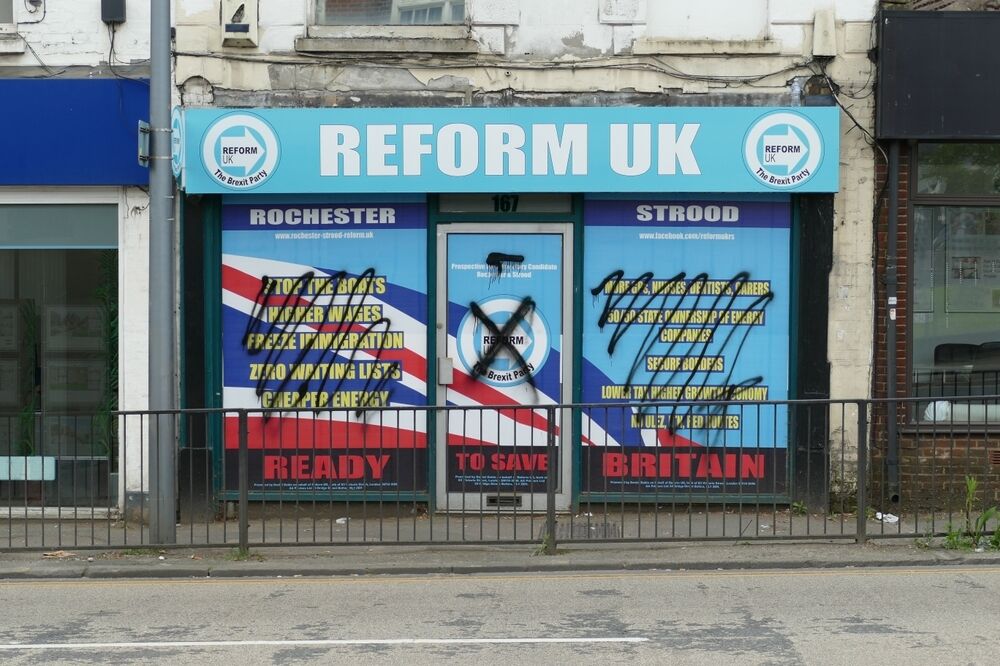
Times are difficult for Britain’s insurgent parties. The Greens remain in and out of the headlines following an antisemitism crisis entirely of their own making and have seen their vote share halved since the spring.
Not to be outdone, Reform find themselves in a miry bog of their own following an undercover investigation by ITV which was aired last night. For a party that has spent much of the summer defending itself over soliciting foreign donations, failing to declare donations, and has various senior figures under investigation, including one who fought a by-election against a bin, ITV’s findings are a potentially devastating blow.
Polling at a high of 33% in October 2025, Reform finds itself reduced to 21% behind both the Labour Party (28%) and the Conservative Party (24%) who it despises so strongly. Faced with the challenge of Restore from the ethno-nationalist right and tactical voting from the centre and left, Reform’s electoral prospects appear to have diminished even prior to a scandal as vile as this.
In a series of clips filmed by ITV’s undercover reporters, Reform figures are exposed with a host of horrific comments about black and Asian people, women, and even the King.
Several Reform councillors are captured making vile and sexually abusive comments about a female colleague. One councillor was found to have signed up for a white supremacist dating site. Another described Asian families as “parasites” that “we’re infested with” and argued for a “nuclear option”. Another described black children as “animals” and claimed King Charles is a secret Muslim who should be decapitated.
At party headquarters, Nigel Farage is accused of defending Chris Parry rather than kicking him out of the party for racist comments with officials attributing the decision ultimately to the party leader. Meanwhile, ITV’s undercover reporter was informed they’d need to be prepared to “defend the indefensible”.
Of course, Reform have not taken the expose lying down but have come out fighting. Farage argued “You can't vet what people are going to say in the future. You can't vet what people say to each other.” Jenrick sought to talk up Reform’s vetting procedures as improving all the time and decrying the Conservative Party’s lack of vetting arrangements.
Nevertheless, ITV’s documentary reveals Reform’s vetting leaves a lot to be desired, with one undercover reporter declaring a support for Tommy Robinson, someone banned from joining Reform, yet rather than being dismissed for such an obvious red flag, is encouraged to delete his social media by the chair of a Reform branch and apply regardless.
For a party leadership that has committed to rooting out “bigots” and “extremists” it’s a rather poor look to say the least.
For Reform’s opponents, ITV’s investigation has simply confirmed what they had long suspected all along: that Reform is an extremist party and a welcome home to racists and other extremists.
Pointing to the pervasive list of examples and the multiple levels of the party implicated, political lines have been drawn with Reform on the wrong side, accused of failing to hold the line against extremism and sectarianism.
For Reform however, the investigation is simply one more piece of evidence that the ‘establishment’ is out to get them and that they, more than any other party, are the subject of undue scrutiny.
Nigel Farage has argued “They would not do this to any other party. And it's yet another example, after Channel 4 and all the rest of it. I mean, this literally is the establishment trying to do everything they can to throw us out of the picture.”
“The massive investment that is going in to try and discredit an entire political movement on a handful of people here and a handful of people there tells you, frankly, all you need to know.”
Meanwhile, Danny Kruger, whilst denouncing Reform councillors and staffers saying “stupid, nasty things”, has been wheeled out to contend for the bigger battle arguing this is an “attack on us not because of who we are but because of what we want to do for this country”.
Pointing to the other parties, they argue Reform is no worse than anyone else. After all the Tories, Labour, Lib Dems, and the Greens have all had their fair share of candidates and officials up to their necks in scandals over the years.
“There is no one righteous, not even one”
And of course they’re not wrong. Our politics is awash with scandals and so you’d be forgiven for concluding there is no one righteous, not even one.
Reform might be the latest in the firing lines but they’re not the only ones.
Robert Jenrick even daringly challenges the BBC to provide a guarantee that no further BBC employees will be exposed as a paedophile, as a number have been in recent years.
And whilst factually correct, that is a rather low bar for what passes as acceptable conduct from a political party intent on governing the nation. It amounts to a form of lowest common denominator morality in which all that matters is being no worse than the next guy.
Rather than recognise the failure to match the standard, the standard is reduced to something achievable. Yet a standard that is achievable makes for a rather miserable politics.
Yet, perhaps even more crucially, the appeal to lowest common denominator morality undermines moral criticism in its entirety. How can you criticise me when I’ve fallen short of the standard when you suffer from the same fundamental problem as me? After all, you too are fallen.
In so doing, moral standards are undercut and accountability erodes.
How can the BBC criticise Reform for having racists in its midst when it had paedophiles in its own ranks? How can any of the other parties come for Reform when they have their own fair share of corruption, antisemitism, racism and abuse allegations against their names?
What results is a sort of whataboutery straight out of the Genesis 3 playbook. I might have done something wrong, but look, so too did they over there!
It’s not quite the folly of claiming to be without sin. Rather it’s a subtle claim that sin doesn’t really matter that much. Sure, I might be guilty, but so too are them, and them, and them! In a cesspit, the stench of my filthy rags is far less stark than if I were in the company of angels.
One alternative of course is to prevaricate and highlight that whilst I might have done X, which is bad, they did Y which is worse. We might both be in the wrong but at least “I am not like other people”.
All in all, one is left with a rather unsatisfactory taste in the mouth.
With the transgressions of the insurgent parties in recent weeks, the traditional big two of Labour and the Conservatives have taken the opportunity to draw a line in the sand and distance themselves as the moderate and sensible gatekeepers of political decency.
And yet here is where the criticism from Reform is cutting. After all, have not both Labour and the Conservatives fallen dramatically short themselves?
If the morality of our political class is self-constructed, then surely the whole edifice lies in smouldering ruins? And is this not precisely what the public thinks?
Trust in politicians is in the doldrums. Political parties are subject to relentless scorn. The scandal-hit Tories were replaced by Labour, who in turn rocketed to the bottom of the polls, who were then challenged from the right by Reform and the Greens from the left, both of whom now nurse their own shredded reputations.
And so, we are left with nihilism. Hopelessness. Cynicism. Despair. And in turn nihilism breeds those uglier attitudes of anger, destruction, selfishness, and revenge.
If there is no higher way, if all are guilty, if no one is good, then what does it all matter?
ITV’s investigation may have exposed Reform, but it has also shone a spotlight on the hypocrisy and brokenness of our politics more generally.
The focus on vetting in the wake of the crisis I think is revealing. In the absence of a robust moral framework and appropriate moral arbiters all that’s left in the armoury of those wishing for a better politics is procedure.
And there is much good in this focus on procedure. Better vetting, as set out above, would have stopped at least some of those exposed in the investigation from flying under the Reform banner and seeking, indeed gaining, political office.
There is a type of defence mounted here by Farage that exudes consternation at the fact ITV have trawled through the minutiae of the lives of Reform candidates, councillors and staffers as though it is only what is put out publicly that matters. That what is said in pubs or behind closed doors or even on hidden social media sites doesn’t matter.
Yet it would be folly to pretend that human lives divide so neatly. The public persona cannot be separate from the private.
Robust vetting ought to determine the sort of person one is. Done well, it is more than a procedural act but a moral one. What is this person like with their family? Their workplace? Their social media accounts? What is the constant thread of a person across public and private?
It is not for nothing that the Bible consistently requires leaders to be of noble repute and of good standing in their community. See, for example, Exodus 18 and Jethro’s encouragement to Moses to pick men ‘who fear God, trustworthy men who hate dishonest gain’ or the New Testament’s qualifications for elders and deacons.
Yet vetting has its limitations.
The pervasiveness of human fallenness cannot be solved by a matter of procedure. Fallen humanity can be deceptive and wicked. An interview can be filled with deceit. An application built on lies. A candidacy can be a fraudulent public persona hiding a love for dishonest gain.
A focus on procedure alone leaves politics open to those who best know how to play the game. As such there will always be ‘bad apples’ who slip through the cracks. It is not for nothing that one of the mantra’s of safeguarding training is that it could happen here. The point being, however good you think your recruitment, however much you trust those around you, we cannot be blind to the power and pull of sin that ensnares and entraps.
And it is this, a wrestling with the universality and depth of sin that is so lacking in our politics today. A recognition of the pervasiveness of sin that haunts both private hearts and public institutions, that undermines the integrity and honour of whatever system we come up with no matter how thorough, and which reduces us all to mudslinging in a desperate attempt to evade responsibility and guilt.
Yet when faced with the pressing weight of human fallenness the Bible does not fall into the despair of nihilism and whataboutery but calls on us to acknowledge the weight and shame of our brokenness. ‘God, have mercy on me, a sinner.’