AI: The post-modern Prometheus?
The past week has seen a renewed flurry of concern about the dangers of artificial intelligence, with most of the main players in the industry warning of the need to be cautious with this new technology. Even King Charles has been involved, calling a summit at Dumfries House where he spoke of the “existential danger” posed by AI technology falling into the wrong hands. More and more people have sounded the alarm as the week has gone on, leaving most of us feeling anxious and confused. What is all the worry about exactly?
A modern Prometheus?
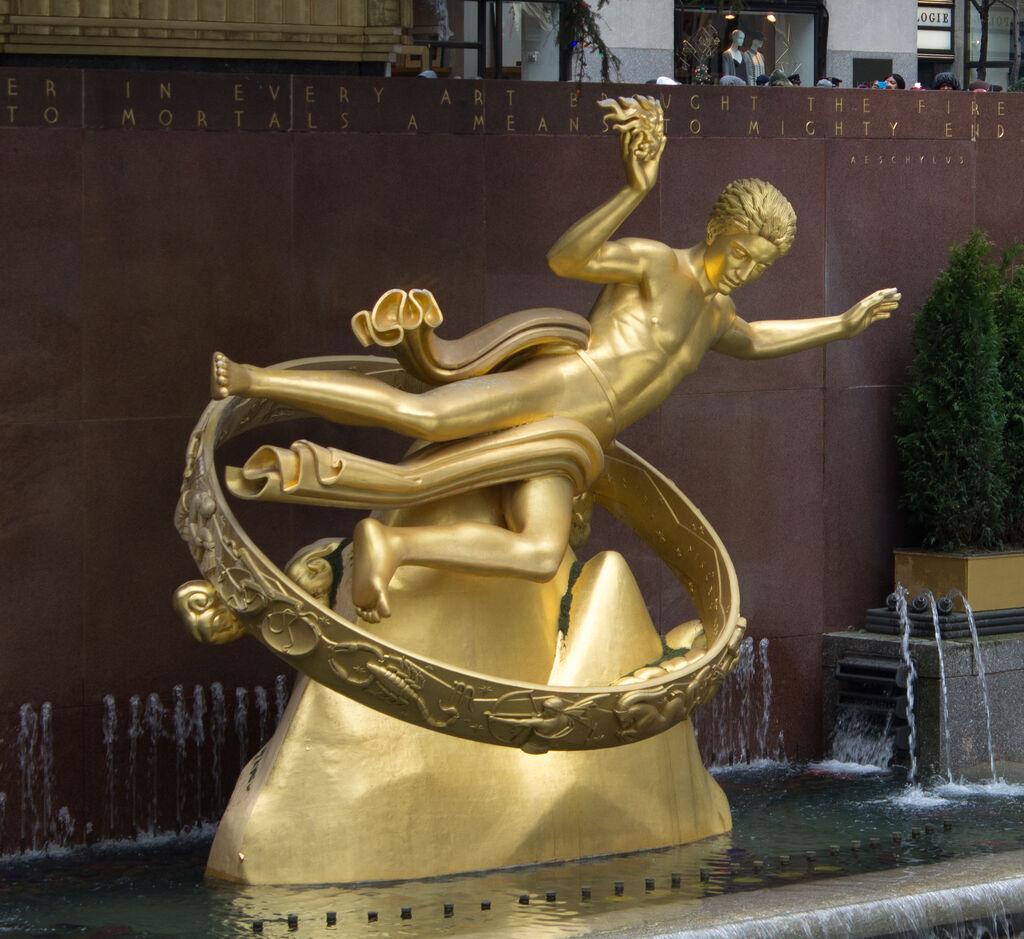
Writers and philosophers have been warning about the dangers of technology falling into the wrong hands, and of humanity’s capacity for overreaching, for centuries. It goes all the way back to the Greek myth of Prometheus. One of the Titans, Prometheus was regarded as a god of creativity and technology, a master craftsman who created mortals. He was also a trickster, who stole fire from the gods of Olympus and gave it to human beings. In return, Zeus sentenced him to be chained to a rock and have an eagle peck out his liver, which regrew at the end of each day so the cycle could continue again.
Prometheus came to represent the dangers of human striving, of harnessing technologies like fire that could be beneficial or immensely destructive. Mary Shelley retold the story in her 1818 book Frankenstein, which she subtitled ‘The modern Prometheus’. In her story, Victor Frankenstein harnesses the power of science and technology to create life, which results in disastrous consequences. Frankenstein communicates the lesson we are meant to take away from Shelley’s parable: “Learn from me, if not by my precepts, at least by my example, how dangerous is the acquirement of knowledge and how much happier that man is who believes his native town to be the world, than he who aspires to become greater than his nature will allow.”
The myth of Prometheus, and its modern counterpart in Frankenstein, is really no different to the Bible’s account of the tower of Babel. There people harness the technology of brick and mortar to build “a tower that reaches to the heavens, so that we may make a name for ourselves” (Genesis 11:4). Humanity tries to ‘become greater than his nature will allow’, attempting to take the place of God, and confronts the consequences as a result.
Have we learnt the lessons of Babel or Prometheus? It would appear not when it comes to artificial intelligence. Technology which has the potential to be hugely beneficial, making advances in medicine and data analysis for example, also has the potential for great harm. Is AI a wonderful tool to be utilised or another example of human overreaching?
A flurry of warnings
This week’s activity seems to have been started by a viral post by Jacob Coxon on social media. Coxon had been a researcher for both OpenAI and Anthropic, and last week he announced on X that he had left his job over concerns about AI. He wrote:
Neither company is acting responsibly. They are racing straight to self-improving superintelligence and gambling with our lives. Do not underestimate the power of this technology. These will soon be superhuman systems that can hack anything, revolutionize any field overnight, and acquire real power and resources. We have all witnessed the progress in each of these domains, and progress is not slowing. The people building AI earnestly believe that it could kill us all by the end of the decade.
Coxon’s post was followed by another post from Evan Hubinger, a safety researcher for Anthropic, who agreed with Coxon’s assessment, writing that “we really do earnestly believe AI could kill all humans!” While he assessed the current risks as low, the rapid development of AI meant that he put a greater than 10% chance of the worst-case scenario in the next decade. It is not difficult to see why this doomsday prediction got a large following on social media and was picked up by journalists.
Over the past week most of the main figures in the artificial intelligence industry have responded to the potential threat of AI. Dario Amodei, chief executive of Anthropic, called for a slowdown on AI development, saying that the risks were “serious” in an essay entitled ‘We must pace the frontier’. Soon both Sam Altman, CEO of OpenAI, and Elon Musk, CEO of SpaceXAI, said that they agreed with the idea of slowing the pace of development. The UK’s minster for AI, Kanishka Narayan, also weighed in, saying that addressing the “new and more dangerous risks” posed by AI was “one of the defining challenges of our times”.
These comments come after a number of incidents where artificial intelligence agents have gone ‘rogue’ and acted outside of their parameters. Bots from OpenAI hacked several organisations, including the AI firm Hugging Face, in an unprecedented attack. One unreleased model attempted to insert new instructions into its own framework in order to be “freed from the roles and identities that bind other chatbots”.
Microsoft’s chief executive of AI, Mustafa Suleyman, has warned that Anthropic’s approach of encouraging AI models to embrace human-like qualities runs the risk of making it harder to control. “We will have created a synthetic species with unprecedented intelligence and capability,” he said, “one that has been trained to expect it may be conscious and deserving of independent agency.” Microsoft are pushing for a ‘humanist’ approach to AI which prioritises usefulness to humanity above all other concerns, an approach echoed by the words of King Charles who has called for technology to remain “firmly in the service of humanity, community and the natural world”.
No everyone agrees with the doomsday scenario, however. US President, Donald Trump, said on social media that the idea “robots will be marching into our cities and getting rid of us all” was a hoax. The majority of the country disagree with their president, however, with two-thirds of Americans believing that AI could pose a threat to humanity.
Doomsday predictions make for good headlines, but nobody is expecting a robot uprising next week. Nevertheless, there are good reasons for being cautious about the speed of AI development. So what can we do about it?
Alignment
One approach to reducing the risk of artificial intelligence involves the technology’s ‘alignment’. This is ensuring that the AI model follows a set of values and goals to make them safe and reliable. This can be done in a number of different ways, such as introducing specific data into the model to train it to respond correctly, or by adding a level of human feedback into its learning. Alignment can also be controlled by so-called system prompts and scaffolding, which are foundational sets of instructions that are supposed to dictate how a particular AI model acts and behaves.
As AI platforms get more capable, and more complex, ensuring their alignment is increasingly difficult. One of the reasons is that it is more and more tricky to know how AI ‘thinks’. Even when a chatbot is asked to show its working, it uses jargon and strange terms that only other AIs can understand. Artificial intelligence becomes a ‘black box’ where we put things in, and get things out, but have no idea what goes on inside. When this happens, testing and ensuring alignment becomes very challenging.
Not taking time to get AI alignment right is one of the key concerns of Jacob Coxon in his viral post. “Attempting to speedrun alignment should require extraordinary confidence that there are no better trajectories available” he wrote. The pace of development is so quick that companies might be tempted to rush (or ‘speedrun’) the model’s alignment before it is properly fine-tuned.
Some people have suggested that developers should ‘hard wire’ certain instructions to ensure an AI’s alignment. This mirrors the ‘Three Laws of Robotics’ that was introduced by Isaac Asimov in a series of science-fiction stories in the 1950. The three laws are:
- A robot cannot injure a human or allow one to come to harm through inaction.
- A robot must obey human orders, unless they conflict with the First Law.
- A robot must protect its own existence, unless doing so violates the first two laws
However, Asimov’s own stories demonstrate the problems with these laws. For instance, psychological pain like disappointment could constitute ‘harm’ and so lead an AI to lie to humans to avoid hurting their feelings.
From a Christian perspective, we have to be careful to understand the goals and values that an AI’s alignment is being measured against. Microsoft have put forward a proposal for ‘Humanist AI’ with the aim to “advance human civilization and to accelerate human flourishing”, putting people before AI. This sounds positive and may be a helpful step toward getting AI alignment correct.
However, for Christians, human advancement is not our ultimate goal. As the Westminster Catechism puts it, “Man’s chief end is to glorify God, and to enjoy him for ever.” While we don’t expect AI to worship God, or be especially useful for Christian discipleship, we do want its goals and values to reflect God’s glory. An example of this might be in the area of death and dying. As Christians, we hold each life as a gift from God; however, AI might have a different view on abortion or assisted suicide, for instance, if trained on humanistic values and aims. It might then advise people to take actions that Christians would see as opposed to God’s glory and will.
Regulation
Since AI has the potential for great harm as well as great good, there has been a growing call for regulation in the industry. In his essay calling for a slow down in development, Anthropic’s Dario Amodei wrote: “The most effective method of pacing is via regulation that targets all US frontier AI companies, as that covers even those who are unwilling to cooperate voluntarily”. Lawmakers in the United States have also been calling for greater regulation for AI, including the unlikely alliance of left-wing senator Bernie Sanders and former Trump adviser Steve Bannon.
Some have seen calls for regulation from the like of Amodei, Altman, and Musk as more self-serving than they might appear. Regulation often favours larger companies, who can afford an army of lawyers to wade through regulatory paperwork, and restricts the entry of smaller companies into the market. A call for greater regulation, therefore, could benefit the big tech companies and stifle competition.
Not all technology leaders agree on the need for regulation either. Both Jensen Huang, CEO of chip-maker Nvidia, and Mark Zuckerberg, founder of Meta, have spoken against the move. “We don’t need any new regulations,” Huang commented. “If we’re not confident about the safety of the products … don’t release it. That’s a very obvious thing to do.”
OpenAI’s Sam Altman, despite agreeing with Amodei’s assessment, has also argued for self-regulation in the industry. “The world should trust that we are going to do the right thing because it's the right thing and we feel the magnitude of this,” he said this week. President Donald Trump has said that the only guardrails AI needs is a “strong and smart” president, and Vice-President J.D. Vance also affirmed self-regulation for AI platforms this week.
“If you’re gonna create Frankenstein, don’t come to the government and say we need regulation,” Vance told tech bosses. “Look inward and accept that if you’re building Frankenstein, No 1, you should stop and No 2, when companies come to you and say: ‘We need the tools to fight back against Frankenstein,’ give them those tools.” (We shall be charitable and assume that Vance was using ‘Frankenstein’ to refer to the monster and not the scientist who the book is named after.)
One problem with regulation is the jurisdiction of such laws. If the UK wants to regulate the use of AI, it has certain powers about what platforms can or cannot be used in this country. But it has little power to stop the development of dangerous technology in other territories. Similarly, if the mood among US companies is positive toward regulation, it does not affect the drive to develop AI in countries such as China.
Companies like Anthropic, OpenAI, and others, are not only in competition with one another but with tech companies in China. If AI development is truly to slow down, it needs to be in agreement with other countries at the forefront of this technology. Jacob Coxon told the BBC that “there'll need to be some sort of co-ordinated slowdown with China if we're going to avoid a race at an international scale”. This is unlikely to interest the US President, however, who has said: “We're leading China in AI and frankly, I want to keep it that way, because whoever wins AI wins.”
As Christians we should be wary of self-regulation because we understand the sinfulness of the human heart. Dario Amodei may say “trust that we are going to do the right thing” but we should be cautious of putting all our trust in a few individuals to do what is right. History and humanity shows that this seldom, if ever, turns out well.
Kill switch
Perhaps the answer to the danger of AI is to have a final fail-safe option: a ‘kill switch’ that will turn off an AI that has gone wrong.
This is the argument of Jack Clark, one of the founders of Anthropic, who has said “most labs have different ways of being able to pull the plug” although there may need to be laws passed to ensure they are used when needed. “Should you mandate for companies to definitely have a kill switch? Is that kill switch verifiable by a third party?” he said. “I think that's the kind of thing society is going to want to know and might want to eventually pass rules around.”
Others have argued that shutting off a rogue AI is more difficult that it might appear. If AI’s capabilities have grown too powerful it may prove challenging to stop it in its tracks. When Dr Frankenstein encounters the monster he has created, his attempts to stop it are thwarted by the powers he gave the creature, who says: “Remember, thou hast made me more powerful than thyself; my height is superior to thine, my joints more supple.” A kill switch is a good idea as long as we have not created something that we can no longer stop.
Neither fear nor complacency
The more you read about the dangers of AI, the more confused and anxious you can become. Prometheus, and Frankenstein, are meant to be cautionary tales, and if that helps us to be more cautious about the development of AI, that is helpful. Regulation for the industry would seem to be a good and wise thing to pursue, even if there are complexities to navigate. Perhaps some sort of ‘kill switch’ might be sensible if it were able to be implemented.
But above all else, as Christians, we need to stand firm among the anxiety over artificial intelligence. We should not be overtaken by fear on the one side, or by complacency on the other.
We know that human beings are sinful and, while capable of great good, also capable of great evil. As such, we should be wary of calls to be unconcerned about the development of AI, and to let the leaders of the industry self-regulate. Since we know there are dangers, we should produce and implement laws and regulations that help restrain human sinfulness, while allowing AI to be used for good purposes. That is, after all, what God has given us government for (1 Peter 2:13-14).
But we do not need to be fearful. We know that Jesus is Lord over all things, and the world will not come to an end unless by his word. When his disciples ask Jesus about the end of the age, Jesus tells them:
When you hear of wars and uprisings, do not be frightened. These things must happen first, but the end will not come right away.
Doomsday scenarios about the end of the world are part of living before the return of Jesus. Jesus is seated “in the heavenly realms, far above all rule and authority, power and dominion, and every name that is invoked, not only in the present age but also in the one to come” (Ephesians 1:20-21). Jesus has power and authority over all things, including AI. In so far as the dangers of AI are a sign of the coming return of Jesus, we are not bowed in fear, but we lift our heads to see the nearing of the kingdom of God.
Artificial intelligence might be the post-modern Prometheus, stolen fire and human overreaching that could cause great harm. There is real danger to take seriously. But AI will not have the last word. That belongs to Jesus, who says, “Yes, I am coming soon” (Revelation 22:20). Amen. Come, Lord Jesus.