The many costumes of Nigel Farage

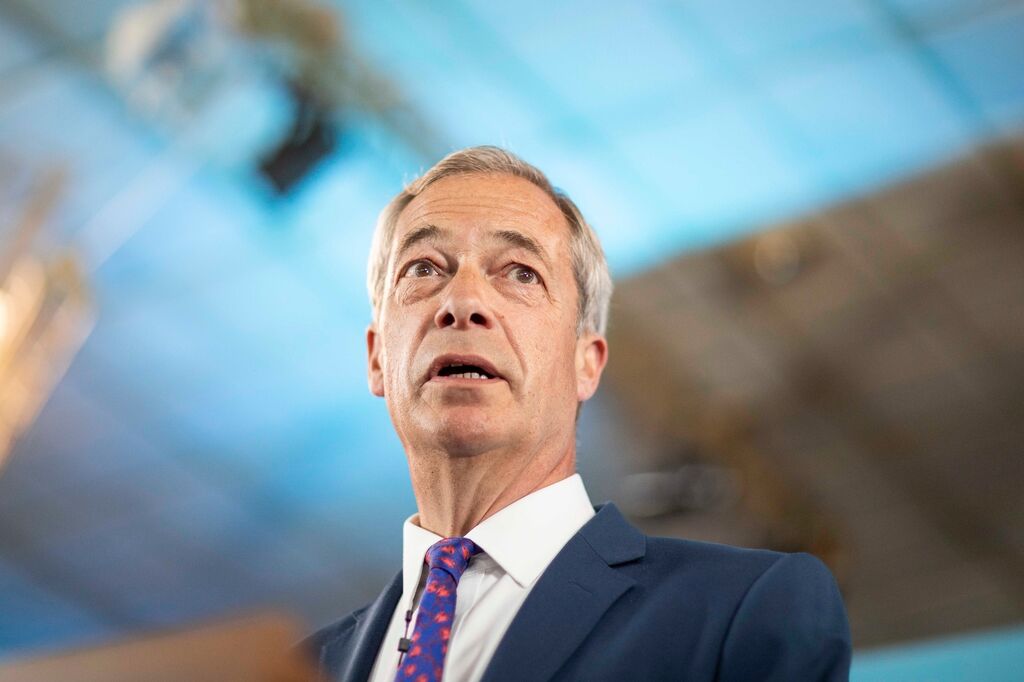
On Tuesday morning, Nigel Farage, leader of Reform UK and MP for Clacton-on-Sea, announced on social media that he would be making a statement about his future in public life. Reporters and political commentators speculated on what he might say and do, as he battled increasing scrutiny over financial donations he had received. Farage has been facing a parliamentary investigation over a £5 million donation he was given before he became an MP, and under pressure over support he received from long-term ally George Cotterell, a convicted fraudster, which he did not declare.
Farage took to the social media platform X to say “I will make a statement on my future in public life at 2pm.” His statement, which was broadcast on social media without any press or questions, claimed he had done nothing wrong. Nevertheless, Farage chose to resign as MP for Clacton and trigger a by-election – one in which he will stand as a candidate. “I've decided that the people of Clacton should be the judges of my actions” he said. “This will be a people versus the establishment by-election.”
Nigel Farage clearly expected to run against candidates from the main political parties, and expected to win. But events took another turn as all of the main rivals – Conservatives, Labour, Liberal Democrats, Greens, and even Restore Britain – said that they would not be fielding a candidate in the election. This leaves Farage running against a collection of ‘parody candidates’, most notably Count Binface. Binface, who is the alter-ego of comedian Jon Harvey, is a staple of British elections, having run against Rishi Sunak, Boris Johnson, and most recently Andy Burnham in the Makerfield by-election.
The Reform leader’s gamble, and the response from the other parties, means that Farage will be spending the coming weeks campaigning against a man in a space costume with a bin on his head. On Wednesday, the chancellor Rachel Reeves received Farage’s request to be “appointed steward and bailiff of the manor of Northstead” which is the arcane method by which MPs can resign from the Commons. Accepting the request, Reeves said “It is a farce and a desperate distraction and the people of Clacton deserve better”. She added: “But if he wants to spend the summer arguing with a bin, I won’t stop him.”
Since Farage’s announcement, other parody candidates have also announced their intention to stand. They include a candidate for the Monster Raving Loony Party, a man dressed as a fish finger, and a ‘human fox’ also recently seen at the Makerfield by-election. Farage might soon be seen surrounded by people in various costumes – but what costume will Farage be wearing? He may not have a fur suit or bin on his head, but his announcement on Tuesday showed the many costumes that Nigel Farage chooses to wear in public life.
Farage the businessman
For a statement about public and political life, Farage spent a great deal of time talking about his business dealings. “Now, going back to the '90s,” he said, “I was in the commodity markets. I had a very, very good high-earning career.”
Some of this focus on his business acumen seems to be an argument against the scrutiny over his financial donations. “So yes, over the last 10 years,” he said, “I have financially done well, but that of itself should not be looked upon as a crime.” Succeeding in business and doing well financially is not a bad thing, and can be used to achieve good goals. But business dealings are a very different thing from financial gifts, which is the subject of the parliamentary investigation.
Perhaps taking a page out of President Trump’s playbook, Farage went on to argue that business success is an asset for politicians:
The really big question that I want to pose is, do we want leaders that know how to make money? Do we want leaders that have run businesses, employed people, and understand how the world works? Well, I'm going to argue today we absolutely need successful people from all walks of life, but particularly from business and industry. We need them not just in parliament, we need them in government if we're even going to have half a chance of turning around the dire economic state this country now finds itself in.
This is a very good point. We do need people in politics and government with expertise in a whole range of fields, from education, healthcare, housing, and, yes, business. But being successful in business does not automatically qualify someone for government, nor does lack of industry experience necessarily disqualify you from public service. Farage the businessman seems to think otherwise as he disparages the Labour government for comprising “a cabinet, 24 men and women, not one of whom has any serious experience of private business, who frankly haven't got a clue”.
“Making money is not a crime” says Farage more than once in his statement. He is quite right, but we need to be careful with making money the ultimate goal. “For the love of money is a root of all kinds of evil” says Paul to Timothy (1 Timothy 6:10). Business success is neither a qualification or barrier to public service.
Farage the performer
Whatever you think of Nigel Farage, it is undoubtable that he has a certain presence and charisma. He can capture people’s attention and draw people to his cause. Sometimes he plays the lovable buffoon with a pint in his hand, while at other times he is the stern protector of common sense and political change. The statement on Tuesday was definitely more of the latter than the former.
Performances are designed to distract you. That is why people go to the theatre or cinema, to be distracted from the stresses and strains of everyday life. Farage’s announcement and resignation appears, at least in part, designed to distract away from the investigations of the parliamentary standards committee.
I don’t know if fighting an election against a man wearing a bin is more or less distracting than fighting against genuine political opponents. But Farage is a master of changing the story, and he has shifted the coverage away from the financial investigations and on to the by-election in Clacton-on-Sea.
If this is simply a performance meant to distract, it might backfire, however. The parliamentary investigation into the donations given to Nigel Farage do not go away because he has resigned as an MP – they are merely paused. If he is re-elected (and he must be reasonably sure that he will be) then the investigations will resume. If he is found to have breached parliamentary standards, then he will be suspended, and we will have yet another by-election in Clacton.
Farage the performer is most at home on the campaign trail. He seems to relish meeting with voters and being the ‘man of the people’. But performance should not distract from proper scrutiny. Transparency is important in public life, just as in all of life. The book of Hebrews reminds us: “Nothing in all creation is hidden from God’s sight. Everything is uncovered and laid bare before the eyes of him to whom we must give account” (Hebrews 4:13). We cannot distract from our accountability before God, and we should not distract from accountability to others either.
Farage the victim
One of the themes of Farage’s statement on Tuesday was how he was a victim of attacks and injustice. His argument for receiving the financial donations was to pay for protection and security from those who are hounding him.
“For over 20 years now, I have been subject to constant demonization by the press,” he said, and was “attacked again and again” for having political views that were different from the consensus. He goes on to detail some specific incidents. One was a time where his car was set on by a group of about 50 people, another when his home was targeted. He also claims that The Times published the location of his daughter’s home, and that various reporters, including Sky News, were harassing her. Sky News disputes Farage’s claim of harassment, while photos used by Farage himself have been found with the house his daughter lives in visible and identifiable.
If even some of these things are accurate, however, then that is a deplorable state of affairs. Attacks against politicians of every party have increased over recent years. I am certain that other MPs can tell stories similar, if not even worse, to those that Nigel Farage has experienced. In particular the families of public figures ought not to be targeted, and many politicians rightly do their best to keep them out of the public eye.
Yet, in his statement, Farage goes on to claim: “I am the most physically and verbally attacked public figure or politician of modern times.” Over the past ten years, two MPs have tragically been murdered – Jo Cox who was killed in 2016 before a surgery in her constituency, and David Amess who was killed in 2021 in similar circumstances. There is no doubt that Farage has been targeted with verbal abuse and assaulted with milkshakes and eggs, but it is hard to justify the claim that he is the ‘most physically attacked politician’ of modern times.
It is right to speak out against injustices. We should work to ensure that every public servant is free from attack. But playing the victim is not helpful. For Christians (and Nigel Farage says he is one of them) we follow the greatest victim of all, Jesus Christ. Yet he did not adopt a victim mentality, but when “they hurled their insults at him, he did not retaliate; when he suffered, he made no threats. Instead, he entrusted himself to him who judges justly.” (1 Peter 2:23)
Farage the rebel
If Nigel Farage’s statement started with business and financials, it finished on a note of defiance. He pitched himself as the anti-establishment rebel who stands against the hypocritical Westminster elite and the unethical British press. He ended his statement like this:
This will be a people versus the establishment by-election. It's a chance to stick two fingers up to the entire establishment, to frankly tell them where to go… I will fight to continue the political revolution that Reform has started. And I would say this to you, the voters of Clacton: If I win, you win. Because if I lose, they win, and we will never, with the two old parties, get the type of fundamental change that we need to fix broken Britain.
It is fascinating to see how Farage pivots from being a successful commodity broker, and recipient of a £5 million donation (“the equivalent of a lottery win” as he called it), to being the anti-establishment underdog and champion of the common people. It seems even more farcical when the anti-establishment rebel is going up against a fox, a bin-wearing spaceman, and a man dressed as a fish finger.
For all the silliness of the by-election scenario, it is interesting to see Farage’s argument here. “It's a chance to stick two fingers up to the entire establishment, to frankly tell them where to go” is a call to reject the old way of doing things and vote for something different. It was a strategy (albeit communicated differently) that worked well for Andy Burnham in Makerfield.
Anti-establisment is fine, as long as you have something better to replace it with. Farage has framed the by-election as a justification of his actions and his fate (even though at least some of that is in the hands of the parliamentary standards committee). ‘If I win, you win’ is good political rhetoric, but it needs to be backed up with a positive vision of what government and politics can be.
Jesus calls us to be obedient to earthly authorities (Romans 13:1) but rebels against the world (Romans 12:2). In resisting conformity to the pattern of this world, we are instead to be conformed to the likeness of Christ. Romans 12 details many practical examples of this that should shape our lives, and political lives, such as: “Bless those who persecute you; bless and do not curse” (Romans 12:14). Being a rebel should mean blessing for others.
Farage the politician?
Although he appeals to a wide range of people, Nigel Farage is not an anti-establishment rebel. Although he has undoubtedly faced attacks, he is not a helpless victim either. He is a businessman and a performer, but he also ought to be transparent about his finances and not distract from scrutiny.
Nigel Farage wears a number of costumes, even within one short statement. Yet the one identity he should wear with pride is as a politician. He speaks about Britain being broken and resistance from the establishment and media. But he also says that “I've really enjoyed the job of being an MP. The people, the constituency, it's an office that I genuinely, genuinely adore.”
The apostle Paul tells the church in Rome: “the authorities are God’s servants, who give their full time to governing. Give to everyone what you owe them: If you owe taxes, pay taxes; if revenue, then revenue; if respect, then respect; if honour, then honour.” (Romans 13:6-7)
Politicians are God’s servants who give their full time to governing. As such they deserve our respect. Whether we agree with them or not, someone who serves the common good in public life is doing an honourable job. Rather than putting on the costume of businessman, performer, victim, or rebel, Nigel Farage would do well to simply be who he is: a politician, a pubic servant and a servant of God in the service of others. By removing the costumes and embracing the honour of being a politician, he might just stand a chance against those in costumes around him.