Flash floods in Nepal and a world that doesn't make sense

“It is a giant graveyard. All that is left are sand and pebbles, soaked red by human blood.” Those are the words of Omkar Joshi, a 35 years old Nepali customs agent. He survived by scrambling up the hilltop as the border town of Timure disappeared beneath him. He estimated that 90% of the town had died, buried beneath the mud.
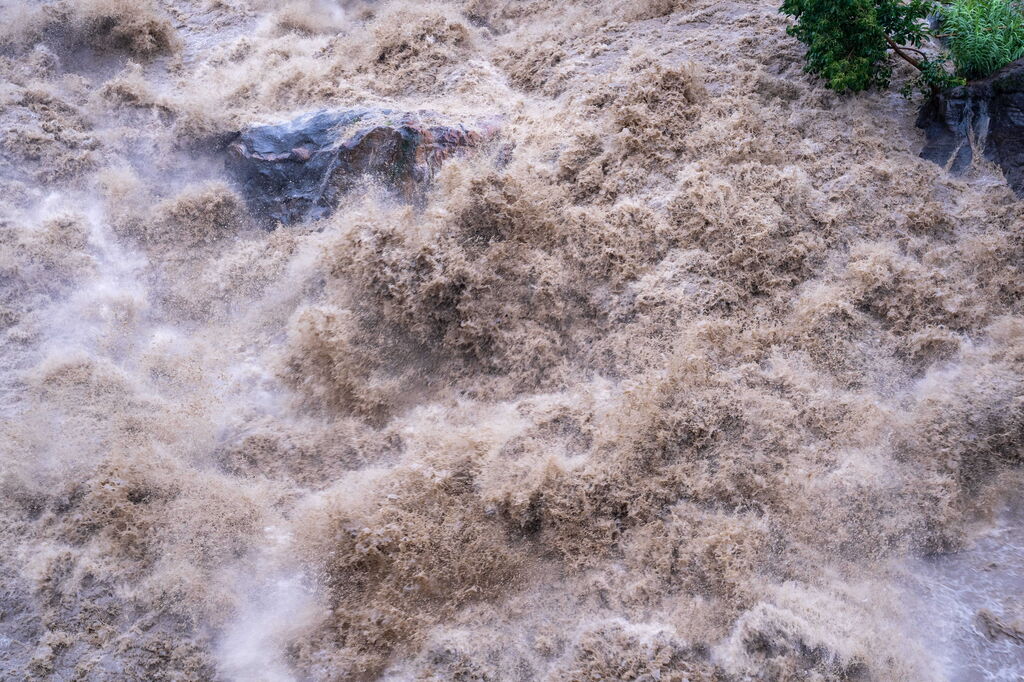
The footage was frightening. Everyday tranquil scenes descended into chaos and cataclysm as the floodwaters surged and swelled. Workers ran for cover from the swirling waters; bridges were swept away; multi-storey buildings were overwhelmed.
The area affected, around the Nepali-Chinese border, is a common tourist destination. At least 469 people are confirmed to have died, and another thousand are missing, including 33 Britons. The death toll is expected to rise further as the rescue efforts continue. Relatives have begun posting images of their loved ones outside the mortuaries in Kathmandu.
Up to 93,000 people have been displaced already, and Kamal Kishore, the UN special representative for disaster risk reduction, said: “In living memory, we haven’t seen a mountain hazard event like this.”
And concerningly, it may not be finished yet: two lakes are at risk of further flooding, and at one stage, search operations were paused when water levels became dangerously high.
An ancient question
When we read stories or watch videos of disasters like this one, there is one question that Christians the world over will be asking: why?
On one level, the answer is quite straightforward.
The flash flood began when a 50-acre chunk of glacier - big enough to fill 11 football pitches - fell almost 4,000 feet to the foot of a valley. The impact was so great that the ensuing shock wave led to a 4.4-magnitude earthquake being recorded. Debris from the avalanche surged into the river, creating a dam, allowing a mass of ice, water, rock and mud to build, until the pressure became just too great. The flood swept through the valley, picking up rocks and trees as it went, and reaching a speed of more than 100mph. Within half an hour, the river level had risen by 30 feet.
But as Christians, we cannot escape these questions so easily. To sing of God’s sovereignty on a Sunday and neglect it during the week? It will not do.
We do not just live in a materialistic universe. Multiple explanations can exist at once. And as we often say with regard to creation, science can explain the how, but it cannot truly explain the why. Where was God? And why didn’t He intervene?
For the reality is, He could have done. When Lazarus dies, both Martha and Mary make exactly the same observation to Jesus: “Lord, if you had been here, my brother would not have died” (John 11:21, 32).
The ‘problem of evil’ has existed for millennia. Its most famous version may have been developed by the Greek philosopher Epicurus in the third-century BC; David Hume summarised it as: “Is [God] willing to prevent evil, but not able? Then is he impotent. Is he able, but not willing? Then is he malevolent. Is he both able and willing? Whence then is evil?”
Of course, the questions which lie behind that go back far further still. The Bible never shies away from the confusion, the pain and the messiness of everyday life. Poets and prophets alike ask God: ‘Why?’.
Psalm 10:1: “Why Lord, do you stand far off? Why do you hide yourself in times of trouble?”
Psalm 13:1: “How long, O Lord? Will you forget me forever? How long will you hide your face from me?”
Jeremiah 15:18 “Why is my pain unending, and my wound grievous and incurable.”
Habakkuk 1:2 “How long, LORD, must I call for help, but you do not listen?”
God does not seem to have an issue with us asking questions like that. Maybe, it’s actually one He wants us to ask, or else, presumably, He wouldn’t have inspired such questions to be in the Bible. Part of being made in the image of a just, loving God, is that we feel a taste of the injustice and grieve when innocent people lose their lives.
The theologian Chris Wright, in his excellent book, ‘The God I don’t understand’, writes, “Am I not also made in God’s image? Has God not planted a pale reflection of his own infinite compassion and mercy in the tiny finite cage of my heart too?...So for the moment, I grieve and lament, I weep and feel intense anger, and I do not hesitate to tell God about it and to file my questions before his throne.”
So what does the Bible tell us? And how can we process a tragedy like the one we’ve just witnessed?
It cannot make sense
Part of being human is trying to make sense of the world around us: God has given us minds as a vehicle to love him (Matthew 22:37) and glorify him. We are rational creatures, made in the image of a rational God. Just as God Himself named what he created (Genesis 1) and brought order out of chaos, one of the first things we see Adam doing is naming the animals.
When we see suffering and evil, it appears to go against all of our natural intuitions: where is the sense in it? It all seems so pointless. That feeling actually hints at a profound truth: in a sense, suffering and evil are senseless.
For they were not part of God’s good creation. Everything God makes in Genesis 1 and 2 is “good” or “very good”. Death, disease and decay are not part of His design, but alien invaders to our world, and signs of creation gone wrong. When we feel in our very bones that it shouldn’t be this way, that is precisely because it shouldn’t.
But when Adam and Eve ate the fruit from the tree of knowledge, every part of this world was affected: our relationships with one another, God and the world. Land which once bore good fruit now chokes with thorns and thistles.
Evil is not just to be passively accepted. We don’t need to be stoic or maintain a stiff upper lip: when Jesus saw Mary at Lazarus’ tomb weeping, our translations tend to say that “he was deeply moved”. The Greek word is stronger: it is more akin to him “snorting with anger”.
We can weep, rage and roar against suffering and death, for they should not exist, and one day, they will not exist again. Paul writes in 1 Corinthians 15: “When the perishable has been clothed with the imperishable, and the mortal with immortality, then the saying that is written will come true: ‘Death has been swallowed up in victory.’”
Chris Wright is helpful again here: “Evil has no proper place within creation. It has no validity, no truth, no integrity. It does not intrinsically belong to the creation as God originally made it nor will it belong to creation as God will ultimately redeem it. It cannot and must not be integrated into the universe as a rational, legitimated, justified part of reality. Evil is not there to be understood, but to resisted and ultimately expelled.”
There is a very real sense in which evil cannot make sense.
It does not make sense
When mortals declare they know the reasons why something has happened, it is often a sign of foolishness and folly. Job’s friends suggest his suffering must have been because of his own sin, and try to convince him he must be a law-breaker or have some particular act he has forgotten. But God rebukes them: “I am angry with you and your two friends, because you have not spoken the truth about me, as my servant Job has” (Job 42:7).
It is a similar story in the New Testament: in Luke 13, some of those present tell Jesus about the Galileans whose blood Pontius Pilate had mixed with sacrifices. They assumed that such an awful fate - God’s own people killed and wedded in death to a pagan offering - must have been a result of wrongdoing. Jesus replied: “Do you think that these Galileans were worse sinners than all the other Galileans because they suffered this way? I tell you, no! But unless you repent, you too will all perish.” Similarly, when the disciples ask Jesus in John 9, “Rabbi, who sinned, this man or his parents, that he was born blind?”, Jesus’ response is unequivocal: “Neither this man nor his parents sinned”.
The poet William Cowper wrote the hymn, ‘God moves in a mysterious way’ in 1773, in the midst of severe depression, and shortly after attempting to take his own life: “God moves in a mysterious way, His wonders to perform; He plants his footsteps in the sea, And rides upon the storm.” We do believe in a sovereign God, but we also have to recognise that we do not, and normally, cannot, understand what he is doing. We try to construct narratives or enter the mind of God, but unless God actually reveals his reasons (as to the prophets with the sack of Jerusalem), we would be better served by recognising how little we know.
We trust that there are reasons, and that He really does know what He is doing, but we do not normally learn them this side of the veil. It is interesting to observe that in the story of Job, the reader understands more about his suffering than he himself does: we find out in Chapter 1 that Satan thinks he can break Job, and that God has permitted him to strike everything he has, but Job never discovers that, even at the very end of the book.
We like to think we can put God in the dock; really, we are in the dark. In Job 38-42, God turns the tables: we might have expected people to ask God questions. Instead, He flips things around: “Where were you when I laid the earth’s foundation? Tell me, if you understand. Who marked off its dimensions? Surely you know! Who stretched a measuring line across it?” (Job 38:4-7).
When we ask God the question, ‘Why?’, he responds with the question ‘Who?’.
The one thing that does make sense
When you recognise what you do not know, you have to come back to what you do know.
We can speculate about the impact of freewill: and in the Nepal flash-floods, scientists are already suggesting that the glacier might have come loose as a result of global warming (Nepal’s mountains have lost almost one-third of their ice in the last few decades). We can say that we believe that God ultimately works all things for good as he did with Joseph, although it is often hard to see quite what. In the Bible, sometimes God refines through suffering, sometimes He judges through it, and perhaps most often, there is no reason given at all.
There are no hard and fast philosophical answers here: imagine trying to do a jigsaw puzzle with millions of people, when you can’t see the image on the box you’re trying to fit together.
But there is one thing - or rather, one Person - that does make sense.
The very first emotion of God’s we encounter in the Bible is his sorrow at evil. We know that He collects our tears in his bottle. We see Him weeping at Lazarus’ tomb. And above all, we look to the life and death of the ‘man of sorrows’.
Jesus knew what it was to suffer. He began his earthly life as a refugee, his parents fleeing from Herod. He ended it crucified as a criminal, despite being innocent, betrayed by a friend, rejected by his nation, and even experiencing the feeling of being forsaken by God himself. And the King who died for us may not intervene in the midst of suffering, but we know that he does understand, and he does care.
John Stott once wrote: “In the real world of pain, how could one worship a God who was immune to it? I have entered many Buddhist temples in different Asian countries and stood respectfully before the statue of the Buddha, his legs crossed, arms folded, eyes closed, the ghost of a smile playing round his mouth, a remote look on his face, detached from the agonies of the world. But each time after a while I have had to turn away. And in imagination I have turned instead to that lonely, twisted, tortured figure on the cross, nails through hands and feet, back lacerated, limbs wrenched, brow bleeding from thorn- pricks, mouth dry and intolerably thirsty, plunged in God-forsaken darkness. That is the God for me! He laid aside his immunity to pain. He entered our world of flesh and blood, tears and death…There is still a question mark against human suffering, but over it we boldly stamp another mark, the cross that symbolizes divine suffering.”
The reason why the Psalmists and the Prophets ask God to intervene is because they know that He cares. But when He doesn’t, all they can do is go back to what they do know. David concludes Psalm 13 like this: “I trust in your unfailing love; my heart rejoices in your salvation. I will sing the LORD’s praise, for he has been good to me.”
When we are confronted with stories like the flash-floods in Nepal, we have to say that we don’t know what is going on. We grieve at loss of life, we weep for their families and we pray for consolation from the God of all comforts.
But we do know one thing: “God is good all the time; and all the time, God is good.”