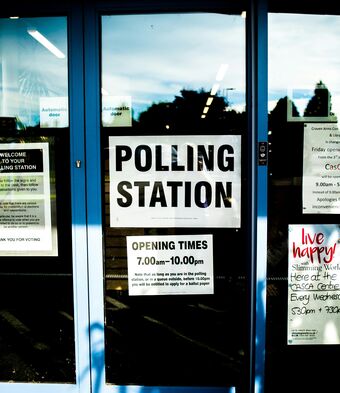

The manifestos are published, the battles line drawn. We sit through TV debates, radio phone-ins, and newspaper pieces. Many of us probably feel like we’ve heard enough.
You might know where you stand; the direction of your vote may have been set before an election is even announced.
But for others of us, we are no closer to truly knowing who to vote for. Maybe you feel little genuine enthusiasm for any particular party. These days, many people seem to be clearer on what they are against, rather than what they are for.
Amid such an atmosphere of doom and gloom, how can we actually work out who to vote for?
What is a vote actually for?
This isn’t actually a simple question. For do we vote based on who we want to win (ie. outcome?). Or do we vote based on having our voice heard (ie. values?).
Sometimes, the two may align, but they may not, if you most naturally align with one of the less popular parties, or if you live in a ‘safe seat’ for a different party.
We know that as Christians, on one level, we are not to go against our conscience. Paul writes in Romans 14:14 (talking about holy days and food laws, although the principle would apply elsewhere to): “If anyone regards something as unclean, then for that person it is unclean.” In short, if there is a candidate you could actually not vote for in good conscience, then don’t vote for them…
And yet, on another level, it is unlikely that any party (or candidate) fully maps onto what we believe. This is probably as it should be for Christians. Every party, every candidate, every political philosophy is subject to fallenness and brokenness, just as we are. None will ever fully reflect Christ.
Christopher Watkin, who a couple of years ago published the book, ‘The Bible and Critical Theory’, writes:
“Christians can all too easily accept these dichotomous choices and begin rummaging through our Bibles to find out whether A or B is the more Christian position, when in truth neither option captures the nuance and complexity of the biblical witness. In many cases it would be much better to say “I wouldn’t start from here”, and let the Bible reconstruct the categories of the debate in a way that cuts across comfortable cultural dichotomies.”
But of course, in an election time, we are subject to such dichotomous choices: do we vote for this party, or for that one? And so, recognising our fallen realities, we might feel that we can achieve the best outcome for the country by voting tactically, supporting the best candidate in the location we are in who has a chance of winning, regardless of whether they do not perfectly align with our views. You can read more about this here…
Convictions
Theologians have sometimes sought to pithily summarise the purpose of government (as ordained by God) in this way: government is both to promote what is good and to restrain what is evil.
1 Peter 2:13-14 says, “Be subject for the Lord's sake to every human institution,[a] whether it be to the emperor as supreme, or to governors as sent by him to punish those who do evil and to praise those who do good.”
Of course, in our desire to promote good and restrain evil, it is vital to know what the options on offer are.
Each election time, CARE creates a wide range of tools to assist you in that process, from the interactive quiz (based around policies), to manifesto analysis and topic primers. It is worth sampling each of those, to work out exactly what the offering is at the latest election, rather than just assuming that particular party will be the same as it always has been. There might just be some surprises!
Because parties do not just stay as static entities; to give just one example, in 2024, Keir Starmer famously made much of the fact that the Labour Party was not what it was five years ago under Jeremy Corbyn, when it was accused of being anti-semitic, and was far more left-leaning in its policy offering.
It is worth investigating what parties are truly promising on the issues you care about. What is the Conservative position on the environment? What are Labour now saying about gender? Or the Greens on immigration?
When working out who to vote for, we have to think about what our potential representatives are promising they will do in office.
But looking at policies is not the only thing we need to bear in mind before we cast our votes. What about character? And competence?
Character
Some people question today whether the character of our leaders truly matters. Gone are the days of politicians resigning over having an affair: Matt Hancock was brought down for not following the Covid rules, rather than for kissing someone who was not his wife, and deflected any questions around his conduct with the answer, “I fell in love”.
Indeed, complicated family arrangements have now become commonplace. Both Boris Johnson and Liz Truss are publicly known to have had affairs; but rather than this being a source of concern, it was merely written off as being part of their private lives.
But as Christians, we believe that there is a correlation between faithfulness in the small things, and faithfulness in the big things; this is a principle which God himself works off. In the parable of the Talents, he tells those who steward their resources wisely: “Well done, good and faithful servant! You have been faithful with a few things; I will put you in charge of many things” (Matthew 25:21).
And, sadly, in recent years this has been brought to the forefront of political discourse once again.
The Boris Johnson who didn’t think the rules applied to him around lying to his employer while a journalist, or to his marriage, was the same Boris Johnson who didn’t think the rules applied to him during the pandemic. Ultimately it was not really a surprise to see his premiership come crashing down around him.
Of course there are far more aspects to our character than our sexuality! But as you come to elect your local representative, it is worth trying to get a feel for the person you are electing. Have they lived a life in public service, or do they seem more interested in themselves? Does their character reflect something of Jesus?
Competence
On one level, manifestos are easy; it’s great to be able to promise all kinds of lovely popular policies. But then you need to be able to fulfill them. Part of the reason why the Conservatives struggled so much in 2024 is that people felt that they hadn’t kept to the commitments on which they were elected.
In one of the TV debates, Nigel Farage powerfully looked to harness the frustration with the some of those on the right feel towards them: ‘Given that your 2010 manifesto, your 2015 manifesto and your 2017 manifesto said you would reduce net migration to tens of thousands, and your 2019 manifesto said immigration would massively reduce, and that net 4.3 million people have come into the country since that time, why on earth should anybody believe the fifth manifesto which promises cuts to net migration?’
But of course, it is unlikely that some parties (such as the Lib Dems or the Greens) would have to actually implement the policies they propose in their manifesto. This means that they are able to get away with producing a wide range of popular-sounding plans which they would be very unlikely to have to ever enact.
As Christians, we believe that the promises we make matter, and that we ought to fulfill them, because we worship a God who always keeps his promises. Indeed, Jesus tells us, “Let your yes be yes, and your no be no” (Matthew 5:37).
But in addition to wanting parties to fulfill their pledges, we also want to elect as our representatives leaders who are capable and talented; leaders who will not simply have the values we believe in, but be able to translate them into action. This again, surely, is part of what it means to promote good and to restrain evil.
In the Royal Psalms of the Old Testament, in which the people of Israel prayed for their King, the people did not detach values from actions. Instead they prayed that their leaders would be able to enact good outcomes:
“Endow the king with your justice, O God, the royal son with your righteousness. May he judge your people in righteousness, your afflicted ones with justice…May all kings bow down to him and all nations serve him. For he will deliver the needy who cry out, the afflicted who have no one to help. He will take pity on the weak and the needy and save the needy from death. He will rescue them from oppression and violence, for precious is their blood in his sight.” (Psalm 72: 1-2, 11-14)
So who can we vote for?
After all that, you might be thinking you have no chance of ever being able to vote for anybody!
The theologian Tom Wright comments:
“When we vote for somebody, we are not saying we agree with them about everything and support them in everything they want to do. We’re simply saying: at this moment in our country’s history, we need the kind of leadership that broadly this person or party might produce…
A binary vote is a very blunt instrument. And the chances of finding one candidate who you absolutely agree with and another who you absolutely don’t, is fairly minimal…We have tended to think we are voting for the least worst! And once you say you’re voting for the least worst, then I think there’s a kind of sigh of relief – I do not have to scrutinise every bit of this person’s voting record, I simply have to assess what the options are and what will be best for the world and for my country, in the current state of affairs.”
Ultimately, by casting a vote we are not saying that we agree with everything a candidate stands for, or that they will always get everything right. Instead, we are saying that we believe that electing them is going to do more good - and perhaps, to see God’s Kingdom grow in some way - more than any of the alternatives would do.
That is the question that we have to consider at election-time, as we seek peace and prosperity for our nation and all the people in it.