
Immigration is one of those rare issues where most of the main political parties agree that something needs to be fixed. The current Labour Government declare that they are “fixing an immigration system that hasn’t worked for years”, the Conservatives say that the UK “faces a border crisis”, Reform state that illegal immigration “is out of control”, and even the Liberal Democrats acknowledge that “our immigration system has been broken”. In polling, the general public also consistently place immigration as one of the most important issues for the country today.
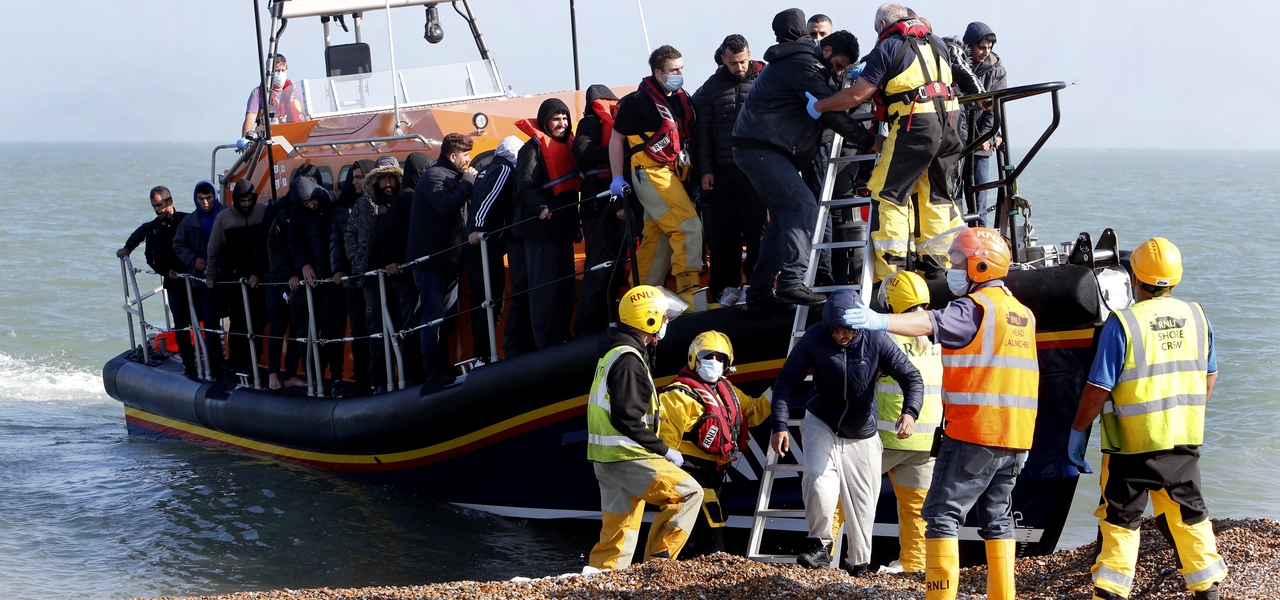
Over recent decades, migration - both legal and illegal - has changed Britain’s demographic with a rise in people from ethnic minority backgrounds and from other religions, such as Islam. As such, immigration has become the most prominent issue surrounding debates about Christian nationalism. Protests at UK ports by the group Patriot Platform over illegal immigration and small boat crossings have co-opted Christian images and language to their cause.
The state of immigration in the UK
There are two main ways to enter the United Kingdom: through legal immigration or through illegal or unauthorised entry. Legal routes include limited-time work or study visas, skilled worker resettlement, re-joining a family member who has settled in the UK, or through a few limited refugee routes.
Net migration measures the difference between those entering the country and those leaving the UK to live or work elsewhere. In 2025, 813,000 people entered the UK legally, and 642,000 left, giving a net migration figure of 171,000. Since the 1990s, legal immigration has exceeded emigration, with a record high net migration of 944,000 in the year to March 2023. At least one in 30 people in the UK arrived between the 2021 and 2024 General Elections.
Illegal immigration can occur in a number of different ways: overstaying a limited-time visa for work or study, being born in the UK to illegal immigrants, remaining in the UK after a failed application for asylum, or entering the country without authority, such as via a small boat across the English Channel.
It is difficult to be accurate about the statistics around illegal immigration due to the way the numbers are counted. It is estimated that there are somewhere between 700,000 and 900,000 illegal immigrants currently in the country. Up to 46,000 enter the country illegally each year, the majority via small boats. Statistics concerning those overstaying visas were halted in 2020 and have not resumed, but the last figures show around 63,000 people a year stay beyond the time limit of their visa.
Successive governments have tried different schemes to remove those who are in the country illegally, from the plan to relocate them to Rwanda to the ‘one in, one out’ system agreed with the French government. In 2025, around 40,000 people were returned or removed from the country in this way.
The Home Secretary, Shabana Mahmood, summed up the situation in March 2026, saying: “In just 4 years, this country experienced levels of migration it had previously seen across 4 decades. It was not just the scale, but also the nature of that change that was so destabilising.”
With this level of immigration in the UK today, how are we to think about the subject as Christians?
The good of immigration
Although much of the media attention has been about the dangers of illegal immigration, there is much good that comes from receiving migrants into the country.
The arrival of those from other nations brings a rich mix of cultures which can enhance British society. Music, art, cuisine, and more have benefitted from the input of those who came here from overseas. The ‘British national dish’ of chicken tikka masala (as identified by Foreign Secretary Robin Cook in 2001) is a British take on South Asian food.
The UK also relies a great deal on legal immigration for a proportion of its workforce, especially in areas such as healthcare. Non-British nationals comprise a quarter of all health and care jobs in the UK, and figures from the NHS show that 22% of staff in England report a non-British nationality. Over a third of all NHS doctors in England come from outside of the UK.
Immigration benefits the economy through the workforce and through the taxes that they pay. The Institute for Fiscal Studies has warned that falling immigration levels will mean a fall in tax revenue of around £4 billion. Immigrants also pay a surcharge for their use of the NHS which raises around £2.5 billion, according to the Nuffield Trust. In fact, statistics show that immigrants are usually healthier than the average Briton, paying in 60% more to the NHS than they take out.
We see the benefits of immigration to the workforce reflected in the Bible. King David employed an immigrant workforce in preparing for the building of the temple, which would be completed by his son Solomon. This wasn’t just brute force labour but skilled craftspeople:
David gave orders to assemble the foreigners residing in Israel, and from among them he appointed stonecutters to prepare dressed stone for building the house of God.
Despite the doom-laden headlines surrounding immigration, there is much good that can come from receiving those from overseas into the country.
The dangers of immigration
It is important to acknowledge that there are difficulties and dangers surrounding immigration. While far-right voices are too often aggressive and confrontational, they do vocalise genuine concerns about the state of immigration in this country.
While immigrants can have a positive benefit to society, they can also put strain on an already-burdened welfare system. A backlog of asylum applications can lead to an increasing number of migrants needing to be housed and cared for. While most immigrants are law-abiding, those who have broken the law have raised fears amongst communities that house asylum seekers. Statistics suggest that migrants are responsible for one in seven sexual offences (according to data from 2024) with Afghan nationals seven times more likely to be convicted of a sexual crime than a Briton. The UK Home Office has issued booklets to new asylum seekers to inform them that rape, sexual harassment, and domestic abuse, are illegal in Britain.
Even legal migration can generate worries about the availability of jobs in certain sectors. Research by the Centre for Social Justice (CSJ) has found that four out of five new jobs created since 2014 were taken by migrants. Out of 3.4 million jobs created in that time, only 734,000 were taken by British nationals, while during the same period the number of British people on out-of-work benefits rose by 2.3 million. The increase in jobs taken by migrants has mainly focused on areas such as social care, hospitality, and retail. The CSJ also found that 27 non-EU migrants under the age of 25 were added to UK payrolls for every one young British worker added between 2020 and 2025. The number of young migrants entering employment in the UK increased by 290,000 during that time, while the number of young people not in work or training increased by almost 200,000.
One of the biggest dangers when it comes to immigration is a lack of integration. Where different cultures meet it can be enormously beneficial and enhance a country’s own culture. But when migrant communities stay in their own spaces without integrating into the wider community it can lead to fear, mistrust, and ghettoisation.
The rhetoric of immigration
We must hold the good of immigration and its dangers in tension. However much of the rhetoric around immigration overemphasises the dangers without recognising the good. This can lead to scapegoating, where migrants and those from other cultures are blamed for all of society’s ills.
Christians ought to avoid some of the language that is used to dehumanise immigrants and refugees. ‘Invasion’, ‘wave’, ‘epidemic’ and ‘swarm’ have all been used to describe people arriving into Britain. Whether intentional or not, this language reduces human beings to insects and viruses. Words have power, and as Christians we should care about the way we talk about people who are made in God’s image.
Negative rhetoric about immigration can fuel the rise of populism and far-right ideologies via the ‘doom loop’. This is where tightened immigration rules lead to economic issues that then lead to cuts to public services. At the same time, lack of legal immigration routes means an increase in illegal migration. This plays into the populist idea that conditions are worse because of immigrants, leading to even tighter immigration rules, and the loop continues. As Minnie Rahman, CEO of UK migrant rights charity Praxis, explains:
“We rely on migration for the economy and several industries, decrease that and the economy is worse. A worsening economy means worse conditions. Unhappy public looks for someone to blame. Politicians tell them it's migrants. And so we end up in a never ending loop while everything gets worse.”
The prevailing narrative around immigration is a narrative of fear: fear of the unknown, or of the country being overrun. Fear of immigration (and by implication, of immigrants) is real for some. But fear is never a good rationale for public policy, and Christians should resist the narrative of fear around immigration. As theologian Barnabas Aspray puts it:
[F]ear has never been a motivator of wise, just, and righteous action. Fear draws our attention away from the poor and needy towards our own plight. Fear makes us strike back with a self-protective instinct. When we are afraid, we feel justified in putting our own needs and priorities first. Violent behaviour is labelled “self-defence,” cutting aid budgets is labelled prudence, and refusing admission to refugees who have lost everything and are fleeing persecution is seen as the only sane course of action in a world of finite resources. Fear drives us to seek our own advantage, something Jesus never did.
When fear imagines a danger that is not present, and when we start to see anyone different to ourselves as a threat, we ought to be concerned. The theologian Thomas Aquinas wrote in the thirteenth century about those “who are in great fear, for they are so intent on their own passion, that they pay no attention to the suffering of others.” If we are not careful, concern turns into fear, and fear stops us from showing compassion to those who need it.
Biblical imperatives for immigration
Each one of us probably has a ‘gut feeling’ about immigration, which will be shaped by a number of factors: our background, our family, our experiences, and the media we consume. But what role does the Bible play in shaping our understanding and attitude toward immigration? Research in the United States found that 90% of evangelical Christians said that Scripture had no impact on their views of immigration. Would we say the same?
It has been said that the Bible is a story of immigrants. From Abraham leaving his land in obedience to God, to Joseph in Egypt, Daniel in Babylon, and Esther in Persia, migrants of various kinds pepper the pages of Scripture. While the Bible does not give a detailed plan for immigration policy in a twenty-first century nation, it does give us key principles to govern our approach to immigration.
Obey
The first immigration imperative is to obey. The Bible is very clear that Christians have a duty to obey civil authorities. “Let everyone be subject to the governing authorities, for there is no authority except that which God has established” (Romans 13:1); “Submit yourselves for the Lord’s sake to every human authority” (1 Peter 2:13).
While resisting human authority is sometimes necessary, unless it directly contracts scripture Christians should obey the laws of the land and encourage others to do the same. “Whoever rebels against the authority,” says the apostle Paul, “is rebelling against what God has instituted” (Romans 13:2).
This means we should encourage legal routes for immigration while enforcing a border that prevents illegal entry into the country. Nations mean borders and it is not wrong or unloving to be clear about how you can, and cannot, come into the UK and to enforce those laws.
As Christians we may want to advocate for specific changes to legal migration. At present, someone can only claim asylum in the UK once they are in this country. For many people fleeing conflict or persecution this means that the only way to seek asylum is to enter Britain illegally. If we are to balance compassion with maintaining our borders, then we might need to establish more valid routes for people to apply for asylum. This would help to stop the need for risky and illegal ways of entry, and reduce the market for people-smuggling that enables it.
Love
The second immigration imperative is to love. As God says through Moses:
The foreigner residing among you must be treated as your native-born. Love them as yourself
Underlying the Israelite – and Christian – attitude to immigration is the affirmation that every person is made in the image of God. What unites all of these people who come to our shores is that they are people – human beings made in the image of God and loved by our Creator. This does not mean we have to advocate for open borders or relaxed immigration policies. But it does mean we should love them and treat them well.
The call to love the foreigner reflects the character of God, who himself loves those who are strangers: “He defends the cause of the fatherless and the widow, and loves the foreigner residing among you, giving them food and clothing” (Deuteronomy 10:18). Not only that, but Israel were to love immigrants because they had been immigrants (indeed slaves) in a foreign land: “And you are to love those who are foreigners, for you yourselves were foreigners in Egypt” (Deuteronomy 10:19).
While God’s people are no longer defined by a geographical nation, we are still to show kindness to those who are strangers. The book of Hebrews reminds Christians to “not forget to show hospitality to strangers, for by so doing some people have shown hospitality to angels without knowing it.” (Hebrews 13:2)
We should also care about what happens to those who are unable to stay in the UK. God tells Moses, “When a foreigner resides among you in your land, do not mistreat them” (Leviticus 19:33). It is right to be concerned about the way people are treated, and what happens to them next, even if their route here was illegal. Detention centres and mass deportation might be one way to tackle immigration, but only if people are treated with dignity and respect. As theologian Russell Moore writes:
The Bible does not give a comprehensive public policy for migration or asylum. Christians of good faith can disagree on those things. But the Bible does give a comprehensive view on what we are to think of human beings, including migrants. The church has a mission to shape consciences around how we minister to scared and vulnerable people, regardless of whether we think they should have stayed somewhere else.
Differentiate
The third immigration imperative is to differentiate. The Bible instructs us to love the foreigner among us, but it also affirms that there are limits to immigration: it does not support completely open borders.
The Bible makes a distinction between different types of migrants. The Hebrew word ‘nekar’ is used to denote someone from another country who is a temporary resident within Israel, perhaps for trade. The word ‘ger’ however is used for someone who is settled in the land and living under God’s law. This second category come under the same rules and worship instructions as the people of Israel:
The community is to have the same rules for you and for the foreigner residing among you; this is a lasting ordinance for the generations to come. You and the foreigner shall be the same before the LORD
While immigrants who settled in Israel were welcomed into the worshipping life of God’s people, there were things in which they could not participate. The Passover, as a key celebration for God’s people, was reserved for those who were Israelites. “No foreigner may eat it” we are told in Exodus 12:43. That celebration was only open to those who were born into God’s people, or those who have their family circumcised – a much greater degree of integration than imagined for most foreigners in the land!
Similarly, in the New Testament, the call to show material help and support also has its limits. Paul tells Timothy: “Give proper recognition to those widows who are really in need” (1 Timothy 5:3). The widows who have other means of support, like family, are to get their help from them; the church should prioritise those who have no other means of living.
Widows are not the same as immigrants, but the principle is useful to compare. Those in genuine need, who are vulnerable and likely to face harm, should be protected. Those who have other means of getting the help they need should draw on that, whether that is through family (in the case of widows) or through home countries, or other nations (in the case of immigrants).
Integrate
The final immigration imperative is to integrate. Concerns and worries about immigration are not completely unfounded, and we are to minimise the dangers that come with uncontrolled or poorly thought-through immigration policies. The way to do that is to help those who come to the UK to integrate and become part of the culture.
Immigration can be good if its aim is integration into the country where they have chosen to reside. As we have already noted, large-scale immigration can lead to isolation of some migrant communities, or even de facto parallel societies forming. A cohesive national identity can be at risk, along with increased pressure on public services, infrastructure, and housing. Integration, however, doesn’t erase cultural differences, but brings everyone together under shared values and norms. It is then that we see the good and positive benefits of immigration to society.
From a Biblical perspective, we see this clearly in the case of Ruth. Born as a citizen of Moab, Ruth marries an emigrant from Israel. After his death, she joins her mother-in-law Naomi as she returns to God’s people. She says to Naomi, “Your people will be my people and your God my God” (Ruth 1:16). Her integration into Israelite society eventually ends in her becoming the great-grandmother of King David, and in the family line of Jesus.
Lack of integration is a genuine concern, but we must be careful that it does not result in ‘Islamophobia’ or anti-immigrant sentiments. We can guard against the isolation of immigrant communities without feeling threatened by them. The church is not ‘under attack’ by an increase in Muslim migrants; rather, this is an opportunity to reach out with the gospel to those from other faiths and nations.
Conclusion
Protecting borders and limiting immigration is not unloving. Just as the New Testament church had to prioritise where they used their resources, so it is right for countries to consider their capacity for immigration. Resources and economics play their part in discerning how many immigrants can be taken in, and how many refugees. We balance the Biblical desires to obey, love, differentiate and guard.
As Christians we are “foreigners and exiles” in the world (1 Peter 2:11). We are “longing for a better country—a heavenly one” (Hebrews 11:16). We know what it is like to be exiled immigrants away from home. When it comes to government policies, we need to recognise that borders are necessary, but not final. As citizens of heaven, we look forward to the day when Jesus returns and we gather around the throne as people from every nation.