
“And did those feet in ancient time,
Walk upon England’s mountains green:
And was the holy Lamb of God,
On England’s pleasant pastures seen!
And did the Countenance Divine,
Shine forth upon our clouded hills?
And was Jerusalem builded here,
Among these dark Satanic Mills?”
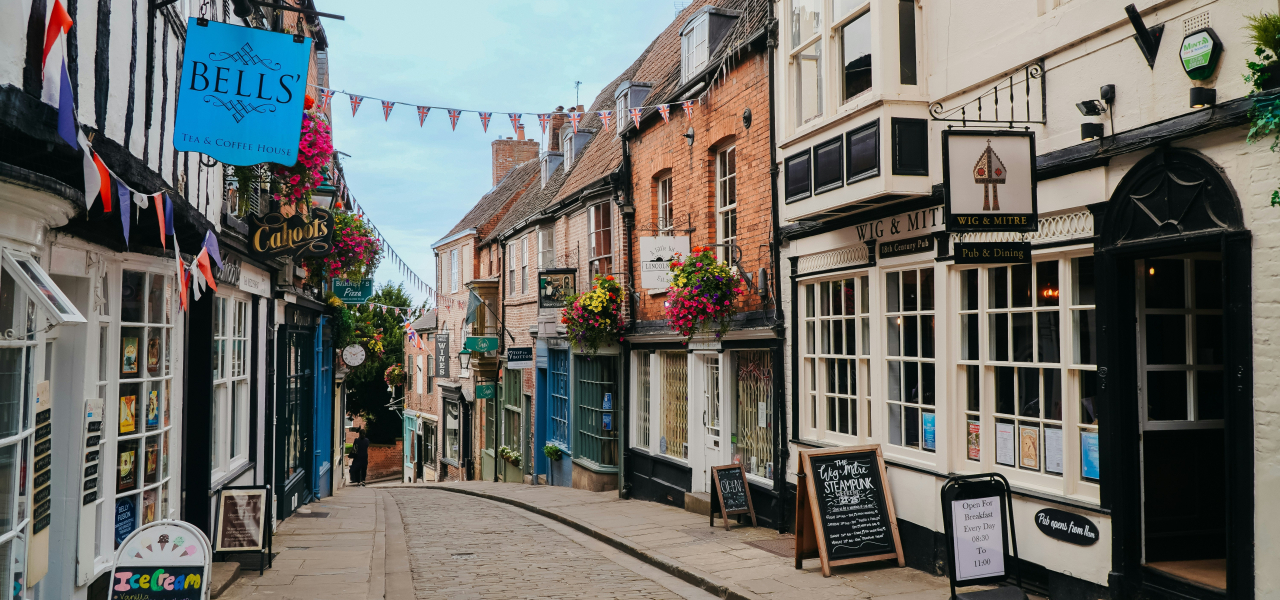
William Blake’s verses, better known today as the hymn ‘Jerusalem’, were written in 1804, in the wake of the Industrial Revolution. They express a longing for a time gone by, when England had a ‘green and pleasant land’. Instead, as the flour mills and cotton mills began to rise up, putting labourers out of work and scarring the landscape, contemporary illustrations depicted the devil squatting on Albion Flour Mills in Southwark, just a few miles from Blake’s own home.
Our world is changing fast. Whereas both Blake lamented the ongoing impact of the Industrial Revolution, we are living through the Technological Revolution, which is already having an impact upon community, work and various other parts of what it means to be human.
Within our current political debate, nostalgia is far broader than just lamenting the state of Britain’s disappearing landscapes. In the space of a couple of generations, Britain’s place in the world, and its own self-understanding, have changed immeasurably. Whereas our parents or grandparents grew up in the final days of Empire, today Britain is a much smaller player, not only surpassed in influence by the traditional superpowers of the USA and Russia, but emerging nations like China and India, and blocs like the EU.
At home, immigration and multiculturalism have altered Britain’s national character, for good or ill, bringing foreign debates (such as around Gaza) into mainstream British politics. Key milestones in life - such as buying a first house - have become almost impossible for young people today without financial support from parents or grandparents. Questions are raised about the decline in traditional family values, the decline in education standards, and crime and antisocial behaviour.
British institutions seem to be in decline, outfought by international competitors or destroyed from within by the postmodernists. Even James Bond has ended up dead.
Amid all of it is the pervading sense that Britain is broken. Politicians talk about the death of Britain’s ‘social contract’: the idea that if you work hard, pay your taxes, obey the law and submit to the government, then the government will give you something worth having in return, like well-run healthcare, affordable housing, a functioning justice system and freedom of expression. Others note the increasing fragmentation and division within society, particularly along generational and racial lines.
Of course this is not just exclusive to Britain. The slogan to power the Trump revolution (which itself has had an impact on politics across the globe) leant into the past: Make America Great Again. In essence, there was a time when America was better, that time is not now, and we need to return to the past to restore her to her former glory.
In 2025, Ipsos released a new report, entitled, ‘Is Life Getting Better?’. 30 major countries were surveyed: Britain was one of the most nostalgic, behind only France, Belgium and Mexico. 52% of Brits revealed that they would rather have been born in 1975 than 2025, compared to just 24% who said today, even though many of the respondents weren’t born then. 63% said that they thought Britain was a happier place in 1975, with just 12% believing the mood was better now.
Humans exist in time. The impulse to look backwards - or forwards - is also part of who we are. We remember how things once were, and we make plans for how they should be in the days to come. Britain is hardly the first society to hark back to a golden age and lament what it has lost. Over two thousand years ago, the great orator Cicero despaired, ‘O tempora, o mores’ (‘O the times, o the customs’) as a cry against the moral degradation of the Roman society in which he lived.
Today, politicians across the political spectrum (not just on the right), hark back to better days. In his first conference speech after becoming Prime Minister, Andy Burnham took aim at the neoliberal consensus of the previous forty years: “We made working-class aspiration feel real for families like mine. We built the common good. Or at least we did until the 1980s. Suddenly, the common wealth we had created, this party, the wealth we had created for the many was seen as an opportunity for the few.”
On the other side of the debate, Nigel Farage has regularly invoked the language of Britain being ‘broken’. At the ARC Conference in 2026, he spoke wistfully of his childhood: “I grew up in a village of the North Downs with just under 1,000 people. Everyone knew everyone. And if the milk wasn’t taken in from an elderly next-door neighbor, mum would go and knock on the door. People looked out for each other. And the church and the shop and the pub — this is where everybody met, and you know what, I look back on that, it was a great way to live.”
But if Britain is broken, then once, surely, it must have been whole…?
Rose-tinted spectacles
‘It’s not as good as I remember’. We have this sensation all the time, whether it’s rewatching plays or films, eating at a favourite restaurant, or returning to a holiday destination. Human memory is unreliable: we form narratives in our head, and it is easy for our perceptions to become unfairly skewed (positively or otherwise). Maybe the past wasn’t so good after all…
We see this pattern in the Bible too, for it is a normal part of human experience. When Pharaoh pursues the Israelites to the Red Sea, upon seeing him, they are aghast, and complain to Moses: “Was it because there were no graves in Egypt that you brought us to the desert to die? What have you done to us by bringing us out of Egypt? Didn’t we say to you in Egypt, ‘Leave us alone; let us serve the Egyptians’? It would have been better for us to serve the Egyptians than to die in the desert!” In essence, we were better where we were…
The Exodus story shows the way in which our minds so often work: of course the Israelites are better where they are, having previously been oppressed and enslaved by Pharaoh for generations, their children thrown into the Nile. But we so often view the past through rose-tinted spectacles, focusing on the immediate problems of the present, rather than taking a fully rounded view.
It is undoubtedly true that some things will have been better in the past. Young people today grow up without the opportunities which were open to the ‘Baby Boomer’ generation: unemployment is high, cost-of-living is up, housing is unaffordable. But just as there is a danger of subscribing to the ‘myth of progress’, there is a similar pitfall in looking back to the past. The ‘myth of the past’ sweeps humanity’s sins under the carpet, rather than doing the complex business of separating the good from the bad.
The French novelist Marcel Proust wrote: “Remembrance of things past is not necessarily the remembrance of things as they were.” There are areas which people might assume are worse today, where the data does not back it up. Although we rightly lament anti-social behaviour and crime, the stats suggest that we live in a more law-abiding society today. Police-recorded crime rose sharply in the 1970s and 1980s, peaking in the mid 1990s. Theft is 77% lower in 2026 than it was in 1995. Homicide rates have also declined. Interestingly, in the Ipsos survey, around three times as many believed that Britain was a safer place to live fifty years ago, and was a better time for living without fear of conflict, even though 1975 was during the Cold War.
The present is often not as bad as we think it is. And the past is not as good either. Life may have been simpler in some ways: but you cannot just take the good without the bad. For all that people said that they would prefer to live in 1975, it was the 1970s when the British economy tanked, companies were forced to do three-day weeks, government was held to ransom by the unions and the UK was called the ‘sick man of Europe’. Since then, healthcare has become safer, technology more advanced, the world more connected. Where previously you might have had to go to the library to take out a book to look something up, now you can find information out within seconds on your smartphone.
In a fallen world, there is no perfect era, just as there is no perfect culture, for each one is affected by brokenness and sin. The theologian Christopher Watkin warns about the dangers of simply saying that one option or another is better: “Christians can all too easily accept these dichotomous choices and begin rummaging through our Bibles to find out whether A or B is the more Christian position, when in truth neither option captures the nuance and complexity of the biblical witness. In many cases it would be much better to say “I wouldn’t start from here”, and let the Bible reconstruct the categories of the debate in a way that cuts across comfortable cultural dichotomies.”
We may well think, if we were building an ideal society, “I wouldn’t start from here”...
The glory days?
But just because there is no perfect era, that does not mean that all eras are equal. Christians are not relativists; yes, we believe that every age, every culture, and every human is fallen, but that does not mean that they are equally so.
Nostalgia is not always misplaced, for the danger of progressivism is to assume that all change is automatically for the better, particularly when it accords with the spirit of the age. In the run-up to the assisted suicide vote, the Labour MP Jess Phillips said, in support of the Bill, “The NHS is not in a fit enough state…but you cannot stop progress happening.” On this view, the latest cause always takes us forward, rather than back, humanity is always getting better, and we are superior to previous generations and walking towards some suffering-free utopia. The irony, of course, is that assisted suicide would have taken us back further still, to a pre-Christian era of ‘survival of the fittest’.
CS Lewis was a vocal critic of ‘chronological snobbery’, which he defined as “the uncritical acceptance of the intellectual climate common to our own age and the assumption that whatever has gone out of date is on that account discredited.” He goes on to explain what is wrong with this approach: “You must find out why it went out of date. Was it ever refuted (and if so by whom, where, and how conclusively) or did it merely die away as fashions do? If the latter, this tells us nothing about its truth or falsehood. From seeing this, one passes to the realization that our own age is also ‘a period,’ and certainly has, like all periods, its own characteristic illusions. They are likeliest to lurk in those widespread assumptions which are so ingrained in the age that no one dares to attack or feels it necessary to defend them.”
Some things were genuinely better before. In Ezra, we read about the rebuilding of the temple in Jerusalem, which had been destroyed by Babylon, and the differing reactions of the people, depending on what they remembered of the past: “But many of the older priests and Levites and family heads, who had seen the former temple, wept aloud when they saw the foundation of this temple being laid, while many others shouted for joy. No one could distinguish the sound of the shouts of joy from the sound of weeping, because the people made so much noise.” This is not a misplaced nostalgia; God confirms the impression of the older priests in his words to Haggai: “Who of you is left who saw this house in its former glory? How does it look to you now? Does it not seem to you like nothing?”
It is not wrong to lament the evils of this present age; we can be angry about the tragic societal experiment of prescribing untested drugs to teenagers grappling with gender dysphoria, or the 10 million abortions since the abortion act. It is not wrong to wish that things like the Sexual Revolution had never occurred, as even some feminists have begun to do, for the damage they have done to marriages, women and children. And it is not wrong to look back to a time when our society recognised the value of the three transcendents, the good, the true and the beautiful, amid the chaos of a postmodern world, which does not just impact politics, but everything from art to architecture.
Of course at times, we are actually able to accurately quantify the past against the present, through the use of statistics. Britain’s economic growth has slowed substantially in recent decades: from an average GDP growth of 2.5% per person in the 1970s to 1.1% in the 2000s and just 0.3% so far in the 2020s. Or consider the NHS waiting lists: the target is for 92% of people to be seen within 18 weeks, and yet as of 2026, the figure is just 65%. Immigration levels have soared (whereas fifty years ago, Britain actually had net emigration, in 2023, our immigration was 891,000). Other things do not pass the eye-test: the decline in Britain’s high-streets (put out of business by online shopping), post-offices, banks, and libraries leave a gap communities have struggled to fill.
But one of the issues with nostalgia is that it confuses the ‘glory days’ with the perfect days, when even the best memories are merely signposts to a deeper reality. Madeleine L’Engle once wrote, “We are all strangers in a strange land, longing for home, but not quite knowing what or where home is. We glimpse it sometimes in our dreams, or as we turn a corner, and suddenly there is a strange, sweet familiarity that vanishes almost as soon as it comes.” The past is not the home we long for either; for it too was fallen and broken…
The true golden age
So if the world is constantly changing, for better or worse, how shall we live? There are some things which we cannot change, and with Paul, we want to learn “the secret of being content in and every situation” (Philippians 4:12). And it is right for Christians to seek to chart a course between the extremes of progressivism and nostalgism, rather than uncritically affirming either.
But as Christians, we are called to a godly frustration: frustration not for ourselves, but frustration that things are not as they should be, as “creation groans for the children of God to be revealed” (Romans 8:19). This is our third option: not harking back to the politics of the past, nor trying to institute some progressive human utopia - for the history books are littered with long-forgotten progressive ideas - but looking ahead to the true fulfilment of history: the day when the King returns, and brings about the true age of peace and prosperity, when all tears are wiped away and all wrongs righted.
This is what Jesus himself did, as he announced the good news of the Kingdom breaking in. He overturned the tables of injustice, cast out the demons and raged against death and decay. Blind eyes were opened, the lame could walk, and the marginalised welcomed in. What was wrong and sad and broken in this world was undone, in a beautiful foretaste of the day when things are put right for good. And he sent his disciples out to do what he had done: “Freely you have received; freely give.” As Christians, we are called to continue in that vein today, going out into the world and being vehicles for God’s kingdom to come, here on earth, as it is in heaven.
For one day He will come again. When Jesus rose from the dead, three days after his death on the cross, he destroyed the power of death forever, and ushered in a new world: he is the “firstfruits” of “new creation”. And as Paul teaches in 1 Corinthians 15, somehow, mysteriously, God is building that new world through our work now: “Always give yourselves fully to the work of the Lord, because you know that your labor in the Lord is not in vain.”
The theologian Tom Wright explains: “The point of the resurrection…is that the present bodily life is not valueless just because it will die…What you do with your body in the present matters because God has a great future in store for it…What you do in the present—by painting, preaching, singing, sewing, praying, teaching, building hospitals, digging wells, campaigning for justice, writing poems, caring for the needy, loving your neighbor as yourself—will last into God's future. These activities are not simply ways of making the present life a little less beastly, a little more bearable, until the day when we leave it behind altogether (as the hymn so mistakenly puts it…). They are part of what we may call building for God's kingdom.”
Anthony Ashley-Cooper, the 7th Earl of Shaftesbury, became known as the ‘Poor Man’s Earl’, having worked tirelessly to improve conditions for the poorest in society. He repeatedly introduced legislation to stop boys working as chimney-sweeps. He worked to improve the appalling conditions in lunatic asylums. And he acted as president of the Ragged School Union, which sought to give poor children a strong education and give them the best chance of escaping poverty. He summarised his motivations: “I do not think in the last forty years I have lived one conscious hour that was not influenced by the thought of our Lord’s return.”
CS Lewis once wrote: “If you read history you will find that the Christians who did most for the present world were precisely those who thought most of the next. It is since Christians have largely ceased to think of the other world that they have become so ineffective in this.”
Progressive activists sometimes speak about being on the right side of history. Conservatives sometimes look back to a golden age.
But Christians know that the true golden age is yet to come; and that it motivates us to live in the present, and bring a glimpse of that gospel-hope into the here and now.