Artemis: Why moon missions matter in a broken world

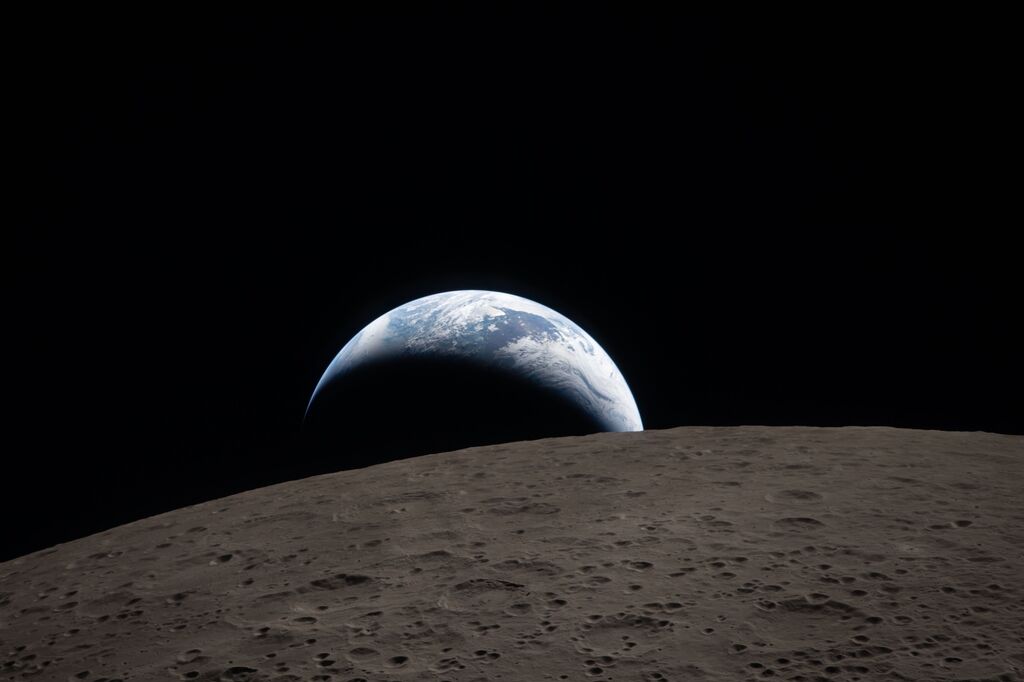
For the past nine days something momentous has been happening in space exploration: humans have returned to the moon for the first time in fifty years. NASA’s Artemis II mission has performed a lunar flyby, without landing on the moon’s surface, and is due to return to earth in the early hours of Saturday morning UK time.
Artemis II is the second mission of NASA’s Artemis program, and the first one to be manned (Artemis I was an unmanned moon mission that launched in 2022). Its objective is to establish an ongoing presence on the lunar surface, and human beings will land again on the moon as part of Artemis IV slated for early 2028.
Despite not landing on the moon’s surface, Artemis II has been a groundbreaking mission. The crew of four – Reid Wiseman, Victor Glover, Christina Koch, and Jeremy Hansen – set a new record for human spaceflight and became the furthest humans from Earth at a distance of 252,756 miles.
I have been one of the many across the world who have been fascinated by news of the mission. I stayed up late to watch the launch which was impressive to say the least (and even more impressive on the ground as the BBC’s science editor demonstrated in her report). I have been following the crew as they have left Earth’s orbit and passed around to the far side of the moon. I may not stay up until 1.00am when the crew are expected to splashdown in the Pacific Ocean, but I will certainly be reading about it tomorrow!
Despite the historic nature of Artemis II, it is possible that much of it has passed many of us by (quite literally!). It comes amid a conflict in the Middle East, and rising concerns about costs here at home. Is a moon mission really something to be excited about with the world as it is? How should we feel about an event like Artemis II as followers of Jesus Christ?
Great is Artemis?
The NASA mission is named for the ancient Greek goddess of the moon (along with hunting, nature, and childbirth). In the Bible, the name Artemis doesn’t have a very good reputation. We encounter Artemis in Scripture as the apostle Paul visits Ephesus. Artemis of the Ephesians seemed to be a slightly different goddess than the ancient Greek deity and the temple of Artemis in Ephesus was one of the seven wonders of the ancient world.
As Paul preached the gospel of Jesus Christ, and many people became Christians, he attracted opposition from worshippers of Artemis. In particular, a man called Demetrius, who made money from selling silver shrines, saw his business dwindling as a result of Paul’s ministry. He called together the other craftsmen of the city and said:
[Y]ou see and hear how this fellow Paul has convinced and led astray large numbers of people here in Ephesus and in practically the whole province of Asia. He says that gods made by human hands are no gods at all. There is danger not only that our trade will lose its good name, but also that the temple of the great goddess Artemis will be discredited; and the goddess herself, who is worshiped throughout the province of Asia and the world, will be robbed of her divine majesty.
As a result, they stirred up a riot in Ephesus, furiously shouting “Great is Artemis of the Ephesians!” (Acts 19:28)
I don’t think there have been any reported riots over recent days because people have been shouting “Great is Artemis of NASA!” However, a mission to space could be seen as exalting what human hands have made. Are we in danger of giving our worship to something other than Jesus by devoting our time and attention to a journey to the moon?
Many Christians would rightly highlight the cost of a project like Artemis II. The mission is estimated to cost around $4 billion, and the total money spent to complete the entire Artemis program will be closer to $100 billion.
It’s natural to react to figures like this with the same attitude as the disciples as they saw perfume being poured on Jesus’ feet:
When the disciples saw this, they were indignant. “Why this waste?” they asked. “This perfume could have been sold at a high price and the money given to the poor.”
Jesus helped his disciples to see that this perfume was given as worship. But when we look at the state of our world, and the poverty that many endure every day, surely $100 billion could be put to better use? Can Christians really get excited about a space mission, or is that putting our worship – and our money – in the wrong place?
There are serious questions about money and funding that we will return to later in this piece, but I want to suggest that exploring space and caring for the poor are not mutually exclusive. It is possible to be excited about Artemis II without falling into the trap of Artemis of the Ephesians.
Many astronauts have been Christians, from the crew of Apollo 8 who read from the Bible as they became the first humans to orbit the moon, to the pilot of Artemis II, Victor Glover. They help us to see that space exploration can honour God in at least three ways: discovery, perspective, and worship.
Discovery
One of the ways that missions like Artemis II glorify God is by exploring new aspects of his wonderful creation. The Artemis II crew have seen sights that no human being has seen before. Those sights are facets of creation that point to a glorious creator who put it there for us to see.
The crew of Apollo 8 made a deliberate choice to read from Genesis as they did their own lunar flyby on Christmas Eve 1968. An estimated one billion people tuned in across the world to watch grainy black-and-white footage of humanity visiting its nearest neighbour for the first time. The crew of Frank Borman, Jim Lovell, and William Anders, read the first ten verses of Genesis chapter one which were added to the mission’s flight manual, connecting the wonder of creation with the Creator of it all.
Artemis II pilot, Victor Glover, did much the same as he was given the opportunity to speak to the press on Easter Sunday. “I don’t have anything prepared,” he said, “I’m glad you brought that up, though.” He went on to speak as someone “so far from Earth and looking back at the beauty of creation”.
These words were deliberate for Glover as, in a 2023 interview, he said: “We talk about our solar system, and I will often refer to the beauty of creation,” adding, “people hear that, and it’s like a trigger word for certain folks” both at NASA and in the church because many people see a conflict between science and faith. “They don’t actually work against each other like some people like to claim that they do … Theoretical physics has actually not said that what’s in the Bible is not how the universe began,” he added.
Discovering more of creation discloses more about our Creator God. As Psalm 19 attests:
The heavens declare the glory of God; the skies proclaim the work of his hands. Day after day they pour forth speech; night after night they reveal knowledge. They have no speech, they use no words; no sound is heard from them. Yet their voice goes out into all the earth, their words to the ends of the world.
God has given us the book of creation to read and understand the glory of God. We need God’s specific revelation about Jesus Christ to know his great salvation, but he has given us the general revelation of the universe to see his power and glory. “For since the creation of the world God’s invisible qualities—his eternal power and divine nature—have been clearly seen, being understood from what has been made” as Paul writes in Romans 1:20.
Apollo 8 astronaut Jim Lovell spoke at the fiftieth anniversary of that mission about the way in which discovery about creation testifies about the Creator:
I arrived on a planet with a proper mass to have the gravity to retain water and an atmosphere — the essentials for life. I arrived on a planet orbiting a star at just the right distance to absorb that star's energy. In my mind, the answer was clear: God gave mankind a stage on which to perform.
Perspective
In his Easter interview, Victor Glover said from the Orion spacecraft of Artemis II:
As we are so far from Earth and looking back at the beauty of creation, I think, for me, one of the really important personal perspectives that I have up here is that I can really see Earth as one thing
Glover describes what author and ‘space philosopher’ Frank White coined in his 1987 book ‘The Overview Effect’. Looking down on Earth from space can powerfully shift how you think about Earth and humanity. As he interviewed those who have gone into space, White found that astronauts consistently reported a sense of Earth’s smallness and a feeling of connectedness with all humanity.
Gary Jordan, the host of a 2019 NASA podcast interview with Frank White summarised the Overview Effect: “The words beautiful and fragile are often used by astronauts describing the experience.” Those who have gone to space have commented on the smallness of our planet and humanity’s place in the universe.
This perspective is a Biblical one, which we see reflected in the words of Psalm 8:
When I consider your heavens, the work of your fingers, the moon and the stars, which you have set in place, what is mankind that you are mindful of them, human beings that you care for them?
Spaceflight, and lunar expeditions like Artemis, give us an opportunity to consider the heavens, the moon, and the stars. Pictures, like the recent ‘Earthset’ image from Artemis II seen above, change our perspective and cause us to ask about our own place in the vast cosmos. What is humanity, and how do we relate to the God who created such a wonderful universe?
We may seem small and tiny from the perspective of the vastness of space, but the reality is that the creator of it all is mindful of us. The one who flung the stars into space cares for each and every person on Earth. “When I read the Bible and I look at all of the amazing things that were done for us who were created,” said Glover on Easter Sunday, “you have this amazing place, this spaceship. You guys are talking to us because we're in a spaceship really far from Earth, but you're on a spaceship called Earth that was created to give us a place to live in the universe and the cosmos”.
The other perspective that space travel gives to us is the connectedness of humanity. Frank White comments on the NASA podcast interview that “the first thing that most people think about when they think about the overview effect is no borders or boundaries on the Earth. And we know that. But we create maps that show borders and boundaries. And what the astronauts were telling me was, I knew before I went into orbit, or went to the moon, that there weren’t any little dotted lines. But it’s knowing intellectually versus experiencing it.”
Victor Glover said much the same on Sunday: “I think, as we go into Easter Sunday … this is an opportunity for us to remember where we are, who we are, and that we are the same thing, and that we’ve got to get through this together”.
As Psalm 8 continues:
You have made them a little lower than the angels and crowned them with glory and honour. You made them rulers over the works of your hands; you put everything under their feet
God has crowned us with honour, giving us the role of ruling over this world and looking after it. He created each one of us, no matter which nation we are from. We are all under his rule, and have responsibility to rule under him.
One thing we can learn from the viewpoint of space travel is that the boundaries between nations, and the conflict between countries, are insignificant from a planetary perspective. Before the Artemis II crew left earth, Victor Glover said that he prayed for God to bless their mission, but added “I also pray that we can continue to serve as a source of inspiration, for cooperation and peace, not just between nations but in our own nation”.
Worship
What is your response to the awe and wonder of space, whether seen through a telescope, a spacecraft window, or images sent back from the moon’s orbit? Romans chapter one tells us that, while God’s ‘invisible qualities’ are evident from creation, humanity “neither glorified him as God nor gave thanks to him” (Romans 1:21). As we step further into uncharted parts of the universe, our response ought to be worship.
Victor Glover spoke about this in an 2023 interview after returning from a mission on the International Space Station (ISS). “My career is fed by my faith, and you know, anytime I do something that’s pretty risky, I pray — before I fly, every time I fly. I fly airplanes a few times a week. Definitely when you go sit on top of a rocket ship.”
“In the military, there’s a saying that there are no atheists in foxholes,” he said, adding: “There aren’t any on top of rockets, either.”
You become acutely aware of your need of God when you are strapped on top of a huge explosive rocket. You become acutely aware of the reality of God when faced with the glory of creation. As Glover said before the Artemis II mission: “We need Jesus—whether here on Earth or orbiting the Moon.”
Worship is the only appropriate response to the glory of God displayed in his handiwork. Rather than suppress the truth (Romans 1:18), the wonder of the cosmos should drive us to our knees.
Glover himself spoke about his desire to worship God in space before his six-month mission on the ISS. He said that he would be taking part in “virtual service, virtual giving, reading my Bible and praying,” packing his Bible along with communion supplies to receive the Lord’s Supper 250 miles above the earth.
Edwin ‘Buzz’ Aldrin famously took communion before stepping out onto the lunar surface as part of Apollo 11. Speaking about it later, he said: “We had come to space in the name of all mankind … But at the time I could think of no better way to acknowledge the Apollo 11 experience than by giving thanks to God.”
If space exploration can teach us anything it is that God is worthy of all our worship. A mission like Artemis can celebrate the creativity and achievement of the huge number of people who worked to enable it to happen. But launching ourselves into the unknown should serve to focus our eyes and hearts on the God who knows us and can be known by us.
Love
“As we continue to unlock the mysteries of the cosmos, I would like to remind you of one of the most important mysteries there on Earth — and that's love,” said Victor Glover from the Orion spacecraft on Easter Sunday. “Christ said, in response to what was the greatest command,” he went on, “that it was to love God with all that you are. And he also, being a great teacher, said this: ‘I give you equal to it, and that is to love your neighbor as yourself.’”
Can you love your neighbour and still explore space? Victor Glover, and other Christian astronauts before him, believe you can.
We have to take seriously the Biblical command to care for the poor. Jesus’ response to his disciples that “the poor you will always have with you,” (Matthew 26:11) is not a call to ignore the plight of the needy, but a recognition of the ongoing care for the poor until Jesus returns.
The truth is that God has blessed us with many good things. As he says to the people of Israel, “there need be no poor people among you, for in the land the LORD your God is giving you to possess as your inheritance, he will richly bless you” (Deuteronomy 15:4).
It is possible to care for the poor and pursue exploration in space. While $100 billion for the Artemis program is a vast sum of money, the defence budget for the United States is $1.5 trillion this year alone. This represents an increase of $400 billion, which would be able to pay for the whole Artemis program four times over.
The important question is about how we use the resources God has given to us. Caring for the poor and needy expresses our love for our neighbour. Space exploration increases our capacity for awe and wonder that leads to worship and love for God. Both are good, and if we use our wealth wisely, both are possible.
Artemis II might seem like a headline-grabbing exercise in human achievement, but its goal can actually be love. Love for God as we discover the beauty of creation and bow our knees before our Creator. Love for others as we recognise the unity of our humanity and the fragility of our precious world. As Artemis II pilot, Victor Glover, said before the crew entered the solitude of a 40 minute communication blackout on the far side of the moon:
And so, as we prepare to go out of radio communication, we're still able to feel your love from Earth and to all of you down there on Earth, and around the Earth, we love you from the moon.
Image credit: NASA