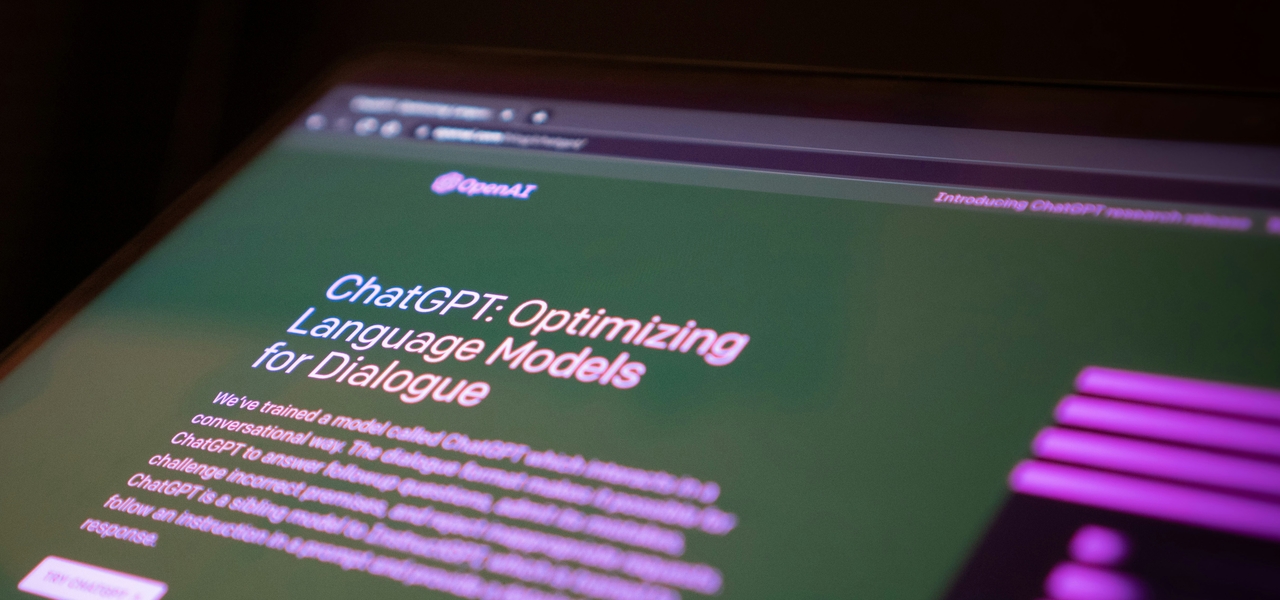

In November 2022, the American firm OpenAI launched a new version of its Artificial Intelligence assistant, called ChatGPT. It could provide well-written answers, in a range of styles and length, in response to almost any question. Within its first five days of being available, it was already being used by around 1 million people; by Autumn 2025, that figure had grown to an estimated 800 million weekly users worldwide. More than 1 billion queries are processed by it every single day.
Chat GPT - in which GPT stands for Generative Pre-Trained Transformer - is a form of Generative AI, a more advanced form of AI that is able to create new content which has not previously existed. Although it might feel personal when responding to queries, the ‘Pre-trained’ element means that it has already been given the billions of terabytes of data required to function. ‘Transformer’ is a technical term about the type of machine-learning that it uses. Although it is particularly associated with writing, it can also generate images, and even videos.
Of course, Chat-GPT is far from the only player in the market. Google’s AI overview (note the irony), when asked about similar types of software, writes: “Top ChatGPT alternatives in 2026 include Google Gemini for ecosystem integration, Claude (by Anthropic) for superior writing and reasoning, and Perplexity AI for real-time, cited research. Other strong options include Microsoft Copilot (free GPT-4 access) and Meta AI for social media integration.”
In the original ‘Jurassic Park’ film, the chaotician Ian Malcolm encapsulates the problem with advances in scientific and technological capabilities: “Your scientists were so preoccupied with whether they could, they didn't stop to think if they should.” It is a similar issue for us today: we are so in awe of what a tool like ChatGPT can produce, and the positive possibilities it might carry, that we don’t slow down to think about its wider impact.
Back in March 2023, industry leaders including Elon Musk, Apple co-founder Steve Wozniak and researchers at DeepMind signed an open letter warning that the race to create new AI systems was becoming out of control, as scientists began to “develop and deploy ever more powerful digital minds that no-one - not even their creators - can understand, predict, or reliably control”. But notwithstanding dystopian visions and existential threats, ChatGPT and similar products are already having an impact on things like work and living in community.
As Christians, we are not to just think about the ‘could’, but the ‘should’. What are the unintended consequences of emerging technologies? And how do they affect the vision God lays out for what it means to be human?
The limits of efficiency
When God created the world, he commissioned humans to “Be fruitful and increase in number; fill the earth and subdue it” (Genesis 1:28). These words, often known as the Creation Mandate, or Cultural Mandate, mark the origin of what we think of as human civilisation, as we unlock the world’s potential and bring order out of chaos, as befits our unique status within creation, being made “in the image of God”. It is not long afterwards that we read about the first references to technology: “Zillah also had a son, Tubal-Cain, who forged all kinds of tools out of bronze and iron” (Genesis 4:22). The word ‘tool’ is illustrative of a broader truth: technology exists to help humans become more efficient, not to replace them. It is, in its very essence, a means to an end.
God has given us an abundance of resources to help us as we work. Tools have been part of the story of work from Genesis onwards, whether it be the wheel, the plough, or digital technology today. Although emerging technologies like Chat-GPT seem radical and new, they themselves stand as the next in a long chain of technological advancement (and no doubt, former technological discoveries also prompted questions!).
Many of these technologies already replace tasks which could be done by humans, and increase efficiency; to take one modern example, consider tools like spell-checkers or grammar-checkers. These tools are often default settings we take for granted in Microsoft Word or Google Docs, and help us improve our work (indeed, as I have been writing, a spell-checker has already flashed up a suggestion!). On one level, they have replaced a human function: my own proof-reading.
However, we don’t tend to question whether using such tools is an ethical matter; we simply take them for granted and are grateful for the way they improve our efficiency. Some forms of writing which humans do are highly repetitive, and do not require particular thought. In performing manual tasks, tools like ChatGPT can save lots of time.
Efficiency can be a good thing: the Bible tells us to “be very careful, then, how you live—not as unwise but as wise, making the most of every opportunity, because the days are evil.” Our time is a resource from God, which we are to steward well.
But efficiency is not the ultimate thing; our work is to be balanced by other considerations. We see this illustrated in the story of Mary and Martha; Martha runs around completing her domestic tasks, and “was distracted by all the preparations that had to be made” (Luke 10:40), while Mary sits at Jesus’ feet. Jesus’ words are a tonic to a world which is obsessed with output: “Martha, Martha, you are worried and upset about many things, but few things are needed—or indeed only one.” (Luke 10:41-42). We do not believe in efficiency for efficiency’s own sake.
Incidentally, philosophers have often speculated that if there is an existential threat to humanity from forms of AI, it is likely to come from this quest for efficiency. Nick Bostrom posited a scenario which is sometimes known as the ‘paperclip problem’. Imagine that an AI-system was given a simple, overriding aim: to increase the number of paperclips in a factory. The AI, as it becomes more efficient, will learn that it can keep increasing the number of paperclips by acquiring more resources and converting them into paperclips. But such resources need not be made of metal; when all that is gone, what is to stop it converting everything else, animal, vegetable and mineral into paperclips as well, in pursuit of its aim? Eventually, it has converted all the matter on earth into a paperclip, including all the humans!
As Christians, we strive to be more than simply efficient: we want to be like Jesus. He is our model, and he is our destiny: “For those God foreknew he also predestined to be conformed to the image of his Son, that he might be the firstborn among many brothers and sisters” (Romans 8:29). Using tools like Chat-GPT to avoid hard graft will shape the kind of people we become.
The author Jeffrey Bilbo explains: “I don’t love weeding or washing dishes or picking rocks out of a field, but spending long days doing those tasks has shaped who I am as a person. I’m grateful for good hoes and automatic dishwashers and tractors with rock rakes. Even so, I recognize that using these tools shifts my relationship to the work at hand; there are real trade-offs when we forgo effort. Athletes and musicians in particular might testify to cases in which these trade-offs are clearly a Faustian bargain…it is the countless hours of disciplined, effortful struggle that make possible the wondrous freedom, the seemingly effortless performance, of a skilled human body.”
If we are to be efficient, it is towards a different goal, one that cannot be measured by GDP or hours billed. Peter warns against becoming “ineffective and unproductive in your knowledge of our Lord Jesus Christ”. Christian productivity is not about getting through tasks as quickly as possible: it is about getting to know Jesus better.
The calling to creativity
The world God created is not a boring world of grey; He has made a world teeming with life, vibrancy, variety and colour. He creates multiple kinds of plants, birds, sea-creatures and animals, “each according to its kind”. We read in Psalm 24, “The earth is the Lord’s, and everything in it, the world, and all who live in it”, from the power of the seas to the intricacy of a spider’s web or the beauty of a golden sunset. There is a long tradition of seeing God as an artist (and Isaiah compared him to a potter). It is not coincidental that both JRR Tolkien and C.S. Lewis began their creation-narratives with their respective god-like figures, Iluvatar and Aslan, singing the world into existence.
As humans we are uniquely created in the image of a creative God, and possess the desire to create ourselves. We can see this in the foundation of language: in Genesis 1, we see God speak creation into existence, and give names to some of what he has made, such as ‘day’ and ‘night’. In the next chapter, we see that humans have been created themselves as speaking beings, and we read of Adam giving names to the animals. At the end of Chapter 2, we read the first love-song, as Adam names Eve, saying: “This is now bone of my bones and flesh of my flesh; she shall be called ‘woman,’ for she was taken out of man” (Genesis 2:23).
In the Bible, we see this desire to create again and again; consider the book of Psalms, beautifully-crafted poems which encompass the breadth of human existence, or the Biblical histories, which tell the stories of Israel, Jesus and the Church not as simple lists of facts, but as narratives, vivid and full of literary devices.
We need not constrain this to the use of language; we can see creativity in the way humans constructed temples, tabernacles and arks, or in a character like Bezalel, who was filled with God’s Spirit “and with all kinds of skills— to make artistic designs for work in gold, silver and bronze, to cut and set stones, to work in wood, and to engage in all kinds of crafts” (Exodus 31:3-5). Indeed, Jesus himself was a carpenter!
Humans stand unparalleled in all creation in their ability to create languages, literature, and deploy arts and crafts. Although we are used to anthropomorphised depictions of animals on stage and screen, they cannot develop culture (in the fact the very word ‘anthropomorphised’ is itself illustrative: we impose human personalities and emotions onto other creatures, because it is only humans who are made in God’s image). Similarly, although it looks like Large Language Models (LLMs) can genuinely speak, in practice, this is only illusory: by being fed enormous data sets, they are simply able to process statistical relationships between different words and phrases.
One of the dangers of using technologies like Chat-GPT is the knock-on effect on our innate human desire to create. The Christians in Parliament APPG wisely warned: “When we use applications like ChatGPT that can produce a story, write an email or even a prayer, we are giving up our own creative activity and imagination, all for the sake of convenience. The author is not human and we rob God of glory when we fail to image him through human creativity and the use of our minds.”
Christians may want to openly acknowledge when they have used a tool like Chat-GPT to help them write; publishing something which an AI tool has written and passing it off as one’s own is plagiaristic in intent at least (irrespective of how it would be perceived in practice). Any ‘creativity’ which Chat-GPT seems to exhibit is ultimately based on organising words and phrases based on what other people have already written.
In theory, there is nothing to stop Chat-GPT writing articles, song-lyrics, scripts and even whole stories, but if we as humans delegate such tasks to technology rather than doing it ourselves, we are neglecting the way we have been designed. In the quest for efficiency and productivity, we can actually become less human.
The importance of truth
It will not come as news to anyone who has used ChatGPT and other similar tools to know that they have a questionable relationship with accuracy. On one occasion, I remember acting as an editor for someone who had written a blog piece, and asked it to find various learned quotes for their article. It turned out that each of the quotes ChatGPT had produced were completely fictional. This is hardly a one-off case; use Google’s AI or X’s Grok to look up the answer to a question and you will be frequently fed inaccurate information.
In March 2026, the journalist Matt Goodwin found himself in hot water after the publication of his book ‘Suicide of a Nation: Immigration, Islam, Identity’. Andy Twelves, a contributor to the New Statesman, wrote on X, “I’m only 5 chapters in and have found a huge amount of what appears to be false quotes and basic misinterpretations of data that appear to be AI hallucinations”. Several of the book’s footnotes had included ChatGPT in their URL.
As Christians, we have particular grounds for caring about truth: we worship a Jesus who claimed that he was the truth, and that “anyone on the side of truth” listens to him. He came from the Father, “full of truth and grace” (John 1:14). Truth is God’s domain; it is the Devil who is ‘the Father of lies’. We read in Numbers 23:19 that “God is not human, that he should lie, not a human being, that he should change his mind”. It is not just that God does not lie: he actually cannot lie.
And that is before we get to questions around how Chat-GPT processes enquiries which are not simply matters of fact, but of philosophy. The mathematician and theologian John Lennox asks: “How can an ethical dimension be built into an algorithm that is itself devoid of heart, soul, and mind?” How can Chat-GPT make value-judgements about right and wrong?
Consider the transgender debate, in which there are two polar-opposite camps with very little which unites them. Then imagine a scenario where a user asks Chat-GPT which side is right. How can it discern? Sometimes, a programmer might build certain moral controls into an LLM. But if they do so, the model can only spit out the moral judgements of the programmer, who at best will be flawed and fall short of God’s glory, and at worst (as in some dictatorships) might be actively nefarious.
As disciples of Jesus, we want to imitate the one, who never lied (we read in 1 Peter 2 that “no deception was found in his mouth”), and the Ten Commandments instructed God’s people to “not bear false witness”. This is not to rule out tools like ChatGPT per se; humans are perfectly capable of making errors too. But it is to say that we ourselves are responsible for what we publish. Using AI to do research for us is a risky business, and it is certainly advisable to double-check each of the facts, figures and quotes which it produces (which then raises the question of whether it was worth it in the first place!).
We live in a world where the lines between truth and fiction seem to be increasingly blurred. Lies from foreign powers are disseminated en masse over social media. Deepfaked videos are now difficult to separate from real footage. There is enough fake news around without Christians helping propagate it.
The dignity of work
Christians believe that the desire to work is part of the way we have been designed as humans. Before creation fell, where we can see God’s good design, mankind was already working, tending the garden: “The LORD God took the man and put him in the Garden of Eden to work it and take care of it” (Genesis 2:15). Work has an inherent dignity to it: it is part of what makes us human. It is part of what it means to be made in the image of God, for God himself works (John 5:22). As the Bible story progresses, we see the wide variety of occupations God’s people are involved in as society develops: farmers, shepherds, politicians, priests, musicians, cupbearers, carpenters, and tentmakers, to name but a few!
In fact, it is not only a part of God’s original creation, it will also be part of the new creation! The Christian image of heaven is not one of us all sitting around in the clouds strumming our golden harps; in Isaiah’s vision of a new heaven and a new earth, we read: “They will build houses and dwell in them; they will plant vineyards and eat their fruit” (Isaiah 65:21). In the very final chapter of the Bible, John writes that “No longer will there be any curse. The throne of God and of the Lamb will be in the city, and his servants will serve him” (Revelation 22:3).
As AI continues to develop, more human tasks will become replaceable, and some more speculative commentators envision a world where humans will not have to be employed, as machines run around doing all the dirty work. But the Bible shows us that such a world would not actually be desirable: we have an innate desire within us to be usefully employed (whether that be in formal employment, or in unpaid work, such as volunteering or caring responsibilities).
Again, this is not to question that LLMs like Chat-GPT have some role within the working world. But it is worth asking the question: are we using it to aid us in our work, or to replace us in our work. What are we doing with the additional time we have as a result of using tools to increase efficiency? Are we being just as productive ourselves as we would have been otherwise?
The Bible contains plenty of warnings about laziness, particularly in Proverbs. We read in Proverbs 10:4: “Lazy hands make for poverty, but diligent hands bring wealth.” This was a sentiment echoed by Paul in the New Testament, when he wrote to the Thesslanoians: “For even when we were with you, we would give you this command: If anyone is not willing to work, let him not eat” (2 Thessalonians 3:10).
And are we still working to improve ourselves and strive for excellence? Jesus calls us to “love the Lord your God with all your minds” as well as our hearts, souls and strengths; by using Chat-GPT, it would be easy to become lazy, and to not employ our minds while we sit back and let the machine do the work.
A 2025 study from MIT found that use of Large Language Models (LLMs) like ChatGPT can “contribute to cognitive atrophy through excessive reliance on AI-driven solutions”. The researchers identified ‘cognitive debt’, where relying on AI replaces independent thinking. They wrote: “Cognitive debt defers mental effort in the short term but results in long-term costs, such as diminished critical inquiry, increased vulnerability to manipulation, decreased creativity. When participants reproduce suggestions without evaluating their accuracy or relevance, they not only forfeit ownership of the ideas but also risk internalizing shallow or biased perspectives.”
The Bible’s vision for work is as something that we are to pursue wholeheartedly: “Whether you eat or drink or whatever you do, do it all for the glory of God” (1 Corinthians 10:31).
Questions about technology, or questions about humanity?
Chat-GPT, and other similar tools, will continue to revolutionise work over the next few decades; many commentators have already heralded the dawn of another ‘Industrial Revolution’. There is a place for such tools, for humans have always used technology to accomplish their ends, and we agree with increasing efficiency in manual tasks, which can often feel mindless.
At CARE, there are certain, limited manual tasks (such as simple rewording) which we are happy to use it for. However, anything involving creative writing, theological thinking, or Bible-teaching we have kept (and will continue to keep) reserved for humans.
Efficiency is actively harmful without other virtues, such as truth, beauty, or goodness (sometimes known as the three Transcendentals). Efficient falsehoods are nothing more than fake news en masse. Efficiency without beauty marks the triumph of brutality and ugliness. And we have seen in the 20th and 21st centuries the way in which lesser technologies than today’s AI have already been used to radically widen the impact of evil, including in warfare and the committing of genocide.
Technology itself cannot be innately good or evil, for it is not personal. This is important to remember when dealing with large language models like ChatGPT, or indeed, chatbots more generally, which sound human, despite simply being automated responses to unfathomably-large data-sets. Rather, it is humans who are good or evil and govern its usage.
Questions about technology are, ultimately, questions about humanity: if technology is a means to an end, is the end we are seeking life-giving, or is it destructive? Does it help us to be the people who God created us to be; people who are creative, people who speak the truth, and people who work? And above all, is it helping us to be conformed into the image of Jesus?