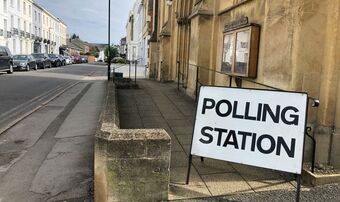

The results are in. The country has spoken: it’s been a good night for some parties. It’s been a disastrous one for others.
At CARE, we do not support any particular party or indeed, any particular candidate. Amongst our team, we have a wide range of views and political leanings; and it would be the same among our supporters too! As we process the results, we might experience a range of emotions.
If you support the winning party, you might feel delighted, and hopeful about the future. If the election didn’t go the way you want, you might be feeling demoralised, depressed, and anxious about what is to come.
And then there will be many of us who just do not know quite what to think. In today’s world, many of us vote depending on who we are against, rather than who we are for; voter apathy is higher than ever, with a general feeling that whoever is in office, things don’t seem to get better.
But whatever you think, here are some pointers on how to respond as a Christian...
1. Be thankful we live in a democracy at all
If you are feeling discouraged, there is still much to be thankful for. The privilege of being able to vote isn’t something which can be taken for granted in a world where so many do not have it.
In his victory speech in his constituency in 2024, Jeremy Hunt, acknowledging the tough night for his party, said this:
“A message to my children, who I sincerely hope are asleep now. This may seem like a tough day for our family as we move out of Downing Street, but it isn’t.
We are incredibly lucky to live in a country where decisions like this are made not by bombs or bullets, but by thousands or ordinary citizens peacefully placing crosses in boxes and bits of paper. Brave Ukrainians are dying every day to defend their right to do what we did yesterday and we must never take that for granted.
Don’t be sad, this is the magic of democracy.”
We can give thanks to God that our elections generally proceed peacefully and fairly, and that we have a voice which is listened to, even if just in a small way.
And we can be thankful that our choice of candidates is generally between decent, hard-working people, who want to serve our country and their constituents, even if the one we voted for lost.
Back in 2024, I cast my own vote in Battersea constituency for a candidate who did not end up winning (or, realistically, have much chance of winning!); but the candidate who did win is a lovely Christian lady, Marsha de Cordova; praise God for that!
2. No party has a monopoly on Jesus
It can be easy – particularly if the party we support hasn’t been elected – to despair when the results at election-time don’t go the way we wanted them to.
If it’s been a good night for Labour, you might feel concerned about some policy areas on which the Bible is clear, like around assisted suicide, or on transgender issues.
Or if it’s been a good night for the Conservatives, or Reform, you might be very nervous about the way in which immigrants to the UK will be treated, or about some of the rhetoric which is used.
You might care about different policy areas, such as education, or the environment, or the economy, but the point is this: Jesus Himself would not have been a card-carrying Conservative, or singing ‘The Red Flag’ at the Labour Party Conference. That’s not to say that we can’t be members of, or indeed, stand for, political parties, but the point is that no party (even those which claim the name of Christian!) perfectly represents Jesus.
In all parties, I am sure, Jesus would have found things to affirm, from the Conservative emphasis on personal responsibility, to the value that Labour places on representing the vulnerable (or even to the Green Party’s desire to steward the environment). And in all of them, I am even more sure, he would have found things to critique. No individual, even the best of us, can perfectly represent Jesus.
All political parties have, embedded in their core values, some sort of political theory, a lens through which they view the rest of the world, whether it be authoritarianism or libertarianism or Marxism or something else.
Christians are to begin with a different lens: that of the Bible (and of Jesus). A couple of years ago, Christopher Watkin wrote a book entitled “The Bible as Critical Theory”. His premise is fairly simple: that the Bible is the lens through which we view the rest of the world, and by which we are able to affirm and to critique what we find there.
None of our political parties have a monopoly on Christian truth. And that should lead us to be cautious about either rejoicing too much or despairing too much, in the aftermath of some fairly one-sided election results.
3. This is the situation into which God has called us
Sometimes we can spend so long thinking about election day that we lose sight of the fact that the more significant thing is the years which follow.
It’s one thing for Labour to achieve a landslide victory, as they did in 2024; what mattered more, is what they did next.
Before a wedding, people sometimes rightly advise that it’s so easy do get distracted by preparations for a wedding day that we lose sight of the more important thing: the years of marriage which follow. It struck me that elections can be a bit similar: we can become so preoccupied with the results of the vote that we lose sight of all the work to be done afterwards.
But this isn’t just relevant to the ruling party. For us as Christians, our work doesn’t just end when we cast our vote; it also matters what we do next.
In 1 Corinthians, Paul teaches about how Christians should respond to a change of life-circumstances; we might take lessons from it around responding to an election today. Paul’s primary concern was not whether people were married or unmarried, whether they were circumcised or uncircumcised, or whether they were slave or free. Similarly, his primary concern might not have been whether we had a Conservative government or a Labour government,
What Paul was far more interested in was how they acted in the circumstances in which they found themselves: “Circumcision is nothing and uncircumcision is nothing. Keeping God’s commands is what counts. Each person should remain in the situation they were in when God called them.” (1 Corinthians 7:19-20).
That is not to say he would not have wanted us to vote: he says to the slave, “if you can gain your freedom, do so.” (1 Corinthians 7:21). When there was an opportunity to pursue change, the Corinthians were not just entitled to do so, they were encouraged to!
But Paul’s point was that the situation in which we find ourselves is the one God has called us to. When we are under a Labour government, that is the situation to which God has called us for the present time; when we are under a Conservative government, then that is the situation to which God has called us for the present time.
In either case, his instruction to us is the same: “each person should live as a believer in whatever situation the Lord has assigned to them, just as God has called them” (1 Corinthians 7:17).
In other words, our call is to be faithful, whoever is in power: for some, that might look like working directly with our political leaders to support them in their work. In other cases, it might look like holding them to account. In all cases, it will at least look like praying for them (1 Timothy 2:1-4).
4. God is working his purposes out…whatever they may be
It can seem almost trite sometimes to say that ‘God is in control’, particularly if the election results haven’t gone the way we wanted them to, and we are worried about the damage that might be done as a result. (And if that is the case here, how much more so around the world, where political situations are far worse than ours.)
But however much it is said, that does not, ultimately, make it any less true. God will, we trust, work out his purposes.
Sometimes those purposes might be confusing to us. Within the Psalms, we have plenty of examples of people who did not understand what God was doing. David sang, “How long, Lord? Will you forget me forever? How long will you hide your face from me? How long must I wrestle with my thoughts and day after day have sorrow in my heart? How long will my enemy triumph over me?” (Psalm 13:1-4).
It might seem like the incoming government or Prime Minister is in control; and in one sense that is true, for God has, graciously, delegated authority to human kings and governments. And yet at the same time, they cannot truly direct the course of history, any more than the greatest of kingdoms and empires which came before them.
For we also know that God is absolutely sovereign: there is nothing outside of his control. And one day, when we reach eternity’s shore, we will look back and see the way all his plans and purposes coalesced, even the ones which didn’t seem to make sense at the time.
And so, whether you are downcast this election-time, or excited at the prospect of change, we would all do well to remember to cast our eyes upwards to the one who does hold history in the palms of his hands. And one day we will see that all things, all all seasons, and all governments have worked for His glory.
“God is working this purpose out, as year succeeds to year; God is working this purpose out, and the time is drawing near; nearer and nearer draws the time, the time that shall surely be: when the earth shall be filled with the glory of God as the waters cover the sea.” (Arthur Campbell Ainger)