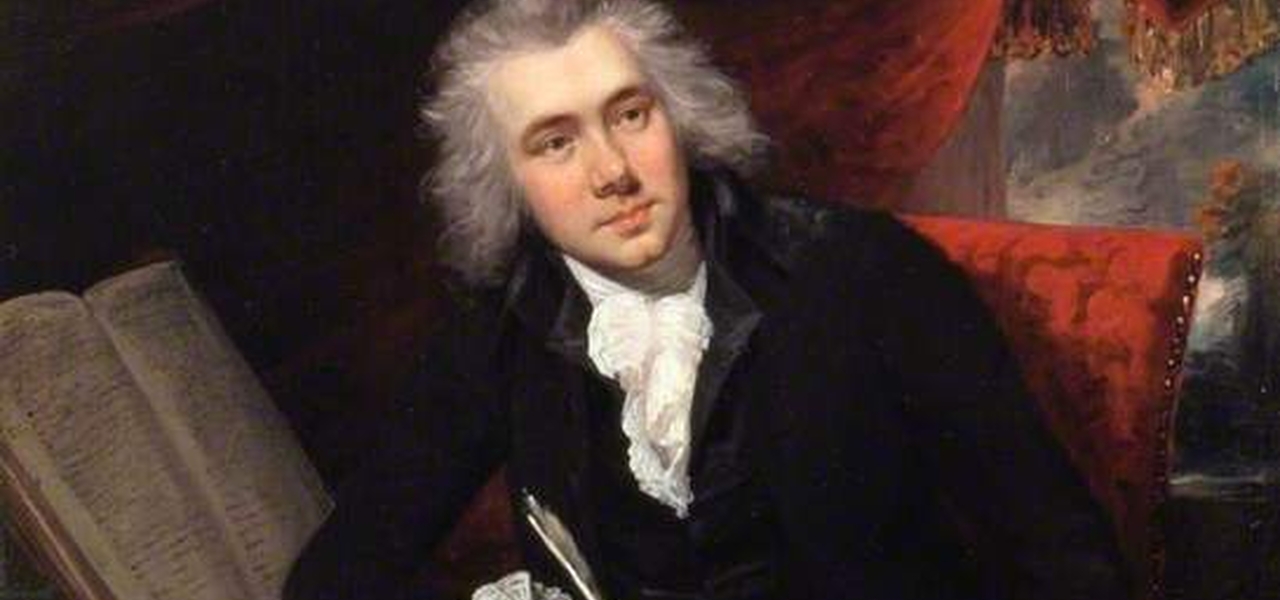

In 1786, the royal Navy Officer and politician Sir Charles Middleton wrote a letter to a young Conservative MP, urging him to lead the movement calling for the abolition of slavery. At the time, British ships were carrying up to 40,000 enslaved men, women and children across the Atlantic every year, in horrendous conditions, in a route that was central to Britain’s foreign income; it is estimated that around 1.4 million Africans, of the 11 million who made the crossing, died during the voyage. It seemed like an impossible task.
William Wilberforce, who received that letter, said he “felt the great importance of the subject, and thought himself unequal to the task allotted to him, but yet would not positively decline it". The following year he committed to leading the Parliamentary campaign. It would shape his life for almost 50 years.
An unexpected candidate
Wilberforce was born in Hull in 1759, the son of Robert Wilberforce, a wealthy merchant, and Elizabeth Bird. As a child, he became interested in evangelical Christianity while staying with his uncle and aunt, who had links with Goerge Whitfield, but when he was brought back to Hull, this soon waned. Wealthy in his own right by 1777 (after inheriting from his grandfather and uncle), he studied at St John’s, Cambridge, and indulged in playing at cards and drinking sessions. He described himself later as ‘as thoughtless as the rest of them’. His studies also brought him into contact with the future Prime MInister William Pitt, with whom he formed a strong friendship.
Wilberforce stood for Parliament and became the MP for Hull in 1780, buying his way to the necessary votes by spending £8,000, as was customary at the time. Not wishing to be constrained by party loyalty, he supported the Tories or Whigs as his conscience dictated. Known for his razor-sharp wit and abilities in speaking, the biographer James Boswell once wrote, "I saw what seemed a mere shrimp mount upon the table; but as I listened, he grew, and grew, until the shrimp became a whale." In 1784, he changed constituency and became MP for Yorkshire. Throughout this period, he continued to be a frequent party-goer, and maintained a hedonistic lifestyle.
However, this was all to change in the winter of 1784, when he toured Europe with his mother, his sister, and Isaac Milner, a friend from grammar school and a tutor at Queens College, Cambridge. Milner was a committed Christian, and the two spent many hours talking about faith. A few months later, they journeyed again around Switzerland. His biographer John Pollock writes that gradually, “intellectual assent became profound conviction”. Wilberforce began to read the Bible and pray, and began to recognise his own sinfulness and selfishness. He referred to this conversion as “ the great change” and repented of how he had used his time and his resources.
At this time, evangelicals were not well-respected in polite society, and although Britain was culturally Christian, in practice, it was a very different story. 1 in 5 young women in 18th century London were prostitutes, and in 1800 in St Paul’s Cathedral, just 6 people took communion on Easter Day. Wilberforce himself was unsure whether he should maintain his position in Parliament; he soon confided in the former slave-trader (and writer of ‘Amazing Grace’) John Newton, who counselled him to remain working in politics. Newton later wrote to encourage him: “It is hoped and believed that the Lord has raised you up for the good of His church and for the good of the nation.”
The beginning of the mission
It was in 1786 that Sir Charles Middleton wrote to Wilberforce; this was not the first time Wilberforce had thought about the subject, as three years earlier he had dined with the ship’s surgeon Rev. James Ramsay, who had served as a clergyman and medical supervisor in the Caribbean and been so disturbed by the conditions endured by the slaves being transported that he had returned to England and joined the abolitionists.
Wilberforce, eager to live out his Christian faith, met with abolitionists in Middleton’s home in winter 1786, and then with the abolitionist Thomas Clarkson in 1787. They began to meet weekly, with Clarkson bringing him evidence about the slave trade. On 12 May 1787, after a conversation with William Pitt, Wilberforce resolved to bring forward an abolitionist motion in the Commons. He wrote in his diary in October, “God Almighty has set before me two great objects, the suppression of the Slave Trade and the Reformation of Manners [morals]”.
The slave trade had become increasingly integral to Britain’s trade routes in the previous hundred years, and made up part of the triangular route taken by many merchant ships at the time: British goods were transported to Africa and exchanged for slaves, which were transported across the Atlantic, and supplied the British, French, Spanish, Dutch and Portuguese colonies in the West Indies. The ships would then transport products back from the Caribbean which had been made through slave labour, including sugar, tobacco and cotton. All in all, this represented around 80% of Britain’s foreign income.
As William Hague wrote in his biography of Wilberforce, “The force of passionately held principle was now about to collide with the rock of immense vested interests.”
Persevering through setbacks
Slowed down by illness, Wilberforce gave his first speech about the slave trade in May 1789. He described at length the conditions in which slaves were transported across the Atlantic, drawing upon the work of Thomas Clarkson and spoke against the idea that people of a different race were by nature inferior. Drawing upon his rhetorical brilliance, he presented the slave trade as a matter of natural justice: “I confess to you, so enormous, so dreadful, so irremediable did its wickedness appear that my own mind was completely made up for Abolition. . . . Let the consequences be what they would, I from this time determined that I would never rest until I had effected its abolition”.
Although some Parliamentarians indicated their support for Wilberforce’s ideas, the opponents of abolition said that Parliament should hear their evidence too, slowing down progress. When Wilberforce was finally able to introduce a bill to abolish the slave trade in 1791, it was comfortably defeated, in an atmosphere of fear at the violence unfolding during the French revolution, and after slave revolts in the French West Indies.
In 1792, Wilberforce tried again, only for the Home Secretary to hijack the debate by suggesting a compromise motion wherein the slave trade would be abolished gradually, something Wilberforce read as a way of playing for time. In 1793, he had a third attempt, in which a vote to abolish the slave trade was lost by just eight votes. When war with France broke out, abolitionism sank down the list of priorities (and was associated with the French revolution), and several more attempts of Wilberforce to introduce bills bore little fruit.
In 1804, Wilberforce finally managed to guide an abolitionist bill through the House of Commons, only for it to be timed out of passing through the House of Lords, and when he reintroduced it in the Commons in 1805, it did not even pass there again.
Success at last
In 1806, Wilberforce sought to form a broader coalition, after the death of his friend Pitt, and worked with more members from the Whigs, alongside forging a working relationship with the new Prime Minister William Grenville. After a Bill was introduced that year to prohibit participating in the slave trade to the French colonies, Wilberforce began to amass evidence about the slave trade as part of a wider campaign to outlaw it, which he published as the 400-page ‘A letter on the Abolition of the Slave Trade’.
Just a few months later, Lord Grenville introduced an Abolition Bill in the House of Lords, which Charles Grey put forward for Second Reading in the Commons on 23 February 1807. This time, the Bill passed comprehensively, by 283-16, with a number of tributes to Wilberforce and his work being read out. His sons documented what happened next: “The House rose almost to a man and turned towards Wilberforce in a burst of parliamentary cheers. Suddenly, above the roar of ‘Hear, hear,’ and quite out of order, three hurrahs echoed and echoed while he sat, head bowed, tears streaming down his face”.
But his work was not done. Legislation did not mean implementation, and Wilberforce worked with the African Institution to ensure that abolition was properly carried out, and to speak on behalf of conducting abolitionist negotiations with other countries. He also introduced bills to aid with the detection of illegal importation of foreign slaves.
And the abolition of the slave trade was not the same as the abolition of slavery itself. He initially trod more cautiously in this area, pursuing incremental change, but in 1823, he wrote a treatise demanding total emancipation, to be achieved through parliamentary legislation. By this stage, Wilberforce’s health had deteriorated significantly, and a couple of years earlier, he had asked the MP Thomas Fowell Buxton to take on the leadership of the campaign within the House of Commons, although he himself continued to act as a figurehead and to attend (and chair) meetings of the Anti-Slavery Society. Although he resigned his parliamentary seat in 1825, the anti-slavery cause continued to make gradual progress, until in May 1833, the Whig government introduced the Bill for the Abolition of Slavery.
On 26 July, news reached Wilberforce that the government had granted key concessions which guaranteed that the Bill was to pass. His health declined the following day, and on 29 July, Wilberforce died. Buxton commented: “It is a singular fact that on the very night on which we were successfully engaged in the House of Commons, in passing the clause of the Act of Emancipation — one of the most important clauses ever enacted...the spirit of our friend left the world. The day which was the termination of his labors was the termination of his life.”
A man of faith
Throughout it all, Wilberforce had been strongly guided by his Christian convictions. His biographer John Pollock wrote, “Everything down to the minutest detail of action and speech [was] considered with reference to eternity.” Towards the end of his life, he wrote, after decades of campaigning on behalf of the vulnerable, “What a lesson it is to a man not to set his heart on low popularity when after 40 years of public service, I am believed by the bulk to be a hypocritical rascal. O what comfort it is to have to fly for refuge to a God of unchangeable truth and love.”
Indeed, Wilberforce himself wrote a book, ‘A practical view of Christianity’, detailing how Christians needed to return to and seep themselves in foundational Christian teaching about sin, grace, and the Cross: “Let him then who would abound and grow in this Christian principle, be much conversant with the great doctrines of the Gospel”. He described it as “a fatal habit…to consider Christian morals as distinct from Christian doctrines”.
Immersed in these core doctrines, he radiated love and joy to those he met. We read in a letter from a Miss Sullivan to a friend in 1815, “By the tones of his voice and expression of his countenance he showed that joy was the prevailing feature of his own mind, joy springing from entireness of trust in the Savior’s merits and from love to God and man...His joy was quite penetrating”.
Wilberforce himself was strongly supported by a group of fellow Christians, often known as the Clapham Sect, although at the time they were mockingly termed ‘The Saints’. Based at Holy Trinity Church, Clapham, other members included Thomas Clarkson, the MP John Thornton, the philanthropist Hannah More, the abolitionist Granville Sharp, and the MP Thomas Fowell Buxton, who Wilberforce would eventually ask to take forward the Parliamentary campaign.
It was Wilberforce, Clarkson and Sharp who were responsible for founding Sierra Leone in 1787, as a region for African-Americans freed by the British during the American Revolutionary War to settle in. This was founded as a way of proving that black people were just as capable of running a society as white people. Clarkson described its purpose as follows: “the abolition of the slave trade, the civilisation of Africa, and the introduction of the gospel there".
Garth Lean writes in his book, ‘God’s politician’ about the Clapham Sect: “They possessed between them an astonishing range of capacities…No prime minister had such a cabinet as Wilberforce could summon to his assistance.” And when the Parliamentary Bills eventually passed, it was the lawyer married to Wilberforce’s sister who drafted them. Various other societies were founded by members of the Clapham Sect, some of which still exist today, including the Bible Society and the Church Missionary Society. The historian Stephen Tomkins summarised its wide-ranging impact as follows: "The ethos of Clapham became the spirit of the age.”
Slavery today
The 19th century minister William Jay wrote of Wilberforce: “His disinterested, self-denying, laborious, declining efforts in this cause of justice and humanity…will call down the blessings of millions; and ages yet to come will glory in his memory.”
As a result of the efforts of Wilberforce and the wider abolitionist movement, the United Kingdom became one of the very first territories around the world to abolish slavery, and by far the most influential. Today, legal ownership of another human being is illegal in every country around the world, following the UK’s lead.
However, many people are still under illegal control, and trapped in forced labour, whether by individuals or by the state. An estimated 50 million people are living in modern slavery on any given day around the world, and it is estimated that around 1 in 4 victims of modern slavery are children.
Modern slavery is a much more sophisticated crime than the slavery of old, but 137 countries have criminalised human trafficking, 87 have criminalised forced labour and just 50 have criminalised forced marriage.
The UK is considered a world leader in this area, and the Modern Slavery Act 2015 was the first major piece of anti-slavery legislation to be passed in almost 200 years. CARE played a leading role in support, and some of our recommendations were taken up, including the creation of the role of an independent anti-slavery commissioner, creating provisions which will allow the assets of traffickers to be seized, and creating a new statutory defence for slavery victims who had been compelled to commit crimes. However, even in the UK, it is estimated there are still approximately 130,000 victims of modern slavery.
Although we are much inspired by the story of Wilberforce, and his courage, determination and perseverance, the man himself knew that the real source of his success was God. In the aftermath of the vote to abolish the slave trade in 1807, one of his friends declared that he “attributes it to the immediate interposition of Providence.”
The transatlantic slave trade might have seemed impossible to defeat two hundred years ago; and modern slavery might seem impossible to conquer today. But as Wilberforce himself knew well, “nothing is impossible with God” (Luke 1:37).