
Sami* came to the UK to work in a restaurant, entering the country on a skilled worker visa. However, once he arrived he found that the situation was very different from what he had been led to believe.
He was paid very little and had to give most of it back to his employer as payment for his accommodation, which was simply a sofa in the restaurant he worked in. The employer then took more money from Sami’s pay, saying it was for tax purposes, leaving Sami with very little to live on. He also verbally abused Sami and controlled him by monitoring him through CCTV.
Sami wanted to leave, but his employer claimed that Sami owed thousands of pounds in fees to leave his contract, and even threatened to have him killed if he returned back to his home country. Sami was locked into a desperate situation with no obvious way out.
In some ways, Sami’s story is a story about immigration, of one person leaving their country to come to another. However, Sami’s story is a story of modern slavery, of one person being exploited by another for personal gain. Those two issues – immigration and modern slavery – are intertwined, and Sami’s story helps us to understand a debate that is occurring in UK society today.
The immigration debate
The question of immigration is at the forefront of our political discourse. From deportations to Rwanda, to ‘one in, one out’ policies, and slogans like ‘Stop the boats’, issues surrounding immigration, refugees, and asylum seekers seem to dominate the headlines. Polling consistently shows immigration as one of the most important issues that dictates the way people vote, if not the most important issue among some voters.
Immigration is about the movement of people into the country from elsewhere in the world, to live and work in the United Kingdom. There are different reasons why someone might choose to migrate, some of which ‘pull’ people to another country, and others which ‘push’ them from their current situation. Pull factors might be the opportunity to study in another country, joining family who are already here, or the opportunity of more consistent, better paid work. Push factors for someone to leave their home country might be poverty, discrimination, persecution, or conflict. The reality is likely to be a mixture of both push and pull: someone facing unemployment at home might be pulled to pursue employment elsewhere in the world.
Governments face a choice about how to respond to migration. They might encourage it, seeing it as a way to increase the number of skilled workers in areas where there might be a need. This is the way in which Sami entered the UK.
Alternatively, governments might discourage migration, either because resources are stretched thin, or because popular opinion is against a rise in immigration. Visa programmes could be revoked, restrictions placed on those entering the country, and immigrations routes closed.
Governments can also support those who come to the country, especially when they seek asylum because of persecution, humanitarian disaster, or human rights violations. Every government has to decide whether to accept refugees and asylum seekers, and how many they are able to welcome.
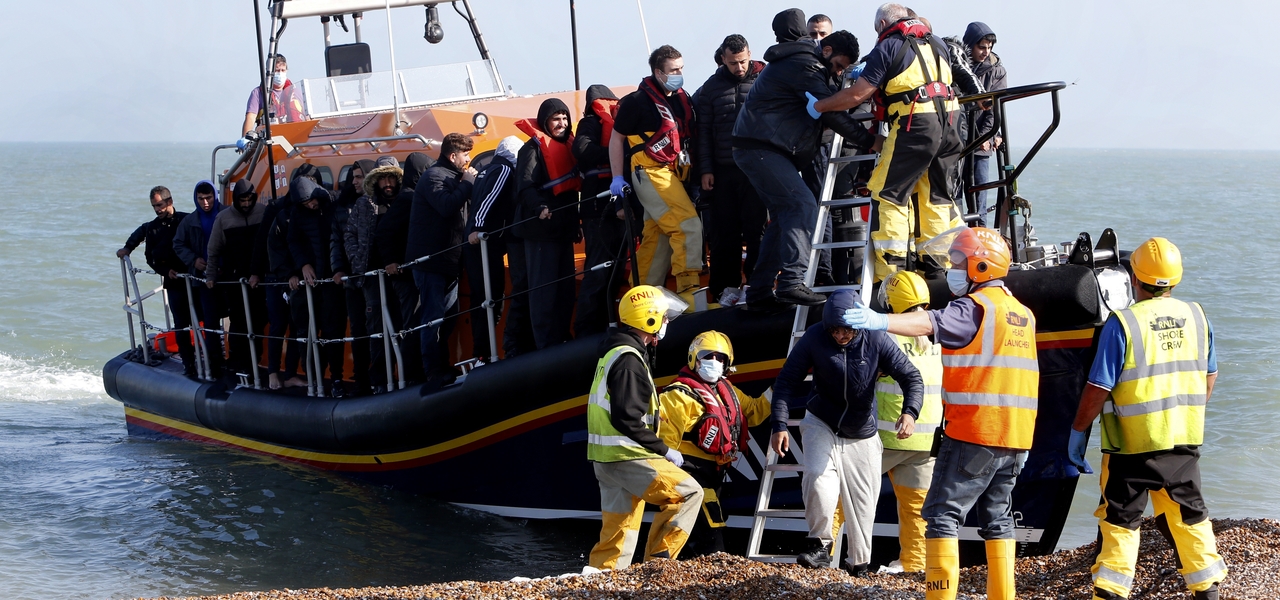
Stopping ways of of entering the country does not stop all immigration, however. There are means of legal migration, but some will come across the border by other means. If the struggles at home are difficult enough, and the potential of better prospects is attractive enough, migrants will try to enter the country regardless. They might pay for others to smuggle them in, cling to the undercarriage of a lorry, or more recently, travel across the channel in a ‘small boat’. Someone who is desperate enough will try anything to pursue a better life for themselves, and their family.
The issue of modern slavery
Sami entered the country by a perfectly legal route: the skilled worker visa. However, what happened to him once he arrived in the UK is another story, and one that is separate from the debate about immigration. Although Sami entered the country by legitimate means, his employers exploited him. They controlled his movements, forced him into unsuitable accommodation, paid him next to nothing, and convinced him he could not leave. Sami became a victim of modern slavery.
Nearly 900,000 people entered the country as immigrants in the year to June 2025. However, modern slavery affects between 120,000 and 130,000 people and not all of those are immigrants; modern slavery affects people from the UK as well as those who have come here from other countries. More victims of modern slavery were referred to the National Referral Mechanism (NRM) in 2025 than any previous year. Yet while public awareness of immigration is very high, awareness of the issues surrounding modern slavery is comparatively low.
Modern slavery is where one or more people exploit one or more others for personal gain. That could be forced labour, sexual exploitation and prostitution, forced crime, domestic servitude, and more. Someone who is a victim of modern slavery is coerced, forced, or deceived, often with threats of violence to themselves or their family. They are often forced to live in crowded and unsanitary conditions, working long hours with no breaks, and having no money or possessions of their own. They are closely controlled and unable to speak freely to other people.
Those who exploit others will frequently tell them they have a debt to pay off and cannot leave unless it is cleared (which is impossible to do). They convince those under their control that they will be deported if they speak to the authorities, which is often sufficient to ensure their silence.
Modern slavery and immigration are not the same
This brief outline of immigration and modern slavery is hopefully enough to show that these two issues are not the same. However, recent political discussion has tended to merge the two, talking about immigration and slavery (as well as asylum) in the same breath.
An example of this occurred in September 2025. The government were blocked from deporting an Eritrean man to France under the ‘one in, one out’ scheme, because he had claimed he was a victim of modern slavery. In response, the Home Secretary, Shabana Mahmood, said:
Last-minute attempts to frustrate a removal are intolerable, and I will fight them at every step. Migrants suddenly deciding that they are a modern slave on the eve of their removal, having never made such a claim before, make a mockery of our laws and this country’s generosity. I will fight to end vexatious, last-minute claims. I will robustly defend the British public’s priorities in any court. And I will do whatever it takes to secure our border.
Popular opinion about immigration has meant that recent governments (both Labour and Conservative) have tried to appear ‘tough on immigration’. However, the Home Secretary’s words reveal a particular view of immigration and modern slavery. Those who claim to be victims of slavery ‘frustrate’ the removal system with ‘vexatious’ claims. They ‘make a mockery of our laws and this country’s generosity’.
The way we use our words is vitally important, especially for followers of Jesus. In the New Testament, the book of James says a great deal about the way we use our tongues, for example:
Those who consider themselves religious and yet do not keep a tight rein on their tongues deceive themselves, and their religion is worthless. Religion that God our Father accepts as pure and faultless is this: to look after orphans and widows in their distress and to keep oneself from being polluted by the world.
We can’t imagine our actions are pleasing to God if our words are not true and helpful. Rather, both our words and our actions should be aimed at looking after those in need – the widow, the fatherless, and the foreigner, to use Biblical terminology. It is important that we not only talk about issues like immigration and slavery, but that we talk about them correctly.
If we talk about immigration and modern slavery as the same thing, then we do both groups a disservice. It is vital that we speak about the complex issue of immigration with clarity, and that we speak about modern slavery with both compassion and accuracy.
The idea that victims of modern slavery are exploiting the immigration system, or that migrants are using slavery as a pathway into the UK, is simply not true. As Eleanor Lyons, the UK’s Independent Anti-Slavery Commissioner said in response to the Home Secretary’s comments:
There is no substantive evidence to suggest this system is being misused. The home secretary’s words have real-life impact on real victims. It is deeply concerning to suggest the system is being misused. Not enough is being done to prosecute those behind these crimes.
Victims are not abusing the immigration system
We can be sure that the UK’s modern slavery referral system is not being misused because of the way that it operates.
Unlike applications for asylum in the UK, you cannot self-refer yourself as a victim of modern slavery. Instead, you need to be identified as a potential victim by a specified ‘first-responder organisation’. These organisations are trained and equipped to spot signs of modern slavery and recognise those who have fallen victim to exploitation. They include the police and National Crime Agency, UK Border Force and Visa and Immigration, local authorities, Salvation Army, Barnardo’s, and others.
This is thankfully what happened to Sami. He managed to flee his situation, even though he had no money, no accommodation, and was afraid he would be deported and that his life would be at risk if he returned to his home country. Sami was made aware of the Modern Slavery and Exploitation Helpline, who encouraged him to go to the police. Once he did, he was referred to the National Referral Mechanism (NRM) and provided with support.
This referral to the NRM happens when a first responder organisation has identified a possible victim of modern slavery. This can only be done by the first responder organisation, and not by the victim themselves. Once entered into the NRM there follows a process of verification. The first stage is receiving a ‘Reasonable Grounds’ decision, which has a relatively low threshold and is designed to quickly identify potential victims and give them support. A lengthier process then leads to a ‘Conclusive Grounds’ decision, where the victim is positively identified as having been subject to modern slavery.
Currently around half of people referred to the NRM receive a positive reasonable grounds decision, and half again then receive a positive conclusive grounds verdict. Those referred to the NRM are not predominantly entering the UK through small boats crossing the channel. About one in 10 referrals come this way, which is about the same as other methods.
Because of the way the system works, it is extremely difficult to falsely claim to be a victim of modern slavery. Of the 19,117 individuals entered into the NRM in 2024, only 13 of them were disqualified for “knowingly making a false claim”.
The political stance that people are circumventing the immigration process by making false claims about slavery is not true and not possible. In their report ‘restoring belief, reducing criminality’ looking at modern slavery and immigration legislation, the charity Unseen concludes that: “This stance, as with the policies that preceded it, is incoherent within the established crime profile of modern slavery, survivor presentation, and the operation of UK identification systems.”
Because of the time it takes to reach a conclusive grounds decision, many victims of modern slavery may also apply for asylum in the UK. There are people who have used tactics to try and gain preferential treatment in the asylum process, such as pretending to be gay, or faking reports of domestic abuse. But while a person might be an asylum seeker and a victim of modern slavery, those two processes are different.
A culture of disbelief
How we speak about issues like immigration and modern slavery shape the way we act. If governments talk about immigration and slavery as the same thing, then it is inevitable that they will put forward policies that treat them the same.
In order to be seen to be addressing problems with immigration, recent Labour and Conservative governments have made a number of changes to modern slavery provision. They have increased the level of evidence needed to be proven as a victim of modern slavery, and reduced the support available, including threatening deportation. These measures, though they have the appearance of being ‘tough on immigration’, actually make it harder to tackle modern slavery.
Changes to the NRM in 2022 made it much more difficult, if not impossible, for victims who have committed a crime to find support as a victim of modern slavery. These ‘Public Order Disqualifications’ exclude those who have been convicted of even minor crimes from being considered as victims of slavery. However, in the course of their enslavement, many victims are forced into committing criminal acts. Around one in ten modern slavery victims fall into this category. Removing eligibility for even minor crimes in this way stops victims from coming forward and speaking about the crimes of their exploiters. Following a High Court decision in December 2025, the Home Office has currently paused public order disqualifications, but they could be resumed after further legal decisions.
As we have already noted, fear of deportation prevents victims from seeking help. Exploiters use the fear of deportation to control their victims and stop them from speaking to the authorities. Recent government policies have moved quickly to deportation, before a victim can be identified and helped, which only fuels this culture of fear. When victims are deported before they can testify about their exploitation, it also works to allow their abusers go free and perpetuates cycles of exploitation.
The political debate about immigration, and wider fears about the issue, has led to a ‘culture of disbelief’, according to anti-slavery charity Unseen. This is particularly seen in ‘bad faith disqualifications’ where inconsistencies in a survivor’s account, or not being seen as credible because exploitation was not disclosed immediately, prevents them from being identified as victims. The reality is that the trauma of exploitation means that victims often take time to talk about what they have experienced, and are not completely consistent in the way they tell their story. Treating late disclosure as a damage to credibility leaves many victims unsupported. It can also lead to flawed decisions: more than half of refusals for modern slavery support that were reconsidered were then overturned.
The UK has ended up with a very messy system that makes it difficult to understand exactly what the current measures actually are. It is the sign of a lack of coherent strategy that takes two separate issues – immigration and modern slavery – and treats them as one. The end result is not tackling immigration but making it harder to tackle the crime of modern slavery.
An Independent Anti-Slavery Commissioner briefing paper in November 2025 says that a “safe, functioning modern slavery system supports, not undermines, border security”. It does this by helping law enforcement to target traffickers who drive irregular migration, and disrupting criminal gangs while making victims feel safe to come forward. The paper also notes that weakening protections for victims “is a false economy: it reduces intelligence, undermines prosecutions, and allows traffickers to operate with greater impunity.”
Loving our neighbour
Talking truthfully and accurately about immigration and modern slavery leads to acting justly and lovingly. Christians will have different political positions and come to different views about the right way to manage immigration. But Christians also know that loving the stranger and protecting the exploited are right responses as followers of Jesus.
When a religious expert of the day questioned Jesus about the meaning of the Old Testament Law, Jesus asked him what he thought about it. His answer was a good one: to love God, and to love your neighbour as yourself. Jesus affirms his response, but the religious expert then proceeded to try and restrict that love.
“Who is my neighbour?” he asked.
Jesus responded by telling the parable of the Good Samaritan. In that story, we come across a victim of a brutal crime. The pious and religious are the ones who walk on by, turning their gaze away from the man in need. It is the Samaritan, someone who would have been looked down on by the religious people, who took pity on that victim and cared for him. Asking the religious expert to reflect on the story, Jesus concludes telling him to “go and do likewise” (Luke 10:37).
Sami was a victim of modern slavery, like many thousands of others here in the UK. Jesus calls us not to pretend he is not there, or rationalise the problem by blurring it with the immigration debate. Instead, Jesus calls us to go and do likewise, acting like the Samaritan in showing care for the victim.
One way we can do that is by speaking accurately, and speaking up, in the political discussion about immigration and modern slavery. It helps neither immigration or slavery to speak as if they were the same thing. The UK has some good legislation to help those in modern slavery, but immigration reforms risk damaging and diluting this good work. Unseen’s report on the impact of modern slavery provisions concludes that while some progress has been made, “many aspects of modern slavery provision in recent immigration legislation remain harmful, and it is alarming that in the face of undeterred irregular migration, policy makers have returned to familiar tropes conflating modern slavery and immigration.”
As followers of Jesus, may we be those who make it better for victims of slavery, rather than make it worse by submitting to those same familiar tropes.
* To protect his identity, some details have been changed. Sami’s story is told by Unseen, the charity that runs the Modern Slavery Helpline.