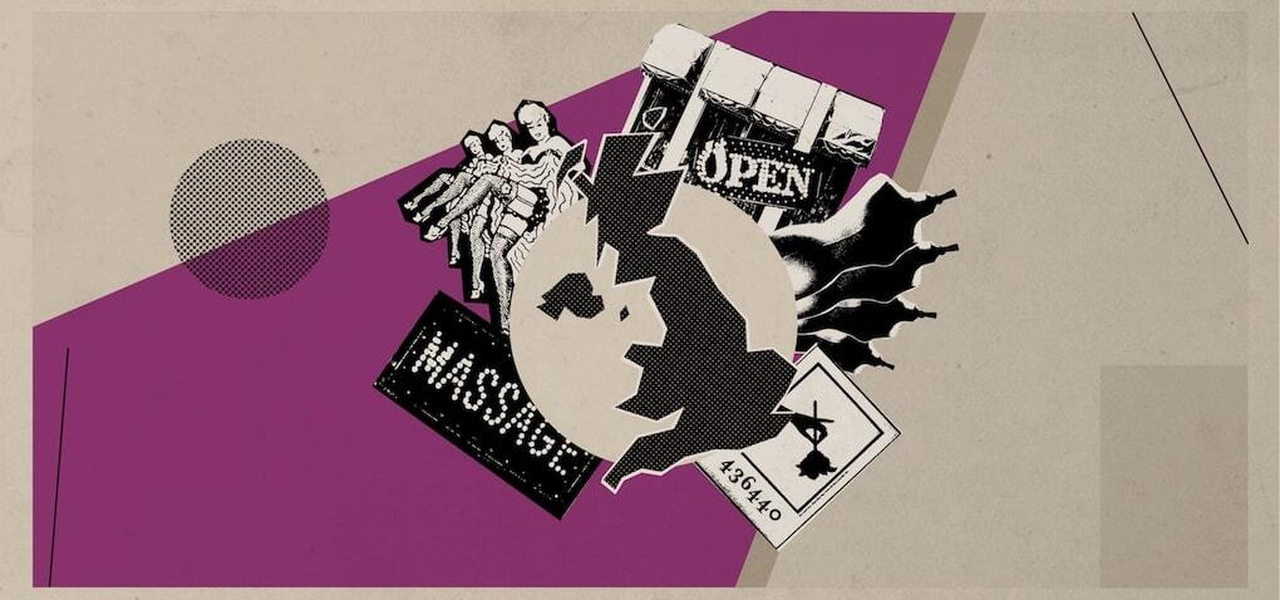

Despite the fact we don’t often see or hear about it, prostitution remains rife throughout the UK. There are an estimated 105,000 people in prostitution. It is also, undeniably, a highly gendered issue, disproportionately affecting women. In 2014, the Office of National Statistics estimated that women in prostitution see an average of 25 clients a week.
Currently, paying for sex and providing sexual services for payment are legal in England, Scotland and Wales. It is possible for a person to sell access to their body for the purposes of sex, and it is possible for someone to pay for that access.
There are, however, a range of activities connected to prostitution that are illegal. This includes soliciting in public places to provide or buy sexual services (commonly known as kerb crawling), and offences relating to keeping brothels and controlling others in prostitution. It is also an offence to purchase sexual services from a person who has been coerced or exploited into prostitution.
Prostitution is a devolved matter, so the law differs in the various regions of the UK. The law in Scotland is currently the same as England and Wales.
However, in Northern Ireland, the approach is very different. The law was changed in 2015 when the Northern Ireland Assembly passed the UK's first comprehensive human trafficking legislation, a process which CARE was privileged to be involved in.
The Act made it illegal to pay for sexual services, criminalising demand for the purchase of sex. This is commonly dubbed the ‘Nordic model’, due to the fact that it was first adopted in Sweden. There is also provision in the Northern Ireland legislation for better services to help individuals exit prostitution.
Why does the law need changing?
There is widespread agreement that the current law on prostitution in England and Wales does not work. For example, policing of prostitution is inconsistent due to a lack of clear, coherent strategy across Britain and sufficient policing resources. The deficiencies in the current law were summarised by the All-Party Parliamentary Group on Prostitution in their 2014 inquiry:
“The legal settlement around prostitution sends no clear signals to women who sell sex, men who purchase it, courts and the criminal justice system, the police or local authorities. In practice, those who sell sexual services carry the burden of criminality despite being those who are most vulnerable to coercion and violence. This serves to normalise the purchase and stigmatise the sale of sexual services - and undermines efforts to minimise entry into and promote exit from prostitution.”
The law is particularly ineffective in its efforts to protect victims of sexual exploitation, especially children. For example, the APPG on Prostitution found that the current law for protecting victims of sexual exploitation (Section 14 of the Policing and Crime Act 2009) is insufficient because it is too difficult to prove coercion has taken place. There have been few prosecutions under this offence – just two in a five-year period from 2013-18, for example.
Similarly, the offence of purchasing sexual services from a child does not operate effectively because there is a defence of ‘reasonable belief’ (i.e. that the child in question is over 18) which makes prosecutions difficult to secure.
What is the Nordic Model?
Prostitution is a form of fundamental violence against women. The overwhelming majority of individuals in prostitution are women, and it is predominantly men who pay for sex. Prostitution is a legacy of a historically patriarchal system; it is an exploitative experience which allows men to use women’s bodies – to buy access to them as property. Often it is the women - many of whom had been exploited into prostitution in the first place - who are criminalised, leaving the men who choose to pay for sex free from prosecution.
The Nordic Model puts the focus of the criminal law on the buyer and makes it a criminal offence to purchase sexual acts and exploit others in prostitution. Under this model, there is no criminal offence for providing sexual services for payment, so an individual in prostitution is not criminalised.
Legislation in this area seeks to tackle the demand for paid sex, in order to significantly reduce sexual exploitation and levels of prostitution generally. It has thus far been adopted by Sweden, Iceland, France, Canada, the Republic of Ireland, Israel and Northern Ireland. It is also supported by Resolutions of the European Parliament and the Council of Europe Parliamentary Assembly.
Criminalising the buyer of sexual services often goes hand in hand with policies helping individuals exit prostitution. By not targeting those selling sexual services, the model recognises that the majority of people who enter prostitution do not do so out of a free ‘choice’, but are often deeply vulnerable individuals who have experienced any or all of child sexual abuse, substance addiction, and homelessness, and may not be able to find work because of language barriers or lack of education. The Nordic Model seeks to give those individuals help to establish their lives outside of prostitution.
What other models are there?
Some people advocate for the legalisation of the sex industry. Those who support this do so because they view prostitution as a form of work that anyone should be able to choose. They argue that it is a job that individuals need to be able to carry out with full employment rights, in order to best protect them from harm.
There are two potential approaches which advocates for this generally take:
Some argue it should be completely decriminalised, for both buyer and seller. The only offences that remain in place target individuals who traffic or exploit people into prostitution. This is broadly the system adopted in New Zealand, where there is full decriminalisation of all prostitution-related activities including brothel keeping and pimping.
Others argue for just legalising prostitution. This is where prostitution is regulated by law, and brothels are legal but must be licensed. Generally, this system requires those providing sexual services to register as ‘sex workers’ and to pay tax. This is roughly the model adopted by Germany and the Netherlands.
Why is the Nordic Model better?
CARE advocates for legislation that will deliver justice for the vulnerable. The evidence demonstrates that prostitution is an exploitative experience for the vast majority of individuals.
We therefore believe that the Government should seek to reduce the overall levels of prostitution and to target those who facilitate prostitution by paying for sexual services. The most effective model that does this is the Nordic model.
Some people would claim that our perspective is derived from a moralistic, religious view of sex and a desire to control other people’s bodies, particularly women. As Christians, we want to protect the vulnerable, and to seek justice and mercy for those who need it.
But many of those campaigning alongside us for the Nordic model do not share our beliefs, and would strongly disagree with us on other issues which we work on. Their chief concern is around what policy is most likely to end the exploitation.
You can read in more depth about why we believe that the Nordic Model is a better solution than decriminalisation here.