
The question of when life begins is central to discussions about abortion. But science is not always clear about the answer to this question, or what constitutes life at all. Daniel Koshland recalls a particular experience he had while president of the American Association for the Advancement of Science (which publishes the journal Science):
What is the definition of life? I remember a conference of the scientific elite that sought to answer that question… After many hours of launching promising balloons that defined life in a sentence, followed by equally conclusive punctures of these balloons, a solution seemed at hand: “The ability to reproduce—that is the essential characteristic of life” said one statesman of science. Everyone nodded in agreement… until one small voice was heard. “Then one rabbit is dead. Two rabbits—a male and female—are alive but either one alone is dead.” At that point, we all became convinced that although everyone knows what life is, there is no simple definition of life.
As Koshland concludes, everyone knows what life is, but defining life itself is far from simple!
Biology gives certain criteria for something to be recognised as alive: response to environment, cells, change and growth, reproduction, complex chemistry, homeostasis and energy processing. For something to be seen as living, it needs to meet all of these criteria. A virus, for example, is not considered alive because, while it has complex chemistry and the ability to change, it does not have cells and cannot reproduce on its own.
An unborn child, however, can meet all of these criteria for life. While a fetus is not able to reproduce, it has the potential to do so, and to categorise it as non-living for this reason would exclude children and infertile adults from being classed as alive.
Closely connected with the question of when life begins is the question of when a fetus becomes a person. This is vital question which science alone cannot answer. Personhood implies a right to life and an obligation to be protected and cared for. For this reason, in debates surrounding abortion, the start of life, and the start of personhood, are connected issues.
When does life begin according to science?
In his book Life in the Balance, Robert Wennberg identifies what he calls ‘decisive moment theories’ – different theories about the moment where life and personhood begins and the fetus ought to be protected. He names seven possible ‘moments’: conception, implantation, human form, viability, brain function, sense perception, and birth.
Conception is the point where sperm and ovum (more accurately ‘oocyte’) fuse to become a zygote, or a new organism in its own right. Also called fertilisation, it is the moment where a new, genetically unique individual is produced.
Implantation occurs when the fertilised egg moves from the fallopian tube and is implanted in the womb. It occurs about a week after conception and is vital for the conception to progress to a viable pregnancy.
Human form is more tricky to clearly identify. Tissue separation happens over a period of time where cells in the embryo separate into different types. From 14 days the embryo does possess some features, with more features developing and becoming clearer over subsequent weeks. By week 7 the heart begins to beat and limb buds have appeared. By week 8 the embryo has hands, feet and lungs. By week 12 the fetus has buds for their teeth and possesses their fingerprints.
Brain function is also difficult to measure with accuracy. The neural tube which will become the brain, spinal cord and nervous system, forms around week 5 of the pregnancy. From that point onwards the brain grows, developing rapidly over the coming weeks.
Sense perception in an unborn fetus is tricky to pinpoint. It is clear that the fetus is able to respond to sounds outside the womb, and react to light, from around week 21. However, there are reflex responses as early as 8 weeks gestation and evidence that the fetus withdraws from a needle from about 18 weeks.
Viability is the point where the fetus could survive outside the womb. This is often used as the criteria when drafting legislation concerning abortion in the UK. The point of viability is dependent on a number of factors including the medical facilities available and health of both mother and baby. The point of viability is often given as 24 weeks, but medical advancements have moved viability to 22 or 23 weeks.
Birth is the point where it is clear that a new life, and a new person has entered the world.
People have argued for life and personhood beginning at each of these seven ‘moments’. But a number of these stages are hard to detect, and most lack a decisive point where enough of a change has occurred to say that life has ‘started’. The idea that a life does not exist until birth would be difficult for even the most hardline of abortion advocates to maintain. The understanding and experience of the majority of women nearing birth is that a unique person is present within their womb.
From a scientific viewpoint, conception is the key stage where we can say that something significant changes in the development of a new human being. Wayne Grudem, in Christian Ethics, quotes Dianne Irvine, a biologist and biochemist, who notes:
scientifically something very radical occurs between the processes of gametogenesis and fertilization—the change from a simple part of one human being (i.e., a sperm) and a simple part of another human being (i.e., an oocyte—usually referred to as an “ovum” or “egg”), which simply possess “human life,” to a new, genetically unique, newly existing, individual, whole living human being (a single-cell embryonic human zygote). That is, upon fertilization, parts of human beings have actually been transformed into something very different from what they were before; they have been changed into a single, whole human being. During the process of fertilization, the sperm and the oocyte cease to exist as such, and a new human being is produced.
Conception is the moment when a genetically different human being starts to exist. As such, the American College of Pediatricians identifies this as the start of life, saying that it “concurs with the body of scientific evidence that corroborates that a unique human life starts when the sperm and egg bind to each other”.
A survey of over five thousand biologists from over a thousand academic institutions around the world found that 96% affirmed the fertilisation view of the start of life. J. T. Eberl, Professor of Health Care Ethics and Philosophy at St. Louis University comments:
As far as human ‘life’ per se, it is, for the most part, uncontroversial among the scientific and philosophical community that life begins at the moment when the genetic information contained in the sperm and ovum combine to form a genetically unique cell.
He goes on to say “However, what is controversial is whether this genetically unique cell should be considered a human person.” Science can say that a new, unique life begins at the point of conception. Science cannot, however, fully answer the question of personhood. While some have tried to bring scientific ideas to bear on this question, it is more properly a philosophical concept.
Philosophers have put forward various ideas surrounding ‘personhood theory,’ that is, what makes someone a person. Thinkers such as John Locke and Immanuel Kant have debated the key characteristics that make up a person, such as rational thought or moral responsibility. Arguing for abortion, Mary Anne Warren offered five criteria for personhood: consciousness, reasoning, self-motivated activity, communication, and self-awareness. She argued that since a fetus does not contain these criteria, even a fully developed unborn child is not a person.
The question of when life begins, and when a fetus becomes a person, are inherently intertwined. As Christians, we need to turn to God’s word to see how the Bible describes the start of life, and the beginning of personhood.
A life within the womb
While the Bible does not contain detailed scientific analysis of possible moments of fetal life, it is clear in its position that life begins within the womb. God tells Jeremiah that: “Before I formed you in the womb I knew you” (Jeremiah 1:5). This simple verse tells us that God is at work in forming the unborn child, that God knows the unborn child personally, and that his knowledge goes back even to a point before embryonic formation.
David’s words in Psalm 139 tell a similar story:
For you created my inmost being; you knit me together in my mother’s womb. I praise you because I am fearfully and wonderfully made; your works are wonderful, I know that full well. My frame was not hidden from you when I was made in the secret place, when I was woven together in the depths of the earth. Your eyes saw my unformed body; all the days ordained for me were written in your book before one of them came to be.
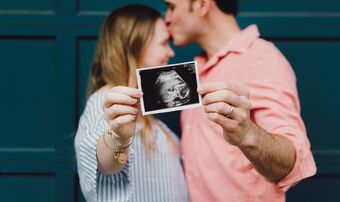
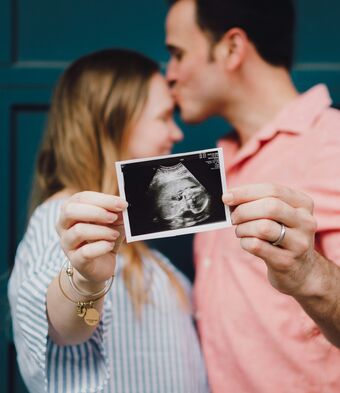
Scientific advancements allow us to look into the womb using ultrasound. In the ancient world there was no such technology, so the womb was the ‘secret place’, as unseen as the depths of the earth.
But David affirms that God sees him within the womb; his unformed body is not hidden from his creator. Indeed, God was at work knitting David together during his mother’s pregnancy, creating him in his innermost being. Although life at the early stage of embryonic development is not visible, life within the womb is visible to God.
A person within the womb
The Bible not only affirms the presence of life even in the earliest point of development, but it also affirms that the fetus in the womb is a person.
Isaiah declares: “Before I was born the LORD called me; from my mother’s womb he has spoken my name” (Isaiah 49:1). David says: “From birth I was cast on you; from my mother’s womb you have been my God” (Psalm 22:10). Both of these verses speak not only of life in the womb, but personhood. Both David and Isaiah speak of a relationship with God before birth. There God calls them by name, they rely on him, and he is their God. Relating to God in this way, and God relating to them, implies that the child before birth is an individual person.
We see the same thing at work with Rebekah, as she is pregnant with the twins Esau and Jacob:
The babies jostled each other within her, and she said, “Why is this happening to me?” So she went to inquire of the LORD. The LORD said to her, “Two nations are in your womb, and two peoples from within you will be separated; one people will be stronger than the other, and the older will serve the younger.”
God calls the two brothers ‘two nations’ and ‘two peoples’ before they are born. God knows them and relates to them as people, and as the nations that their descendants will become. God does not say they have the potential to be this, or that they will become this at their birth. In God’s eyes, within the womb, both Jacob and Esau are unique people.
A person from conception
The Bible does not speak about the stages of implantation, brain function and sense perception. But it does talk about conception and affirms it as the decisive point when life and personhood begin.
David says in Psalm 51: “Surely I was sinful at birth, sinful from the time my mother conceived me” (Psalm 51:5). David does not mean that it was sinful for his mother to have conceived him. Rather, he recognises that the pattern of sin present in each and every human being since the garden of Eden was present within him from his conception. The stain of original sin was there from fertilisation. David therefore affirms that his humanity, including humanity’s brokenness and sin, existed from his conception. In short, he became alive and a person at conception.
We see this illustrated in the encounter between Mary and her cousin Elizabeth. Having received the message that she would conceive by the Holy Spirit and give birth to Jesus, Mary travels to visit Elizabeth:
When Elizabeth heard Mary’s greeting, the baby leaped in her womb, and Elizabeth was filled with the Holy Spirit. In a loud voice she exclaimed: “Blessed are you among women, and blessed is the child you will bear! But why am I so favoured, that the mother of my Lord should come to me? As soon as the sound of your greeting reached my ears, the baby in my womb leaped for joy.”
We are told that Mary “hurried” to visit Elizabeth after the angel’s visitation. The life in her womb would have been at the very early stages of development. Yet Elizabeth, and the unborn John the Baptist, recognise the presence of Jesus and respond with joy. Bible scholar Scott Rae writes:
From the earliest points of life in the womb, Mary and Elizabeth realize that the incarnation has begun. This lends support to the notion that the incarnation began with Jesus’s conception and that the Messiah took on human form in all of its stages, embryonic life included.
Jesus was Lord and Messiah from conception, just as a human being is a person from the point of conception too.
Conclusion
Defining life, and identifying where life begins, is not straightforward. Nevertheless the scientific consensus and Biblical witness agree: a human life and a human person begins at conception. However an embryo or fetus develops, and the different stages it reaches during gestation, an unique individual, created and loved by God, exists from the very earliest stage of pregnancy.
This has profound implications for the abortion debate. Abortion views the unborn child as clump of cells, not a human person, and thus able to be disposed of. But if life begins at conception, as many scientists would affirm, then we need to consider the unborn fetus as a living human being. If that unborn baby is a person in their own right, as the Bible shows, then they have inherent value, and are deserving of protection from harm. It is impossible to argue for abortion if you understand life to begin at fertilisation. The only logical course of action is to care for the unborn child just as you would after they have been born.